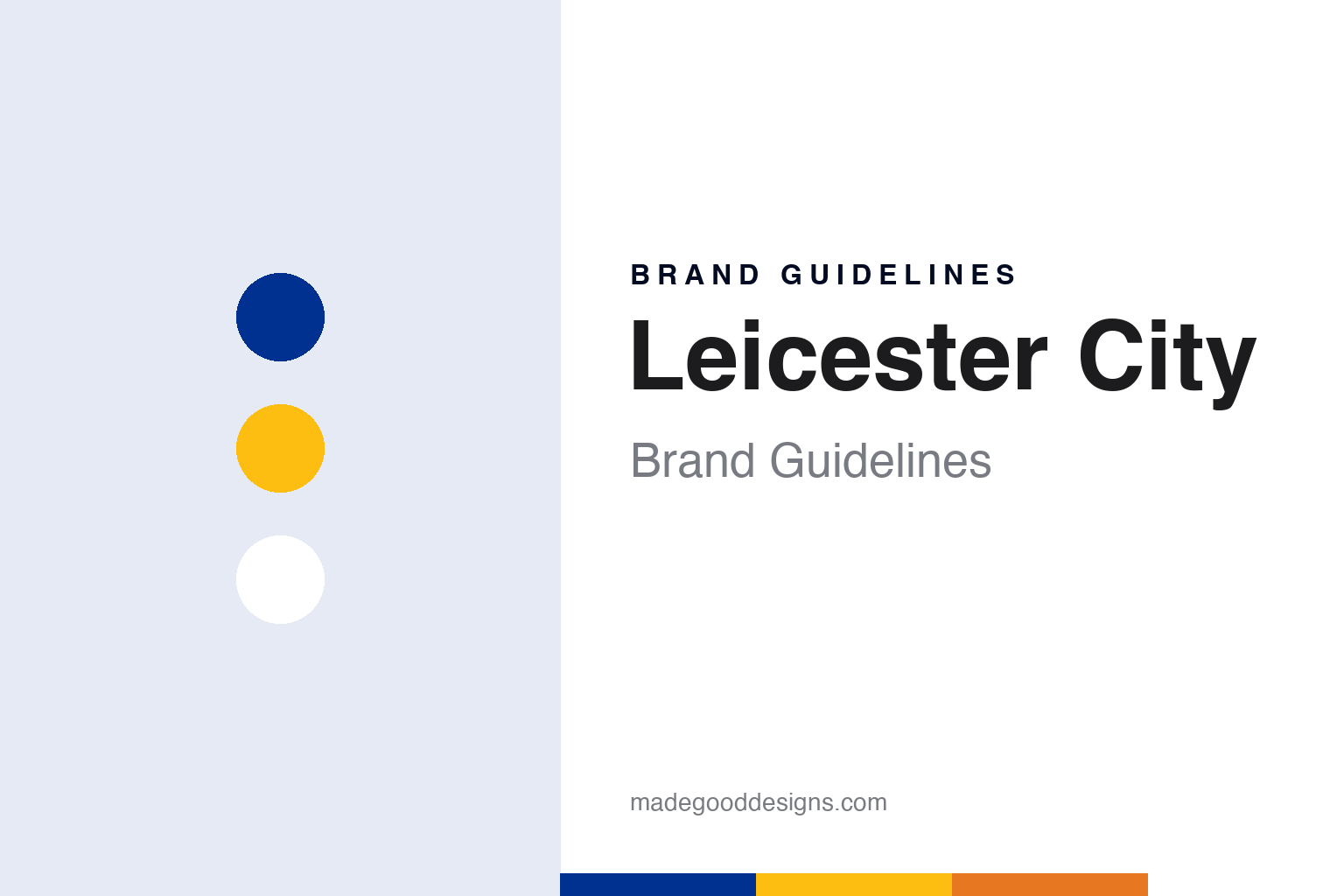
Leicester City Brand Guidelines
A club named after a road, renamed when its town became a city.
Aa
Two constants: a royal blue, gold and white palette and a condensed sans register. Abstract homage — not a Leicester City crest, kit or mark; no logo is reproduced.
Fosse Road
Old boys of a school, a field by a road, and a borough that became a city.
Leicester City began as Leicester Fosse. English Wikipedia says the club was formed in 1884 by a group of old boys of Wyggeston School, and that it took its original name from the field by Fosse Road where the team started out. The club joined The Football Association in 1890 and was elected to the Football League in 1894.
The early years were spent moving between grounds. Wikipedia says that after Fosse Road the team played at Victoria Park, south-east of the city centre, and at the Belgrave Road Cycle and Cricket Ground. On turning professional it moved to Mill Lane, and after being evicted from there it used the County Cricket Ground while it looked for a permanent home. In 1891 it secured the use of land by Filbert Street, the ground it would occupy for more than a century.
The name changed with the city. In 1919, as league football resumed after the First World War, Leicester Fosse ceased trading because of financial difficulties, Wikipedia says, and the club was re-formed as Leicester City Football Club. Wikipedia describes the new name as particularly appropriate, because the borough of Leicester had recently been given city status.
Filbert Street grew in stages. Wikipedia says the football architect Archibald Leitch made improvements in the Edwardian era, and in 1927 a two-tier stand nicknamed “The Double Decker” was built; it stood until the ground closed in 2002. Apart from compulsory seating, the ground was not developed again until 1993, when the Main Stand was demolished and replaced by the Carling Stand.
The move in 2002 kept the address close. The club left Filbert Street for a new all-seater stadium less than 300 yards away, and Wikipedia says the new site’s address, Filbert Way, retains a link with the old ground. The stadium was known as the Walkers Stadium until 2011, under a sponsorship deal with the Leicester-based snack maker Walkers. In 2020 the club moved into a new training complex in the Leicestershire village of Seagrave, and its former training ground at Belvoir Drive is now used by Leicester City Women.
Sound is part of the matchday identity. Wikipedia says the club adopted the “Post Horn Galop” in 1941 to signal both teams entering the pitch; the tune is usually played live on the pitch for the first half, with a modern version played over the public address system for the second. The club also plays a modern version of “When You’re Smiling” before kick-off on home matchdays, a connection that dates back to the late 1970s, and the motto “Foxes Never Quit” is placed above the tunnel inside the stadium.
Colour
Royal blue, a fox from 1948 and the city’s cinquefoil.
Leicester’s colours have stayed steady. Wikipedia says the club’s traditional home colours of royal blue shirts, white shorts and either white or blue socks have been used for most of its history. Since the 2015–16 season the team has played in an all-blue strip, except in 2019–20 and 2021–22, when it went back to white shorts.
The Fosse colours still come back. For the 2009–10 season, the club’s 125th anniversary year, Wikipedia says the away kit returned to the colours originally worn by Leicester Fosse, though with black shorts in place of the original white. The same kit had featured in 2004–05 and returned again for the 2023–24 season. That anniversary season also brought a special edition badge on both the home and away kits.
The fox entered the badge after the Second World War. In 1948, Wikipedia says, an image of a fox was incorporated into the club’s crest. Since 1992 the badge has set a fox’s head over a cinquefoil, the five-leafed figure from the coat of arms of the city of Leicester; Wikipedia says 1992 was the point at which the fox and the cinquefoil were combined on the crest.
The crest moved with the club. Wikipedia says the stadium move in 2002 prompted some changes to the crest, and the updated design was built into the new ground, where the emblem is the main feature on the outside of the West Stand. The current crest has been in use since 2010.
The kit makers have changed often. Wikipedia lists Bukta, Admiral, Umbro, Scoreline, Fox Leisure, Le Coq Sportif, JJB, Jako, Joma and Burrda among the club’s suppliers, followed by Puma from 2012 to 2018. Adidas has made the kit since 2018.
Sponsors have come and gone across the front of the shirt. Wikipedia says Ind Coope’s logo appeared on a Leicester shirt in 1983, and that Walkers Crisps sponsored the shirts from 1987 to 2001 and the stadium from 2002 to 2011, remaining the club’s official snack partner. Other shirt sponsors have included John Bull, LG, Alliance & Leicester, Topps Tiles, the hospice charity Loros, the Tourism Authority of Thailand and King Power, whose name was on the shirt from 2010 to 2021 and again in 2023–24. Siam Commercial Bank took the sleeve in 2017–18, and the Vietnamese beer brand Bia Saigon has been the sleeve sponsor since 2018–19.
Typography
Clubs, crests and colours.
English club crests draw on a small set of visual sources. Some borrow directly from heraldry, with rampant lions, shields, mottoes and stars arranged in the manner of a coat of arms. Others take an animal associated with a club’s nickname, such as a fox, a bird or a hammer-bearing figure, and render it as a simple silhouette. Many lean on the arms of the town or city the club represents, adapting towers, ships, rivers or civic symbols into a badge that can sit on a shirt, a programme cover or a stadium wall.
Crests change over time. Clubs redraw them to work at small sizes, on screens and on merchandise, to simplify fine detail, or to register a mark as a trademark. A redesign can be contentious, because supporters often treat the badge as part of their own identity, and several clubs now run fan consultations, surveys or supporter panels before a new crest is adopted. Some redesigns have been revised or withdrawn after supporters objected.
Shirt sponsorship sits alongside the crest on the kit. Sponsor names, kit-maker logos and sleeve partners appear on the front of the shirt, and they change far more often than the badge itself, which is one reason the crest and club colours carry so much of a club’s visual continuity.
Aa
A condensed sport sans — the register of a shirt number and a stand sign. (Specimen set in Saira Condensed, a sans-serif STAND-IN; NOT the Leicester City logo.)
Leicester City
A Thai duty-free group, a renamed stadium and a family succession.
The present owners arrived through a shirt deal. The Moodie Davitt Report, a travel-retail trade publication, reported on 11 August 2010 that Leicester City had announced its acquisition by an international consortium, Asia Football Investments, led by King Power International Group of Thailand, the duty-free retailer that had agreed a three-year shirt sponsorship with the club the previous week. The report said the chairman, Milan Mandarić, would remain in post and was a stakeholder in the new consortium, and that the chief executive Lee Hoos and the management team would also stay.
Wikipedia says the consortium was headed by the King Power owner Vichai Srivaddhanaprabha, then known as Vichai Raksriaksorn, and his son Aiyawatt, who was quoted in the 2010 announcement. Mandarić left in November 2010 to take over at Sheffield Wednesday, and Vichai was appointed chairman on 10 February 2011.
The owners put their company’s name on the ground. Wikipedia says it emerged on 19 August 2010 that King Power wanted to rename the stadium, and on 5 July 2011 it was announced that the Walkers Stadium would be known as the King Power Stadium.
Ownership has since passed within the family. Sky Sports reported on 29 October 2018 that Leicester City had confirmed the death of its chairman, Vichai Srivaddhanaprabha, on 27 October 2018. Wikipedia says the Vichai Srivaddhanaprabha Memorial Garden opened on 27 October 2019. His son Aiyawatt Srivaddhanaprabha is now the club’s owner and chairman, Wikipedia says. A King Power-led consortium has owned Leicester City since 2010.
For a design guide, Leicester City shows how a club can root its badge in a civic symbol, the city’s cinquefoil, and pair it with an animal emblem, the fox, while keeping royal blue as a constant through name changes, stadium moves and new owners. Compare the Premier League, which Leicester rejoined on promotion in 2014, and Adidas, which has made the club’s kit since 2018. For this guide we use royal blue, fox gold and white with a condensed sans, an unofficial interpretation; no product or logo is reproduced.
Explore & save
Keep Leicester City’s identity on hand — save it to a board in the Made Good inspiration library.
Leicester City identity set
Pin the Leicester City royal blue, gold and white palette and the condensed sans register to your own board.