Bloomingdale’s Brand Guidelines
From a hoop-skirt shop to a whole block on Lexington Avenue and a plain brown bag.
Aa
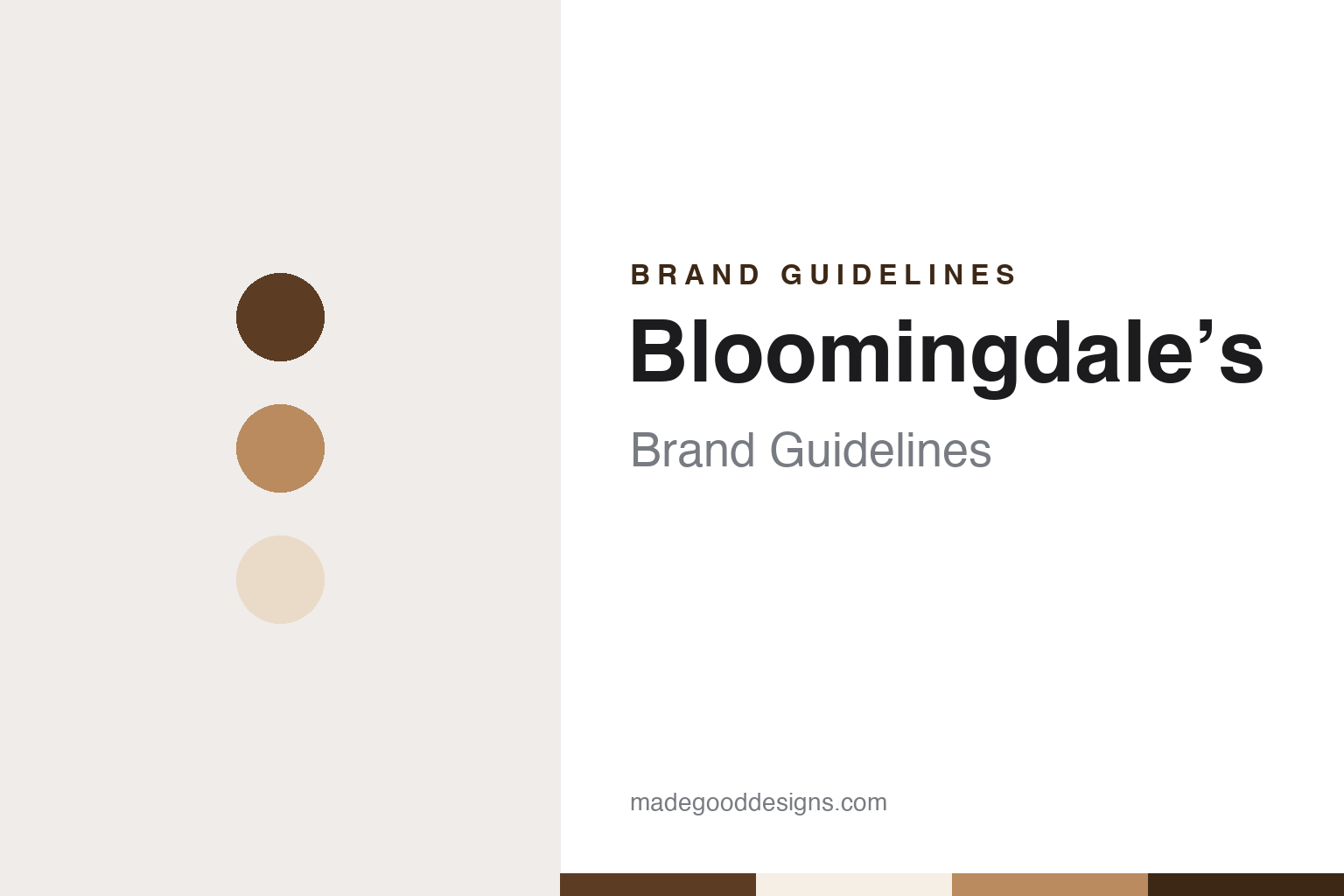
Two constants: a kraft brown and cream palette and a plain geometric sans register. Abstract homage — not a Bloomingdale’s product or mark; no logo, bag or packaging is reproduced.
A family name on the East Side
Hoop skirts, a bazaar and a move to Lexington Avenue.
The Bloomingdale’s story starts with a family business on the Lower East Side of Manhattan. English Wikipedia dates the beginning to 1861, when Benjamin Bloomingdale and his son Lyman Bloomingdale opened a shop selling hoop skirts and European fashions under the name Bloomingdale’s Hoopskirts. The name that survives belongs to the next step. In 1872, Wikipedia says, Lyman and his brother Joseph Bloomingdale opened Bloomingdale’s Great East Side Bazaar on Third Avenue in Midtown, between 56th and 57th Streets, and the store took the family name as its trading name that year.
The bazaar grew by taking over neighbouring buildings and then moved north. Wikipedia records a move to 59th Street and Third Avenue and then, in 1886, to the corner of 59th Street and Lexington Avenue, the address that still serves as the company’s headquarters and flagship. Over the following decades the store bought up the block piece by piece. By 1902, Wikipedia says, it filled much of the block between 58th and 59th Streets and Third and Lexington Avenues, and by 1927 it controlled all of it.
The subway changed the front door. After the Lexington Avenue line opened a stop at 59th Street, the store moved its main entrance to the Lexington Avenue side in 1918, which is why the brand is now identified with that avenue rather than with Third Avenue, where it started. Joseph Bloomingdale retired in 1896, Wikipedia says, leaving Lyman in charge, and Lyman’s sons Hiram and Samuel later inherited his shares. During World War I Samuel Bloomingdale gave the American Red Cross the use of an entire floor of the store.
The early shopping bags belong to this period too. Writing for the Cooper Hewitt, Smithsonian Design Museum on 4 May 2016, Sakura Nomiyama described a Bloomingdale’s shopping bag of 1922 that carried an anniversary message thanking customers. Nomiyama wrote that executives saw the promotional value of the bags and used them as part of the store’s marketing, which set up the role the bag would play in the decades to come.
Colour
Federated, Campeau and Macy’s, Inc.
In early 1930, after the 1929 stock market crash, Bloomingdale’s merged into the newly created Federated Department Stores, the holding company that Wikipedia says helped it through the Depression. Federated has remained the owner ever since under a series of names. In 1988 the Canadian developer Robert Campeau won a hostile takeover of Federated, and in 1994 Federated acquired the Macy’s chain. On 1 June 2007 Federated changed its corporate name to Macy’s, Inc., and Wikipedia notes that the Bloomingdale’s store names were left as they were. Macy’s, Inc. has owned Bloomingdale’s, through Federated, since 1930.
Outside Manhattan, the name spread to the suburbs after the Second World War. Wikipedia lists a branch in New Rochelle in 1947 and a purpose-built store in Fresh Meadows, Queens, in 1949. The Hackensack, New Jersey store of 1959 was designed by the architect William T. Snaith of Loewy Associates, the industrial design firm. In 1973 it opened a store in Chestnut Hill, Massachusetts, and in 2004 it returned downtown with a store in SoHo.
The 1960s and 1970s gave the brand much of its visual reputation. Wikipedia says the store set up a dedicated Halston department in 1969, followed that year by a Polo Ralph Lauren boutique in its men’s store, and that it introduced its rounded logo in 1972. In 2010 a franchised store opened in Dubai, operated under licence by Al Tayer Group, and a store in Kuwait followed in 2017.
The shopping bag remained a design platform throughout. In a PRINT magazine column published on 25 September 2023, Steven Heller described a long-running series of artist-designed bags commissioned under the creative director John Jay, built around seasonal and cultural themes such as postmodern architecture and Memphis design. The Cooper Hewitt’s 2016 post shows examples from the museum’s collection, including a 1984 “Ecco l’Italia” bag by Natalie du Pasquier and Christoph Radl of the Memphis group and a 1985 bag by the Japanese designer Kazumasa Nagai.
Typography
Design and documentation.
A department store is one of the few retail formats where the building itself carries the brand. Many flagships occupy purpose-built premises on major city streets, and their facades, corner towers, clocks and glass domes are designed to be recognised from a distance and photographed from the pavement. Inside, atriums, galleries and grand staircases give the name a physical setting that a logo alone cannot supply, and the building often appears in advertising, on postcards and on the store’s own merchandise.
The shopping bag is the identity that leaves the building. A strong bag uses a single colour, a wordmark or a simple pattern that reads clearly at street level, and stores tend to keep the same scheme for years so that the bag becomes a familiar sight in other parts of the city. Gift boxes, tissue and ribbon usually follow the same palette.
Window displays add a seasonal layer. Many department stores dress their street windows to a theme each season, and the year-end windows are often unveiled at a public event that draws crowds. Spring fashion launches, sale periods, illuminated facades and in-store decorations follow a yearly calendar, so the identity changes on a schedule while the name and the building stay the same.
Aa
A plain geometric sans with even strokes — the register of a word printed on a paper bag. (Specimen set in Didact Gothic, a sans STAND-IN; NOT the Bloomingdale’s logo.)
Bloomingdale’s
A surname, an avenue and a brown bag.
One element of the Bloomingdale’s identity is the family name. It passed from the 1872 East Side Bazaar to a store that filled a Manhattan block, then to a Federated division in 1930 and on through Federated’s change of name to Macy’s, Inc. in 2007. The possessive has stayed in the name the whole time, and the 1972 logo set it in rounded letters.
The second element is the address. Because the main entrance moved to the Lexington Avenue side in 1918, the store has been tied to 59th Street and Lexington Avenue for more than a century, and the corner doubles as the company headquarters.
The third is the Big Brown Bag. The Cooper Hewitt’s Sakura Nomiyama wrote in 2016 that the bag was created by Massimo Vignelli in 1973, in a big size meant for bulky household goods such as linen and pillows, and that little and medium bags followed. Its only decoration is its size name in a plain sans-serif. Jessica Deseo, writing in PRINT on 21 September 2023, credited the design to Massimo and Lella Vignelli of Vignelli Associates and said it had stayed unchanged for fifty years; she noted that the anniversary edition added gold accents and rope handles. Steven Heller, in PRINT that same week, pointed to what the bag leaves out: it carries no store name or logo at all.
The fourth element is the artist bag. Under John Jay, Heller wrote, the store issued a changing series of designed bags for holidays and seasonal events, from a New Year’s bag to a 1980 bag for a China promotion. The plain brown bag and the changing artist bag sit side by side, one constant and one topical.
For a design guide, Bloomingdale’s shows how a store can make a carrier bag do the work of a logo, using a size word in place of a name. Compare it with Macy’s, its sister banner in the same group, and with Saks Fifth Avenue. For this guide we use kraft brown, deep brown and cream with a sans, an unofficial interpretation; no product or logo is reproduced.
Explore & save
Keep Bloomingdale’s’s identity on hand — save it to a board in the Made Good inspiration library.
Bloomingdale’s identity set
Pin the Bloomingdale’s kraft brown and cream palette and the plain sans register to your own board.