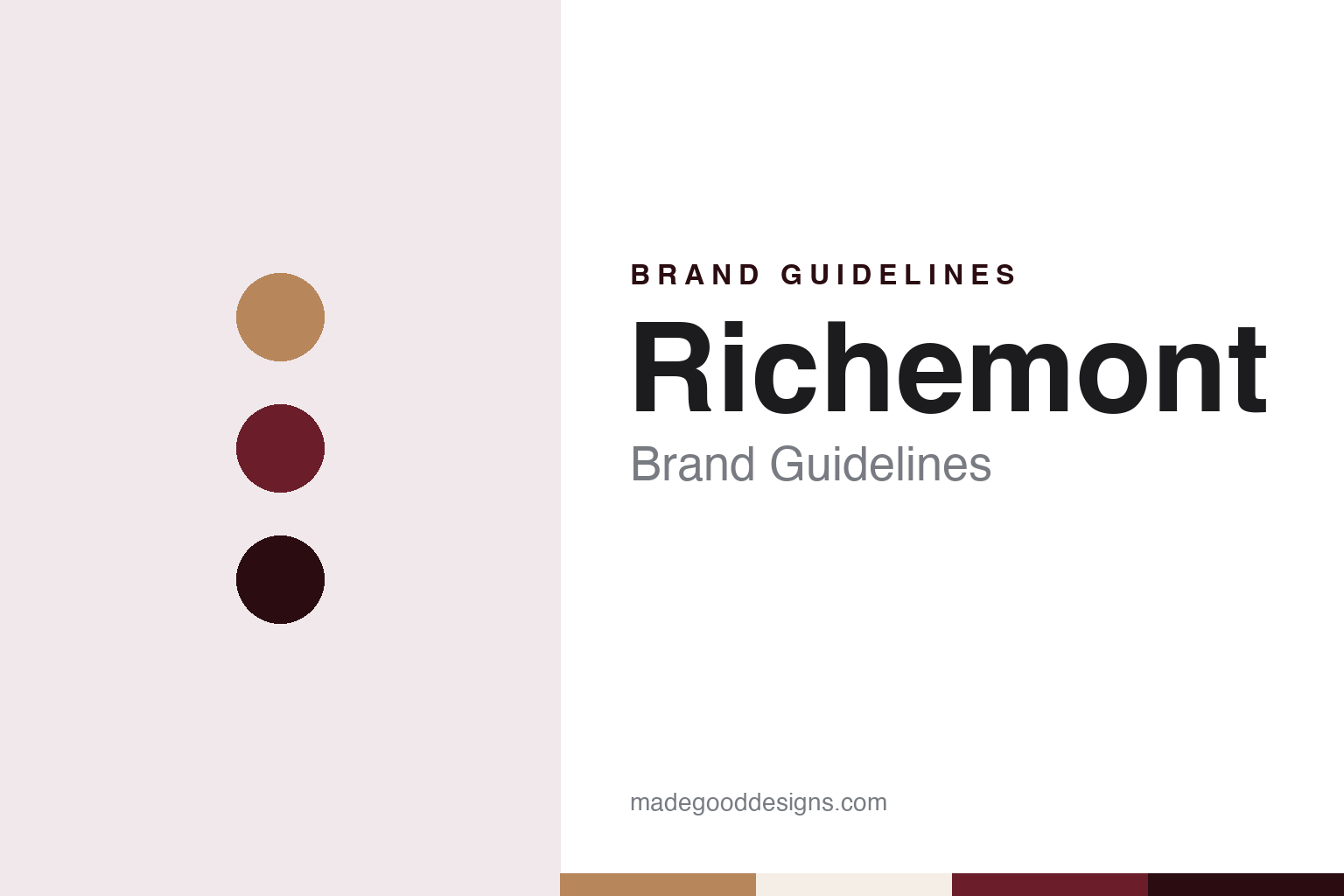
Richemont Brand Guidelines
A father’s holding company, a son’s spin-off and a house of maisons.
Aa
Two constants: a bronze, bordeaux and oxblood palette and an Old-style serif register. Abstract homage — not a Richemont asset or mark; no logo, icon or wordmark is reproduced.
A spin-off from a family holding company
Switzerland, 1988.
Richemont is a company that was assembled before it was named. Its full name is Compagnie Financière Richemont SA, and Wikipedia describes it as a Switzerland-based holding company founded in 1988 by the South African businessman Johann Rupert. The group did not grow out of a workshop or a single shop window. It grew out of a portfolio of shareholdings in other companies.
The portfolio came from Johann Rupert’s father. FashionUnited, in a history of the group published on 20 May 2021, says Richemont was founded in 1988 through the spin-off of the international assets of Rembrandt Group Limited of South Africa, now known as Remgro Limited, which Anton Rupert had founded; the magazine gives the year as 1948, while the company’s own history page places Rembrandt’s founding in the 1940s. According to FashionUnited, Rembrandt held interests in tobacco, financial services, wine and spirits, and gold and diamond mines, as well as investments in jewellery, watch and fashion houses.
The legal shell was older than the name. Wikipedia says the division that became Richemont was set up on 5 March 1979 as Intercontinental Mining and Resources S.A., renamed IMR Group S.A. on 31 March 1987, and renamed Richemont S.A. on 17 August 1988. The spin-off itself was completed on 20 September 1988. A company originally registered under a mining name became the vehicle for a group of watch and jewellery houses.
At its founding the group was still a mixture. FashionUnited says Richemont then held minority stakes in Cartier Monde SA and Rothmans International, and that Rothmans in turn held interests in Cartier Monde and Alfred Dunhill, and, through Dunhill, in Montblanc and Chloé. Wikipedia adds that the jewellery, watch and fashion investments of the Rembrandt Group, combined with Rothmans International, formed the initial group of Richemont subsidiaries. The tobacco side and the jewellery side sat in the same group for two decades before they were separated for good.
Colour
Vendôme, tobacco and a clean break.
A reorganisation came quickly. The company says that in 1993 it separated its jewellery, watch and fashion holdings into Vendôme Luxury Group, a newly created, UK-listed group, and placed its tobacco business in Rothmans International. Vendôme became the buyer of several houses that remain in the group. The company says Vendôme acquired James Purdey & Sons, the British gunmaker, in 1994; FashionUnited says Vacheron Constantin was acquired by Vendôme in 1996, and that Officine Panerai and the French leather-goods house Lancel followed in 1997.
Vendôme then folded back into its parent. The company says that in 1998 Richemont bought out Vendôme’s minority shareholders, and that in 1999 the management and executive board structures of Richemont and Vendôme were merged. The same year, according to the company, Rothmans International merged with British American Tobacco, leaving Richemont with a shareholding in the enlarged tobacco company rather than a tobacco business of its own.
The watch houses arrived next. FashionUnited lists the acquisitions of Jaeger-LeCoultre, IWC Schaffhausen and A. Lange & Söhne in the period from 2000 to 2003, and says Richemont later took full ownership of Van Cleef & Arpels. In 2007, the magazine says, the group formed a joint venture with Polo Ralph Lauren for watches and jewellery and took a stake in the Paris fashion house Azzedine Alaïa.
The break with tobacco came in 2008. Wikipedia says that in October 2008 the group divested its remaining interests in the tobacco industry, spinning off its other businesses, principally its stake in British American Tobacco, into a newly formed and separately traded holding company, Reinet Investments S.C.A. FashionUnited describes the 2008 restructuring as the moment Richemont gave itself a new form and could concentrate entirely on its jewellery, watch and fashion business.
Typography
Founders, houses and a parent signature.
A group identity works differently from a product brand. The name on the stock ticker, the annual report and the head-office lobby is often one that shoppers rarely see on a shelf. Beneath it sit consumer names with their own colours, mascots and lettering, and the parent’s job is usually to stay out of their way. That is why so many corporate wordmarks are plain: a simple sans or a restrained serif, one or two colours, a symbol that reads at small sizes in a footer or on the back of a pack.
Where the parent name does speak, it speaks to a different audience. Investors, employees, suppliers and journalists meet it in annual reports, careers pages, press releases and the signage of headquarters buildings. Those surfaces become the group’s real brand canvas, and they deserve the same attention as any pack design. A merger, a demerger or a rename tends to arrive with a new mark and new typography, so the group logo can also read like a timeline of how the business has been put together and taken apart. Studying these quieter identities shows how a parent name carries authority without competing with the brands it owns.
Aa
An old-style serif — after a group that speaks through its houses. (Specimen set in Cormorant Garamond, a serif STAND-IN; NOT the Richemont logo or any Richemont typeface.)
Richemont
A parent of maisons.
Richemont’s vocabulary is part of its identity. The group calls its businesses Maisons, the French word for houses, and Wikipedia describes the portfolio in those terms. The company groups them into divisions: Jewellery Maisons, which Wikipedia lists as Cartier, Van Cleef & Arpels and Buccellati; Specialist Watchmakers, including A. Lange & Söhne, IWC Schaffhausen, Jaeger-LeCoultre, Panerai, Piaget, Roger Dubuis and Vacheron Constantin; and a third group of other businesses that includes Alaïa, Chloé, Delvaux, Dunhill, Montblanc, Peter Millar, Purdey and Serapian.
The parent company has its own listing. Wikipedia says the company is publicly traded as CFR on the SIX Swiss Exchange and on the JSE in Johannesburg, a listing that keeps the group’s South African roots visible alongside its Swiss base.
The portfolio has kept changing at the edges. FashionUnited records the sale of Shanghai Tang in 2017, the sale of Lancel and the purchase of the British watch platform Watchfinder in 2018, the acquisition of the Italian jeweller Buccellati in 2019, and the AZ Factory venture with the designer Alber Elbaz in 2019. Wikipedia says Richemont acquired a majority stake in the Italian shoemaker Gianvito Rossi in July 2023 and bought the Italian jeweller Vhernier in May 2024.
The group’s leadership changed in 2024. FashionUnited reported on 17 May 2024 that Nicolas Bos, chief executive of Van Cleef & Arpels, was appointed to the re-established role of CEO of Richemont from 1 June 2024, continuing to report to Johann Rupert as chairman. The magazine said Bos joined Richemont in 1992, working initially with the Fondation Cartier pour l’art contemporain in Paris, moved to Van Cleef & Arpels in 2000 and became its global president and chief executive in 2013.
For a design guide, Richemont shows how a holding company can build an identity almost entirely through the names it owns, with the parent signature kept small and constant. Compare Cartier, the jewellery house at the centre of the group’s story, and LVMH, another group built as a parent of houses. For this guide we use bronze, bordeaux and oxblood with a serif, an unofficial interpretation; no product or logo is reproduced.
Explore & save
Keep Richemont’s identity on hand — save it to a board in the Made Good inspiration library.
Richemont identity set
Pin the Richemont bronze, bordeaux and oxblood palette and the Old-style serif register to your own board.