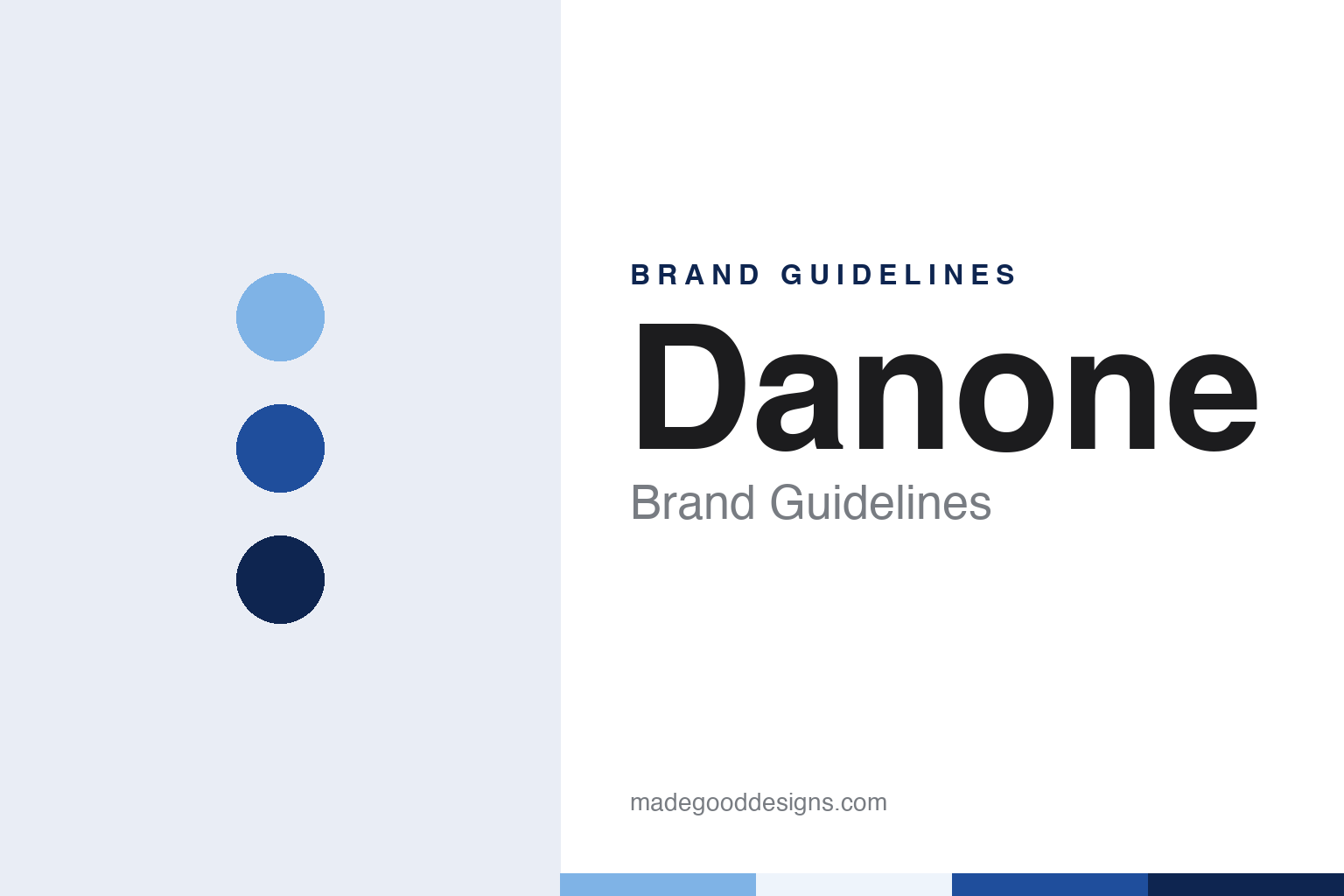
Danone Brand Guidelines
A boy’s nickname, a glassworks and a star.
Aa
Two constants: a sky, cobalt and navy palette and a Rounded sans register. Abstract homage — not a Danone asset or mark; no logo, icon or wordmark is reproduced.
A nickname in Barcelona
Barcelona, 1919.
Danone began as the name of a yoghurt, not of a company. The New York Times, in its obituary of Daniel Carasso published on 20 May 2009, reported that his father, Isaac Carasso, created the yoghurt in Barcelona in 1919 and named it after his son, whose nickname in Catalan was Danon, or Danny. The family were Sephardic Jews from Thessaloniki, the paper said, and Isaac had taken them back to Spain in 1916. Using cultures developed at the Pasteur Institute in Paris, he began producing yoghurt, which in its early years was sold through pharmacies.
The spelling came from a registry rather than a designer. Le Figaro, in a 30 July 2009 article by Jean-Yves Guérin on how the company got its name, said the Spanish authorities would register the unusual name only if Carasso added a final e, and so Danon became Danone. English Wikipedia gives the same account and adds that, under Spanish law, a proper name could not serve as a trade name. The extra letter has stayed on the name ever since, and it gives a word born in Barcelona its French-looking ending.
Daniel took the name north. Le Figaro said he studied at a business school in Marseille and did a placement at the Pasteur Institute, then settled in Paris, where in 1929 he founded the Société parisienne du yoghourt Danone, a cousin of the Catalan firm with no shareholding link to it. He chose to sell his yoghurt through the dairy shops of Paris, the paper said.
War forced a second change of spelling. Le Figaro reported that Daniel Carasso, who was Jewish, had to flee France and arrived in New York in 1941, where he bought a yoghurt maker that he wanted to call Danone. The French designer Raymond Loewy, known in the United States for the Lucky Strike cigarette pack, suggested that he Americanise the name, and Danone became Dannon. The New York Times said the business began producing plain yoghurt in half-pint glass bottles under the Dannon name in October 1942. Both papers said the American company was sold to Beatrice Foods in 1959 and returned to the French group in 1981; in the United States the name is still spelt with two n’s.
Colour
From a glassworks to a group name.
The group that carries the Danone name today was assembled from very different businesses. Le Figaro said that after the war Daniel Carasso returned to France and took back the reins of Danone, and that nearly twenty years later Danone merged with the fresh-cheese maker Gervais. To spare the feelings of both sides, the paper said, the group was renamed Gervais-Danone. English Wikipedia dates that merger to 1967.
The other half of the story was made of glass. Wikipedia says Boussois-Souchon-Neuvesel, or BSN, was created in 1966 through the merger of the glass manufacturer Boussois and the glassworks Souchon-Neuvesel. Le Figaro said that after a failed takeover bid for Saint-Gobain in 1968, BSN turned to food, buying Kronenbourg, Évian and Amora. Its chairman, Antoine Riboud, led that shift. In 1973, the paper said, BSN and Gervais-Danone merged and the new group was called BSN-Gervais-Danone, with Riboud as its operational head.
Then the name shrank. Ten years later, according to Le Figaro, the group shortened its name to BSN, while Gervais-Danone remained the division in charge of fresh products; Wikipedia dates the change to 1983. The group kept buying food businesses, and in 1987, Wikipedia says, it acquired Générale Biscuit, the owner of the LU brand from Nantes. For a decade the parent of Danone yoghurt, Évian water and LU biscuits was known by three letters that came from its glassmaking past.
Those three letters did not travel well. Le Figaro said BSN struggled to make itself known around the world, not least because the initials were used by others: a television channel in Japan and a textile group in the United States. Wikipedia adds a bank in Spain. In 1994 BSN was renamed Groupe Danone, after the subsidiary whose name was known around the world, which the paper described as a sort of return to the source. The last step came on 23 April 2009, when, Le Figaro reported, Groupe Danone became simply Danone. Daniel Carasso died in Paris in May 2009, The New York Times reported, a month after the name had become Danone once more.
Typography
A nickname, a registry and a star.
A group identity works differently from a product brand. The name on the stock ticker, the annual report and the head-office lobby is often one that shoppers rarely see on a shelf. Beneath it sit consumer names with their own colours, mascots and lettering, and the parent’s job is usually to stay out of their way. That is why so many corporate wordmarks are plain: a simple sans or a restrained serif, one or two colours, a symbol that reads at small sizes in a footer or on the back of a pack.
Where the parent name does speak, it speaks to a different audience. Investors, employees, suppliers and journalists meet it in annual reports, careers pages, press releases and the signage of headquarters buildings. Those surfaces become the group’s real brand canvas, and they deserve the same attention as any pack design. A merger, a demerger or a rename tends to arrive with a new mark and new typography, so the group logo can also read like a timeline of how the business has been put together and taken apart. Studying these quieter identities shows how a parent name carries authority without competing with the brands it owns.
Aa
A rounded sans — after a name that began as a child’s nickname. (Specimen set in Nunito, a sans STAND-IN; NOT the Danone logo or any Danone typeface.)
Danone
A child, a star and a signature.
The 1994 name came with a picture. Danone says on its history page that Antoine Riboud renamed the company in 1994 and introduced a new logo, and that the child looking upwards symbolises its ambition to reach for the stars. English and French Wikipedia both describe the renamed Groupe Danone as represented by “the child with a star”, in French “l’enfant à l’étoile”. The mark gave a group that had spent two decades as a set of initials a human figure, and it tied the corporate name back to a yoghurt originally named after a child.
Leadership passed within the Riboud family and then beyond it. Wikipedia says Antoine Riboud retired as chairman in 1996 and was succeeded by his son Franck Riboud, who handed general management to Emmanuel Faber on 1 October 2014. In March 2021 the board removed Faber and named Gilles Schnepp as interim head, and Antoine de Saint-Affrique became chief executive from September 2021, Wikipedia says. Le Figaro noted in 2009 that the group’s dairy research centre had carried Daniel Carasso’s name since 1981, and that it moved from Le Plessis-Robinson to Palaiseau, near Paris, in 2002.
The portfolio has been reshaped around the name more than once. In 2007, Wikipedia says, Danone sold its biscuit business, including LU, Tuc and Belin, to Kraft Foods, the company later renamed Mondelez International. Danone’s own brand pages today list names such as Activia, Actimel and Evian.
The signature has changed with the company’s stated purpose. In 2017, Danone says, a purpose line was added to its logo signature, echoing a speech Antoine Riboud gave in Marseille, which Wikipedia dates to 25 October 1972. In 2020, Wikipedia says, Danone adopted the French status of société à mission, introduced by the PACTE law of 2019. The group is headquartered in Paris and listed on Euronext Paris.
For a design guide, Danone shows how a name can outlast a century of mergers by being the one part that never needed explaining: a boy’s nickname, fixed by a registry’s final e, outlived Gervais, BSN and the hyphens between them, and returned with a picture of a child. Compare Activia, one of the yoghurts sold under the group today, and LU, the Nantes biscuit maker the group owned from 1987 to 2007. For this guide we use sky, cobalt and navy with a rounded sans, an unofficial interpretation; no product or logo is reproduced.
Explore & save
Keep Danone’s identity on hand — save it to a board in the Made Good inspiration library.
Danone identity set
Pin the Danone sky, cobalt and navy palette and the Rounded sans register to your own board.