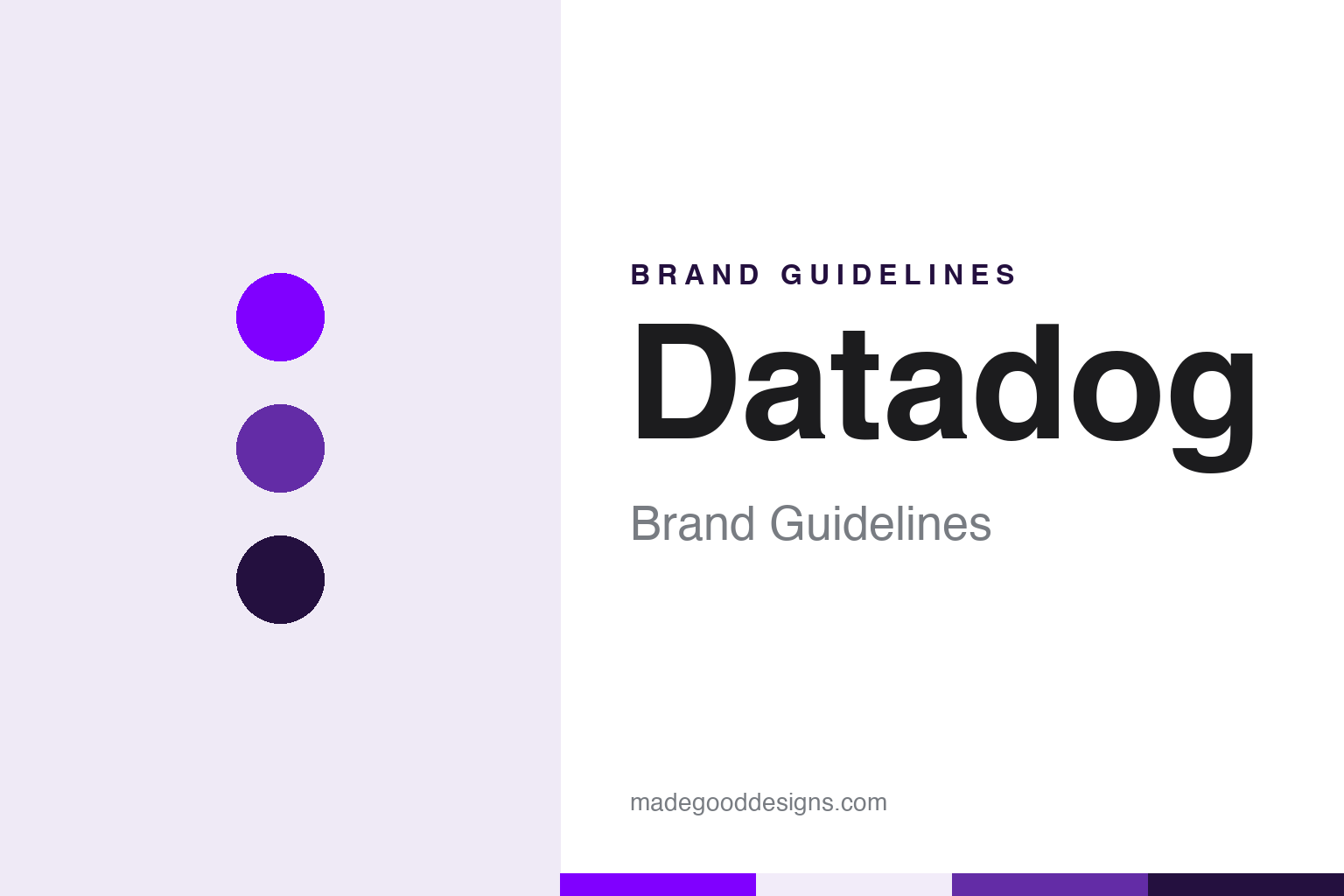
Datadog Brand Guidelines
Two engineers who met in Paris, an office in Times Square and a dog called Bits.
Aa
Two constants: a Datadog Purple, accent purple and night palette and a Grotesque sans register. Abstract homage — not a Datadog asset or mark; no logo, icon or wordmark is reproduced.
From Wireless Generation to Times Square
Two engineers, New York, 2010.
Datadog was started in New York by two engineers who had known each other since their student years in France. TechCrunch, in a profile by Danny Crichton published on 21 April 2018, said the company was founded in 2010 by Olivier Pomel and Alexis Lê-Quôc. Wikipedia says the two met as undergraduates at the École Centrale Paris, and TechCrunch added that Pomel was helping to run the campus network there.
Their paths crossed again in the United States. According to TechCrunch, Pomel moved to IBM’s offices in upstate New York after graduating and later led technology at Wireless Generation, a New York education start-up working with schools, where he found Lê-Quôc running operations. Wikipedia says the pair worked together there for nine years and set out on their own after Wireless Generation was acquired by News Corp.
The idea came from the office they shared. TechCrunch reported that the two had watched developers and operations staff at Wireless Generation work at cross-purposes, with plenty of finger-pointing between the two sides, and that they wanted one set of tools both teams could read. Wikipedia describes the same motive in plainer terms: reducing the friction between developer and systems-administration teams who were often pulling in different directions. At the same time, TechCrunch said, the founders noticed companies beginning to talk about building on Amazon Web Services, still a relatively new idea in 2009.
The company was incorporated in 2010, and TechCrunch said the product reached general availability in 2012. Pomel told the publication that raising money for an infrastructure company in New York had been hard in those years, with investors on the West Coast not listening and those on the East Coast unsure of the field, and that the difficulty pushed the founders to spend their early time with customers. The company stayed in New York. Wikipedia says it opened a research and development office in Paris in 2015 and in 2016 moved its headquarters to a full floor of the New York Times Building, which is where TechCrunch placed it, in Times Square, in 2018.
Colour
A name that ends in a dog.
The company’s name ends in an animal, and the animal is in the logo. On its logos and press kit page, Datadog says it calls the dog in its logo “Bits”. The logo pairs the dog with the Datadog wordmark, and the page sets out two configurations: a vertical lock-up, which the company calls the primary version and asks people to use by default, and a horizontal one, for cases where it is absolutely necessary.
The colour rules are short. Datadog says Bits should always be white, and it supplies a purple version of the logo for light backgrounds and a white version for purple, dark or neutral ones. It publishes the logo colour as Datadog Purple, matched to Pantone Violet C and given as hex #632CA6, and a brighter purple for backgrounds and accents, matched to Pantone 266 C and given as hex #8000FF. That pairing of a deep logo purple with a vivid secondary purple is the core of the palette on this page.
The same page lists what not to do with the mark. Datadog asks that the colours of the logo not be inverted or changed, that the ratio between the mark and the type be left alone, that the aspect ratio not be altered, and that the logo not be placed in a box or another shape, outlined or given a gradient. Written down in that way, the rules turn a friendly character into a mark with fixed proportions and fixed colours.
The dog has since lent its name to the software itself. Datadog’s own roundup of announcements from its DASH conference, published on 3 August 2023, introduced Bits AI, an assistant built into the service, and the company’s product menu now groups several features under the Bits name, from Bits Chat to Bits Code. The name of the logo’s dog now also appears on features that users meet inside the product, not just on the website and in press material.
Wikipedia records another change from the same years, this one out of sight. The Datadog agent, the program customers install on their own machines to send data to the service, was rewritten in the Go language for version 6.0.0, released on 28 February 2018; the earlier agent had been written in Python and forked from one that David Mytton created in 2009 for Server Density.
Typography
Dashboards, docs and a dog.
Enterprise software sells something nobody can hold, so its identity has to work on surfaces many consumer brands never think about. The name is the starting point. Some companies coin a word with no prior meaning, which clears trademark searches and domain registration but leaves the brand to build every association from scratch. Others borrow an ordinary word or a fragment of a phrase, which lends a ready image but invites confusion with everything else that shares it.
Mascots and illustrated characters appear more often than the sector’s sober reputation suggests. A friendly figure can soften a product built around tickets, workflows or compliance, though many are quietly retired once a company starts courting larger buyers.
The real brand surfaces are often screens. A login page, an empty dashboard, an error message and a notification email are seen far more often than any advertisement, and their colour, spacing and type do much of the identity work day to day. Annual user conferences add a third surface: the stage set, the keynote slides and the lanyard all carry the system in front of a live audience, which is why many enterprise identities are tested at scale in a convention hall.
Aa
A grotesque sans — after a short compound name and a purple published with exact values. (Specimen set in Work Sans, a sans STAND-IN; NOT the Datadog logo or any Datadog typeface.)
Datadog
A listed company with a mascot.
Datadog went public on the Nasdaq exchange on 19 September 2019, Wikipedia says, and it is still headquartered in New York City. Since then it has added businesses by acquisition. Wikipedia lists Sqreen, a cloud application-security company, in April 2021; Codiga, a static code analysis platform, in April 2023; Metaplane, a data observability company, in April 2025; and Eppo, a feature-flagging and experimentation platform, in May 2025. Wikipedia also says Datadog was added to the S&P 500 index in July 2025.
None of those steps changed the name or the dog. The company that TechCrunch described in 2018 as a New York business built by two engineers who met in France still carries the compound name chosen in 2010 and the character on the logo. The acquired companies were folded into the Datadog platform, according to Wikipedia, rather than kept as separate consumer brands, so the purple and the dog sit over a longer list of products.
For a designer the Datadog identity is useful for how much of it is written down. The press kit gives exact values for two purples, names the character in the mark, sets a primary and a secondary lock-up and lists the changes it does not allow. Anyone placing the logo on a conference slide, a partner page or an article has a clear starting point, and the colour is easy to reproduce from the published hex rather than sampled from a screenshot.
The other half of the lesson is the mascot. A software company that sells to engineers chose a dog and gave it a name, and later used that name for features inside the product. That keeps a single character working at several levels, from the logo on the website to a menu item in the software, without adding a separate brand.
For a design guide, Datadog shows how a named mascot and a published colour can carry a technical company’s identity from a logo into its product names. Compare IBM, where Pomel worked before Wireless Generation, and Twilio, another software company built for developers. For this guide we use Datadog’s published purples with a night tone and a sans; the night and tint tones are an unofficial interpretation, and no product or logo is reproduced.
Explore & save
Keep Datadog’s identity on hand — save it to a board in the Made Good inspiration library.
Datadog identity set
Pin the Datadog Purple, accent purple and night palette and the Grotesque sans register to your own board.