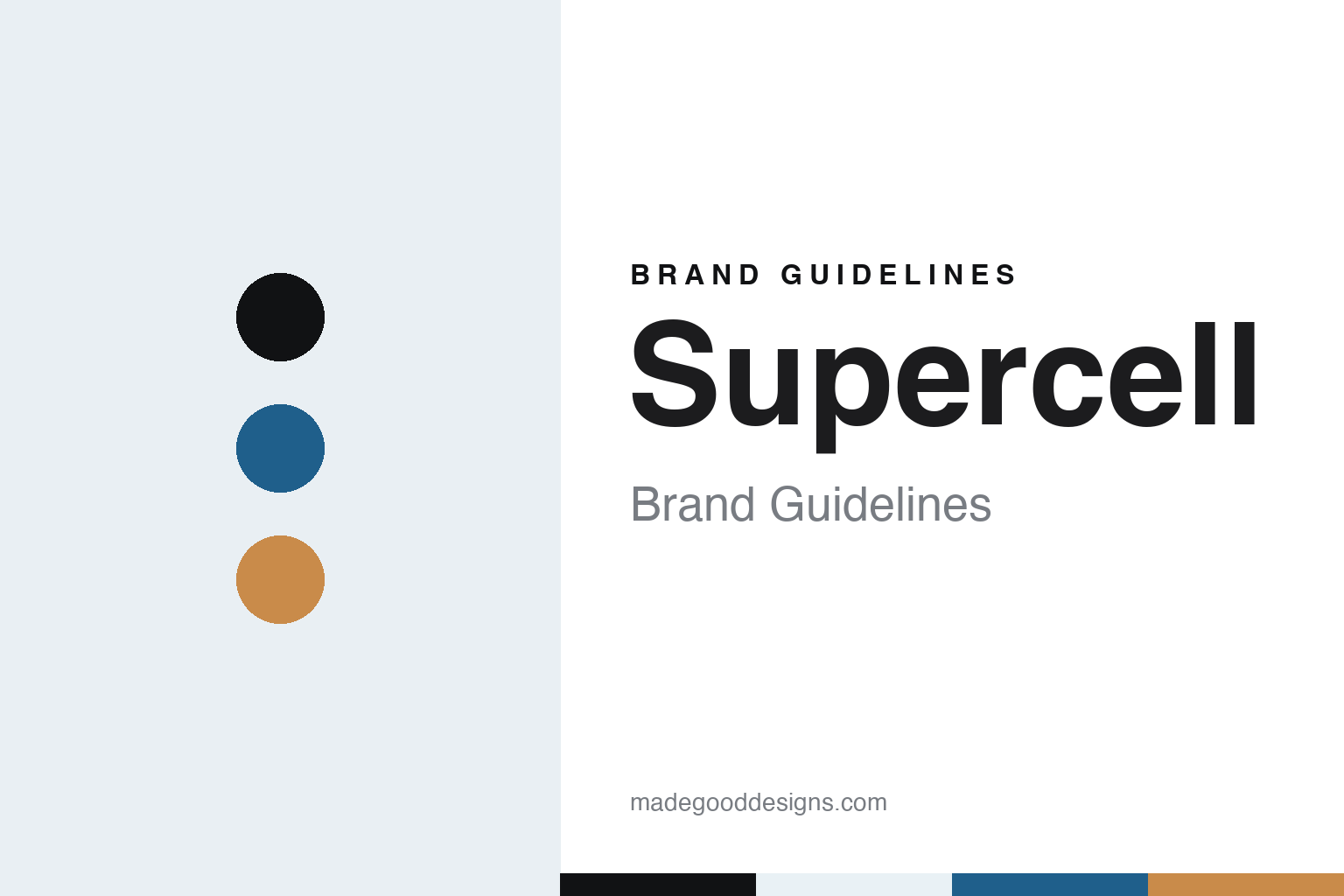
Supercell Brand Guidelines
Six founders, small teams and games that are allowed to end.
Aa
Two constants: an ink black, harbour blue and sauna pine palette and a Rounded heavy sans register. Abstract homage — not a Supercell asset or mark; no logo, character, game art or wordmark is reproduced.
Six founders and a guiding sentence
From Sumea to a new company in Espoo, 2010–2012.
Supercell was founded by people who had already built a mobile game company together. Wikipedia says that two of its founders, Mikko Kodisoja and Ilkka Paananen, had worked at Sumea, a Finnish mobile game developer that Kodisoja co-founded in 1999 and that Paananen joined as chief executive in 2000. The American company Digital Chocolate bought Sumea in 2004 and made it its Finnish base, with Paananen as its European manager. Kodisoja left in 2010, and Paananen soon followed.
The new company came out of a wish to change who made the decisions. Wikipedia says Paananen, then at the venture firm Lifeline Ventures, wanted to create a game company where executives would not disturb the work of the developers. Together with Kodisoja, Petri Styrman, Lassi Leppinen, Visa Forstén and Niko Derome, who had all known one another through work, he founded Supercell in 2010; the infobox gives the date as 14 May 2010. The company started in the Niittykumpu district of Espoo, and its headquarters are now in Jätkäsaari, Helsinki. Paananen remains its chief executive.
Paananen looked back on that start in a long blog post marking ten years of the company, which VentureBeat summarised on 15 May 2020. “When we started the company, we were inspired by companies like Blizzard, Nintendo, and Pixar,” he wrote, adding that what those companies shared was the ability to make entertainment people loved, consistently, over decades. He said that inspiration had not changed, and nor had the company’s stated dream: to create games that are played for years and remembered forever. In 2010, he wrote, Supercell had started from the idea that great individuals make great games; years later it decided the point was the team as a whole, and changed its guiding sentence to say so.
The early games did not all survive. Wikipedia says an early project, Gunshine, a multiplayer game for Facebook in a browser and on mobile, was abandoned in November 2011, because players did not stay with it, it was hard to play and the mobile version worked less well than the browser one. The company then turned to tablets and phones. Wikipedia dates Hay Day on iOS to 21 June 2012 and Clash of Clans on iOS to 2 August 2012, with Boom Beach in 2014, Clash Royale in March 2016, Brawl Stars worldwide in December 2018 and Squad Busters on 29 May 2024.
Colour
SoftBank, a Tencent-led consortium and control from 2019.
Supercell’s ownership has changed hands at the level of its investors rather than its management. Wikipedia says Accel Partners and Index Ventures led the company’s Series A funding in 2011. By 2016, Reuters reported, the Japanese group SoftBank held a majority of the company.
That June, Reuters reported from Beijing, Helsinki and Tokyo that Tencent Holdings would buy a majority stake in Supercell from SoftBank through a wholly owned consortium, including all of SoftBank’s shares. The consortium could be opened to co-investors, the agency said. Supercell’s management would keep their operational independence, and the company would remain in Finland. Paananen told the agency that Supercell had taken part in the search for a new partner and had also considered a stock market listing. “This deal enables us to keep Supercell privately held,” he said, adding that this was a better match with the company’s small size and culture than being a public company under pressure from financial markets to think short term.
The structure was adjusted three years later. GamesIndustry.biz reported on 23 October 2019 that a Luxembourg consortium formed in 2016 for the sole purpose of acquiring Supercell held the majority of the company, and that Tencent had increased its holding in that consortium, giving it effective control of Supercell. Wikipedia names the consortium as Halti S.A. A consortium led by Tencent has owned a majority of Supercell since 2016, and Tencent has controlled that consortium since 2019.
Inside the company, the unit that shapes the work is the team. In a talk reported by Gamasutra on 16 March 2016, Supercell game lead and artist Jonathan Dower said the company hires carefully and keeps its teams small, because more people bring more overhead, more bureaucracy and less ownership. “Financial goals are secondary to quality,” he said. He also said the arrangement was not all easy: strong individuals did not always make strong games, small teams were not automatically focused, and being independent brought its own pressure.
Paananen’s 2020 post, as VentureBeat reported, described how teams test games in a beta phase and look above all at how long players keep playing. “This means that we don’t only kill games in beta, we kill good games,” he wrote, naming Smash Land and Rush Wars as polished games whose own teams decided to stop, because they were not games people would play for years. He said teams try to think about the next decade rather than the next quarter.
Typography
A wordmark, a cast of characters and a minute of television.
A game studio’s identity usually reaches players before the game does. The company logo appears on a splash screen or a short animated ident in the seconds while software loads, then again on store pages, trailers, packaging and the credits. Because those seconds repeat every time someone opens a game, the ident tends to be short, legible on a phone or a television, and quiet enough that it does not compete with the title that follows. Animation studios use the same device in front of their films, often with a brief piece of motion or a sound cue that returns from release to release.
Much of the visible branding, though, belongs to the work rather than the company. Characters, mascots and title logos carry the recognition, and a studio name may sit underneath them in small type. Some companies let a recurring character stand in for the studio; others keep the studio mark plain so that each new game or film can look different. Ownership changes add another layer: when a studio is bought or becomes independent, the parent’s mark may appear beside its own or drop away. For designers, the practical point is that a studio identity is a set of placements — a splash screen, a store icon, a credit line, a website — and each needs a version of the mark that works at its size and in its moment.
Aa
Rounded heavy sans — a friendly, chunky register suited to small screens. (Specimen set in Lilita One, a display STAND-IN; NOT the Supercell logo or any Supercell typeface.)
Supercell
A company that markets its games, not itself.
Supercell’s public face is largely its games. The company name appears on the studio’s site and in the credits, but the characters, names and art that reach players belong to individual titles, and several of those titles share a family name: Wikipedia lists Clash of Clans and Clash Royale, and says Clash Royale uses characters similar to those in Clash of Clans. A cast that carries from one game to the next lets a new release borrow recognition from an older one.
Television made that cast visible beyond phones. The Guardian reported on 9 February 2015 that Supercell’s commercial for Clash of Clans, called “Revenge”, aired during Super Bowl XLIX on 1 February 2015. It starred the actor Liam Neeson, who spoofed his much-quoted threat from the 2008 film Taken, this time aimed at an anonymous player who had raided his village; the newspaper noted that Supercell had bought a full minute of airtime rather than the usual thirty seconds. The paper placed the spot within a wider move by mobile game companies from online advertising to television during 2014.
Closing games is part of how the company presents itself, too. Gamasutra reported in March 2016 that Jonathan Dower described Supercell as a long-time “serial killer” of games, and told the story of Smash Land: after a beta that did not meet its targets, the team got some beers, sat in a sauna and decided to end the project. They then told the chief executive, held a postmortem for the whole company and moved on to other work, including Clash Royale. Dower said management trusts game teams to make that call. Wikipedia records a series of later projects that Supercell announced on its own site as ending, including Rush Wars, Clash Quest, Clash Mini and Everdale.
The chief executive’s writing is another channel. Supercell’s own site lists a section called “Ilkka’s Long Texts” in its menu, and the ten-year post that VentureBeat summarised in 2020 is an example: a long, personal account of what had worked, what had not and what the company believed. Paananen wrote it, the publication said, as a way of sharing lessons with other game companies, and he asked staff for ideas while drafting it. He stressed that the rules suited Supercell and that each company must develop its own culture.
For a design guide, Supercell shows a company brand that stays quiet while its game characters do the talking, held together by a few repeated ideas about teams and time. Compare Devolver Digital and Minecraft, two other game brands in this library. For this guide we use ink black, harbour blue and sauna pine with a sans, an unofficial interpretation; no product or logo is reproduced.
Explore & save
Keep Supercell’s identity on hand — save it to a board in the Made Good inspiration library.
Supercell identity set
Pin the Supercell ink black, harbour blue and sauna pine palette and the Rounded heavy sans register to your own board.