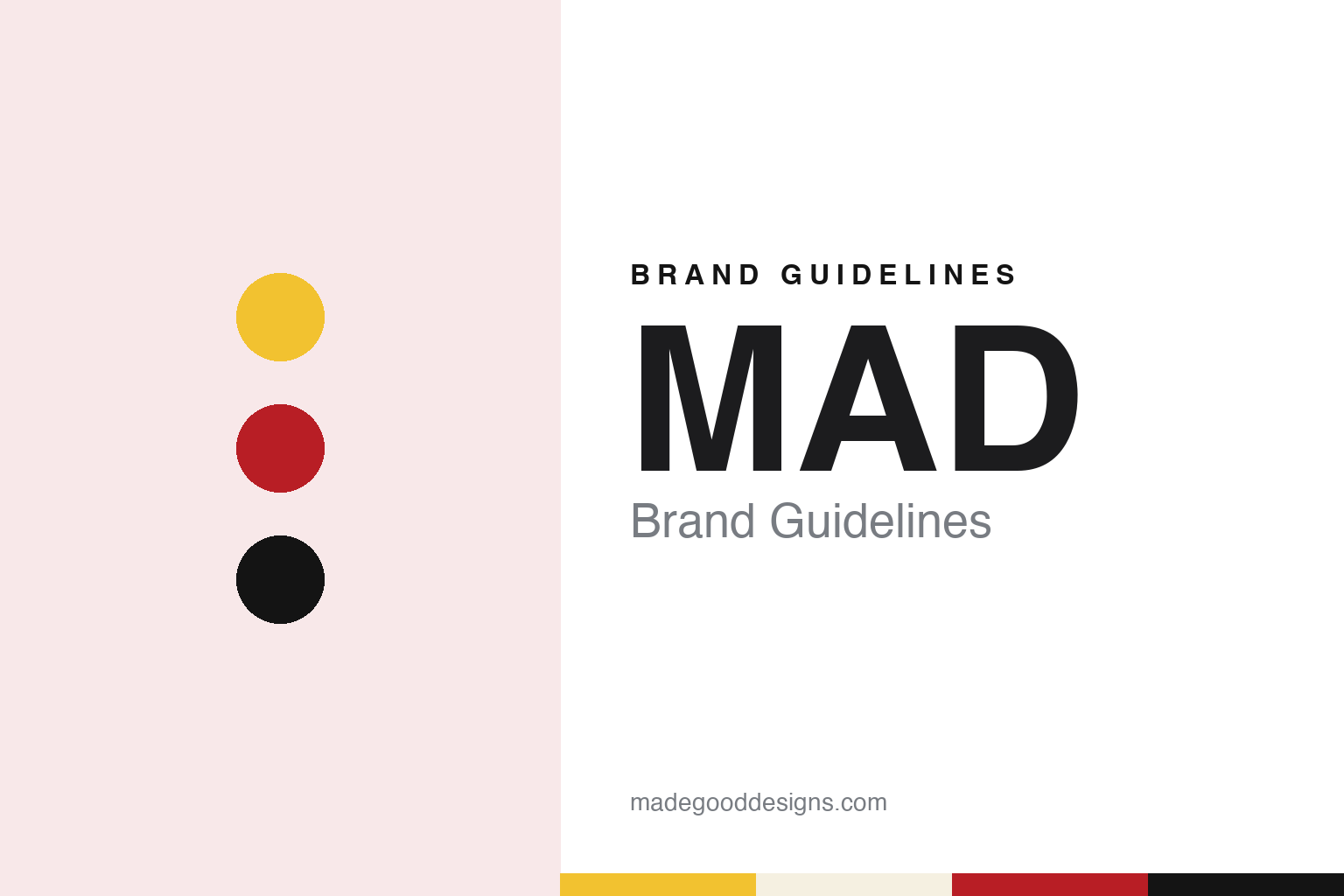
MAD Brand Guidelines
Three capitals and a gap-toothed grin.
Aa
Two constants: a red, newsstand yellow and comic ink palette and a condensed sans register. Abstract homage — not a MAD asset or mark; no logo, cover, character or masthead is reproduced.
A comic book that became a magazine
Kurtzman, Gaines and the move to magazine format.
MAD began as a comic book. English Wikipedia says it was founded by the editor Harvey Kurtzman and the publisher William Gaines, and that it debuted from Gaines’s company, EC, in August 1952, with a cover date of October–November. The Hollywood Reporter, writing on 3 July 2019, said the magazine was founded in 1952 by a group of editors led by Kurtzman, and that although it began as a comic book, regular magazine issues became the norm. English Wikipedia spells the title in all capitals, as the masthead does.
The early office was in lower Manhattan. English Wikipedia places it at 225 Lafayette Street, and says that in the early 1960s the magazine moved to Madison Avenue, an address it printed with the joke spelling MADison Avenue. The launch issue was written almost entirely by Kurtzman, with drawings by Kurtzman, Wally Wood, Will Elder, Jack Davis and John Severin; Wood, Elder and Davis remained the main artists of the comic-book run.
The format changed in 1955. English Wikipedia says the comic book became a magazine with issue No. 24, in order to keep Kurtzman as editor. It quotes Gaines, speaking in 1992, as saying the change was not made to avoid the Comics Code, though it had that result, and that Kurtzman had been interested in turning MAD into a magazine and had received an offer from another magazine. The switch kept Kurtzman for one more year.
Kurtzman left in 1956, and Al Feldstein took over. English Wikipedia says Feldstein brought in contributors such as Don Martin, Frank Jacobs and Mort Drucker, and later Antonio Prohías, Dave Berg and Sergio Aragonés. The Hollywood Reporter, on 26 June 2017, said MAD was created by Kurtzman and run for decades by Feldstein, and named the features that grew up in those years: Spy vs Spy, the Fold-in and A MAD Look At….
The schedule settled slowly. English Wikipedia says early issues appeared between four and nine times a year, that by the end of 1958 MAD had settled on eight issues a year, a pattern that held for almost four decades, and that issues went on sale weeks before the month printed on the cover. The magazine reached a monthly schedule with issue No. 353, dated January 1997.
Colour
From EC to DC, and from New York to Burbank.
Gaines sold the company early. English Wikipedia says that in 1961 he sold it to Premier Industries, a maker of venetian blinds, and that around 1964 Premier sold MAD to Independent News, a division of National Periodical Publications, the publisher of DC Comics. Kinney National bought National Periodical in 1967, the company was reincorporated as Warner Communications in 1972, and National Periodical was renamed DC Comics in 1977. English Wikipedia says MAD is published by DC Comics today.
The editors after Feldstein came from inside. The Hollywood Reporter wrote in June 2017 that when Feldstein retired, John Ficarra became editor with Nick Meglin, and that Ficarra ran the magazine alone after Meglin retired in 2004. English Wikipedia adds that the production artist Lenny Brenner became art director, and that Sam Viviano took over as art director in 1999. In the mid-1990s, it says, MAD left Madison Avenue for DC’s offices on Broadway.
The magazine changed its look in 2001. English Wikipedia says that with issue No. 404, dated April 2001, MAD began running paid advertising, and that the outside income allowed the introduction of colour printing and better paper. After issue No. 500 in June 2009 it moved briefly to a quarterly schedule, then settled at six issues a year in 2010.
MAD left New York in 2018. The Hollywood Reporter reported on 26 June 2017 that the illustrator Bill Morrison, co-creator of Bongo Comics with Matt Groening, had been named executive editor of DC Entertainment’s MAD, and that Ficarra would stay through the end of the year to help with a transition that would move the magazine from New York to DC’s headquarters in Burbank, California. English Wikipedia says the New York run ended with issue No. 550, cover-dated April 2018, and that the opening California issue was renumbered No. 1.
The magazine was cut back the following year. The Hollywood Reporter reported on 3 July 2019 that MAD would leave newsstands and be sold through comic-book shops and to subscribers, and that from issue No. 11 it would carry previously published material, apart from new end-of-year specials. NPR, on 4 July 2019, said the reprinted classic and nostalgic material would be repackaged with new covers. English Wikipedia says some new pieces have appeared since, that Spy vs. Spy and A Mad Look at… returned from late 2024, and that the issue of August 2026 went back to the original numbering as No. 600.
Typography
Three capitals, a mascot and a fold-in.
A magazine’s masthead can stay in one plain serif and still change in small steps. Jeremy Leslie of magCulture wrote in September 2015 that the Fantastic Man logo is set in Times Roman, that the earlier covers carried a stacked, centred version of it, and that issue No. 21 broke away from that arrangement before No. 22 returned to it. In No. 22 the magazine also introduced Founders Grotesk, by Kris Sowersby, as a new headline sans. Leslie described pages built on strict typographic rules, with little decoration beyond the fonts, and a look based on an approach rather than a fixed set of devices. It’s Nice That described the same magazine in October 2015 as mostly black and white, with rule lines, two columns and long passages of text.
Other titles put more of the identity into the cover image itself. AnOther says the first cover of AnOther Magazine, in 2001, was a photograph by Nick Knight of two young lovers cast as Adam and Eve, and that Jefferson Hack’s foreword framed it as the magazine’s statement for that season. For its fifteenth anniversary in 2016, It’s Nice That reported, AnOther made a limited edition with a 3D hologram cover of Karl Lagerfeld, made by the holographer Rob Munday, alongside covers of other subjects in the same issue. When reading a magazine’s identity, look at how the masthead is set and how often it moves, which typefaces carry the headlines, and whether the cover photograph or the cover object carries the brand.
Aa
A condensed sans — loud capitals for a magazine that shouts its own name. (Specimen set in Anton, a sans STAND-IN; NOT the MAD logo or any MAD lettering.)
MAD
A name in capitals and a face that stands in for everyone.
MAD’s identity rests on a short word and a recurring face. English Wikipedia gives the name as Mad, stylized in all caps, the form The Hollywood Reporter also used in June 2017. The magazine also folded its name into its address, printing the Madison Avenue office as MADison Avenue.
The face is Alfred E. Neuman. English Wikipedia describes him as a boy with misaligned eyes and a missing-tooth smile, with the motto “What, me worry?”, and says the picture circulated as a humorous image for decades before MAD adopted it. MAD used the face in November 1954, and the boy was named on a full cover with issue No. 30, dated December 1956. The Hollywood Reporter wrote in July 2019 of MAD’s covers featuring the gap-toothed Neuman, and NPR described his freckled face in a report of the same week.
The cover method follows from the mascot. English Wikipedia says Neuman is usually on the cover, with his face replacing that of the celebrity or character being parodied. English Wikipedia also names Norman Mingo as a MAD cover artist.
Recurring features act as a second set of marks. The Hollywood Reporter named Spy vs Spy, the Fold-in and A MAD Look At… in June 2017, and NPR reported in 2019 that the reprint issues would carry new covers. English Wikipedia says new covers and new fold-ins continued after the switch to reprints.
For a design guide, MAD shows how a capitalised name, one mascot and a few fixed features can hold a magazine together through format changes, new owners and a move across the country. Compare The New Yorker, another New York magazine with a recurring cover figure in Eustace Tilley, or Rolling Stone, another American magazine in this collection. For this guide we use red, newsstand yellow and comic ink with a condensed sans, an unofficial interpretation; no product or logo is reproduced.
Explore & save
Keep MAD’s identity on hand — save it to a board in the Made Good inspiration library.
MAD identity set
Pin the MAD red, newsstand yellow and comic ink palette and the condensed sans register to your own board.