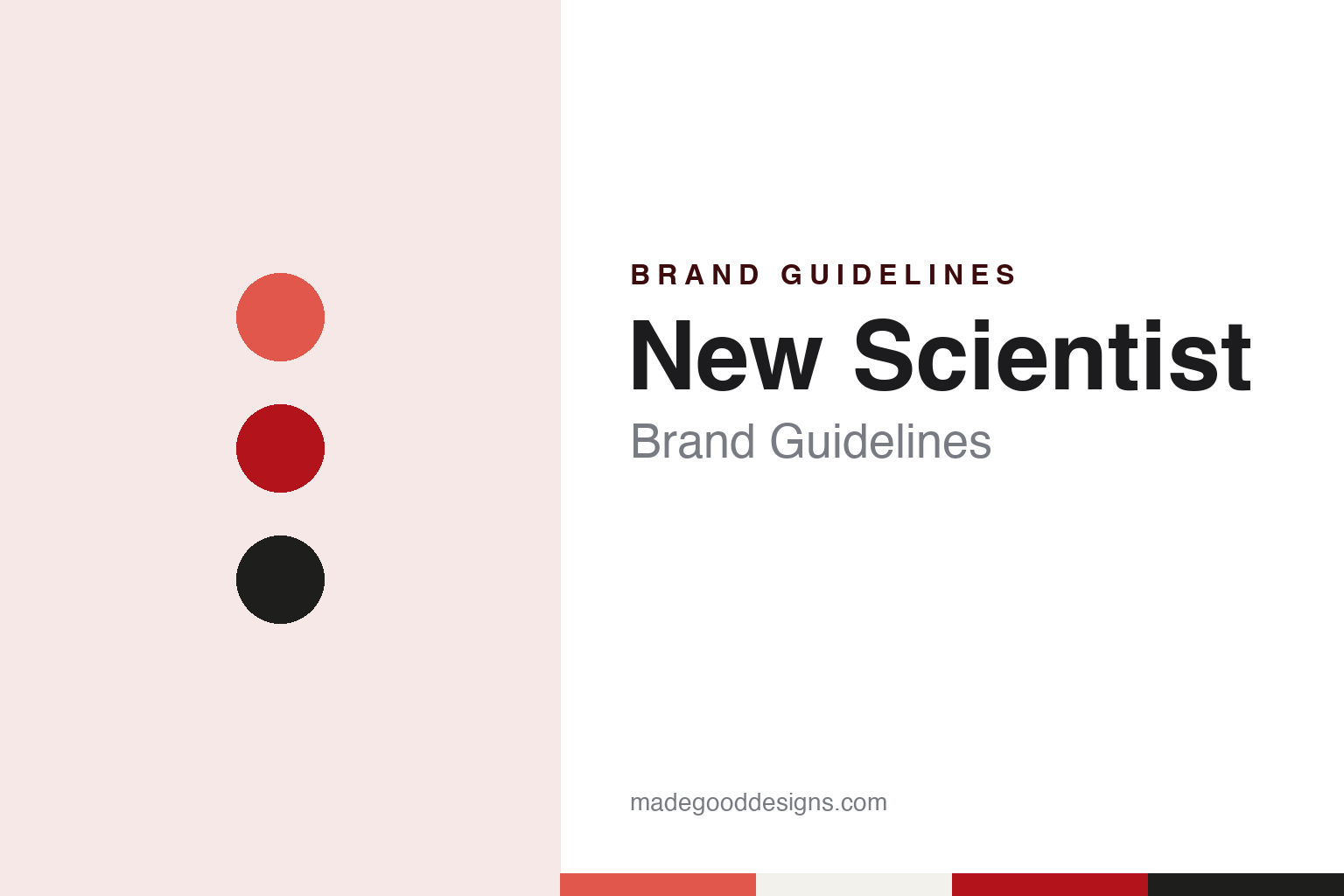
New Scientist Brand Guidelines
A weekly whose cover went from a list to a picture.
Aa
Two constants: a red and black palette and a compact grotesque register. Abstract homage — not a New Scientist asset or mark; no logo, cover or masthead is reproduced.
A shilling weekly from 1956
Three founders, an editor and a cover made of text.
New Scientist began as The New Scientist. English Wikipedia says the magazine was founded in London in 1956 by Tom Margerison, Max Raison and Nicholas Harrison, and that its opening issue appeared on 22 November 1956, priced at one shilling. The same article lists Percy Cudlipp as its editor from 1956 to 1962, and says the magazine’s tenth-anniversary issues carried an article with anecdotes about how it was founded.
The early covers were type, not pictures. English Wikipedia says the cover of New Scientist originally listed articles in plain text, and that page numbers at first followed academic practice, running in sequence through each quarterly volume, so that an issue in March could open on a page in the hundreds. Later issues were numbered separately. From the beginning of 1961, the same article says, the word “The” was dropped from the title, leaving the two-word name it still carries.
Pictures arrived on the front in the mid-1960s. English Wikipedia dates the move to illustrated covers to 1965, and says that until the 1970s colour was not used inside the magazine, only on the cover. The same article says the opening issue already covered the uses of science in industry, with an article on the future of nuclear power in the United Kingdom, and that in 1964 the magazine ran a regular section called “Science in British Industry”.
Editors changed at intervals of a few years. English Wikipedia lists Nigel Calder from 1962, Donald Gould from 1966, Bernard Dixon from 1969, Michael Kenward from 1979, David Dickson from 1990, Alun Anderson from 1992, Jeremy Webb from 1999 and Roger Highfield from 2008. Sumit Paul-Choudhury followed in 2011, Emily Wilson in 2018 and Catherine de Lange in 2023, according to the same list.
Another title was folded in along the way. English Wikipedia says the British monthly Science Journal, published from 1965 to 1971, was merged with New Scientist to form New Scientist and Science Journal. New Scientist has been available online since 1996, the same article says, and is based in London, with weekly English-language editions in the United Kingdom, the United States and Australia.
Colour
From a magazine group to a consortium to a newspaper publisher.
The magazine spent decades inside large publishing groups. English Wikipedia says that in 1970 the Reed Group, later Reed Elsevier, acquired New Scientist when it merged with IPC Magazines. When Reed sold the bulk of its consumer titles in a management buyout, the same article says, it kept New Scientist, which stayed with the group as it became RELX.
That ended in 2017. English Wikipedia says that in April 2017 RELX sold the magazine to Kingston Acquisitions, a group set up by Sir Bernard Gray, Louise Rogers and Matthew O’Sullivan to buy it, and that Kingston Acquisitions then renamed itself New Scientist Ltd. Press Gazette, reporting on 3 March 2021, described the owner in the intervening years as a consortium of individual investors led by Gray, and said the Gray team had bought the title in 2017 from Reed Business Information.
The next owner was a newspaper company. Press Gazette reported on 3 March 2021 that New Scientist had been sold to DMGT, the owner of the Daily Mail, and quoted the editor, Emily Wilson, saying the magazine would remain editorially independent. English Wikipedia dates the acquisition by Daily Mail and General Trust to March 2021, and says DMGT guaranteed the magazine’s editorial independence and ruled out sharing editorial content. In December 2021, according to the same article, DMGT announced that New Scientist and the daily newspaper i would move into a new division called Harmsworth Media.
The name also travels in other languages. English Wikipedia says a monthly Dutch edition was launched in June 2015, replacing the magazine Natuurwetenschap & Techniek. It is published by Veen Media, is editorially separate, and carries translated articles alongside its own reporting on the Netherlands and Belgium.
The pages have long made room for drawings. English Wikipedia says New Scientist has published cartoons for much of its history, with regular contributors including Mike Peyton and David Austin, and that Bill Tidy’s comic strip Grimbledon Down ran from 1970 to 1994. The same article says a cartoon by Tom Gauld appears on the letters page.
Typography
A two-word title, a picture cover and a back page of questions.
A magazine can keep its name for decades and still change the way that name is set. InPublishing reported on 5 November 2015 that the London design magazine Icon, launched in 2003, marked its 150th issue with a new logo, new typefaces and a faster-paced layout, together with three new sections and a new strapline, “Design worth knowing”. English Wikipedia says the same title moved from monthly to quarterly publication in 2020, so the masthead now appears four times a year.
A name can also travel between titles. English Wikipedia says the Paris weekly Elle was founded in 1945 and that its publisher launched Elle Decoration in France in 1987; Business of Home reported that the American Elle Decor marked its 35th anniversary in 2024. Covers carry the other half of the change. Business of Home wrote on 11 September 2024 that the first Elle Decor issue under a new editor in 2020 used an illustration by Rachelle Baker that reimagined Nancy Lancaster’s Yellow Room. When reading a magazine’s identity, look at when the logo and typefaces were last redrawn, how often the issues appear, which parent title lends the name, and whether the cover shows a room, a photograph or an argument.
Aa
A compact grotesque — the register of a London weekly about science and technology. (Specimen set in Archivo, a sans STAND-IN; NOT the New Scientist logo or any New Scientist typeface.)
New Scientist
A title shortened once and a format refreshed in 2019.
The title is the main design decision on record. The magazine launched in 1956 as The New Scientist and, according to English Wikipedia, lost its definite article at the start of 1961. Four years later, in 1965, the cover moved from a plain list of articles to an illustration, and the two-word name has sat above a picture ever since.
The inside was reorganised in 2019. English Wikipedia says that, until May 2019, the magazine was arranged in sections including a leader, news, technology, opinion, features with the cover story, the review pages called CultureLab, the humour column Feedback, the question-and-answer page The Last Word, and jobs. From issue 3228, dated 4 May 2019, the magazine introduced what it called a slightly updated design with a fresher, brighter feel, adding a Views section between the news and the features and gathering Feedback, The Last Word and puzzles into the Back Pages.
The back pages have also become books. English Wikipedia lists a run of collections drawn from The Last Word, starting with The Last Word in 1998 and including Does Anything Eat Wasps? in 2005 and Why Don’t Penguins’ Feet Freeze? in 2006. The same article says the light-hearted Ariadne pages once carried the inventions of the fictional Daedalus, written by David E. H. Jones, before Daedalus moved to Nature.
For a design guide, New Scientist shows how a weekly can keep one short name through a change of title, a change of cover format and several changes of owner, and how recurring pages such as Feedback and The Last Word give a magazine a fixed shape behind a changing cover. Compare The Economist, another London weekly, or WIRED, a technology magazine. For this guide we use red and black with a sans, an unofficial interpretation; no product or logo is reproduced.
Explore & save
Keep New Scientist’s identity on hand — save it to a board in the Made Good inspiration library.
New Scientist identity set
Pin the New Scientist red and black palette and the compact grotesque register to your own board.