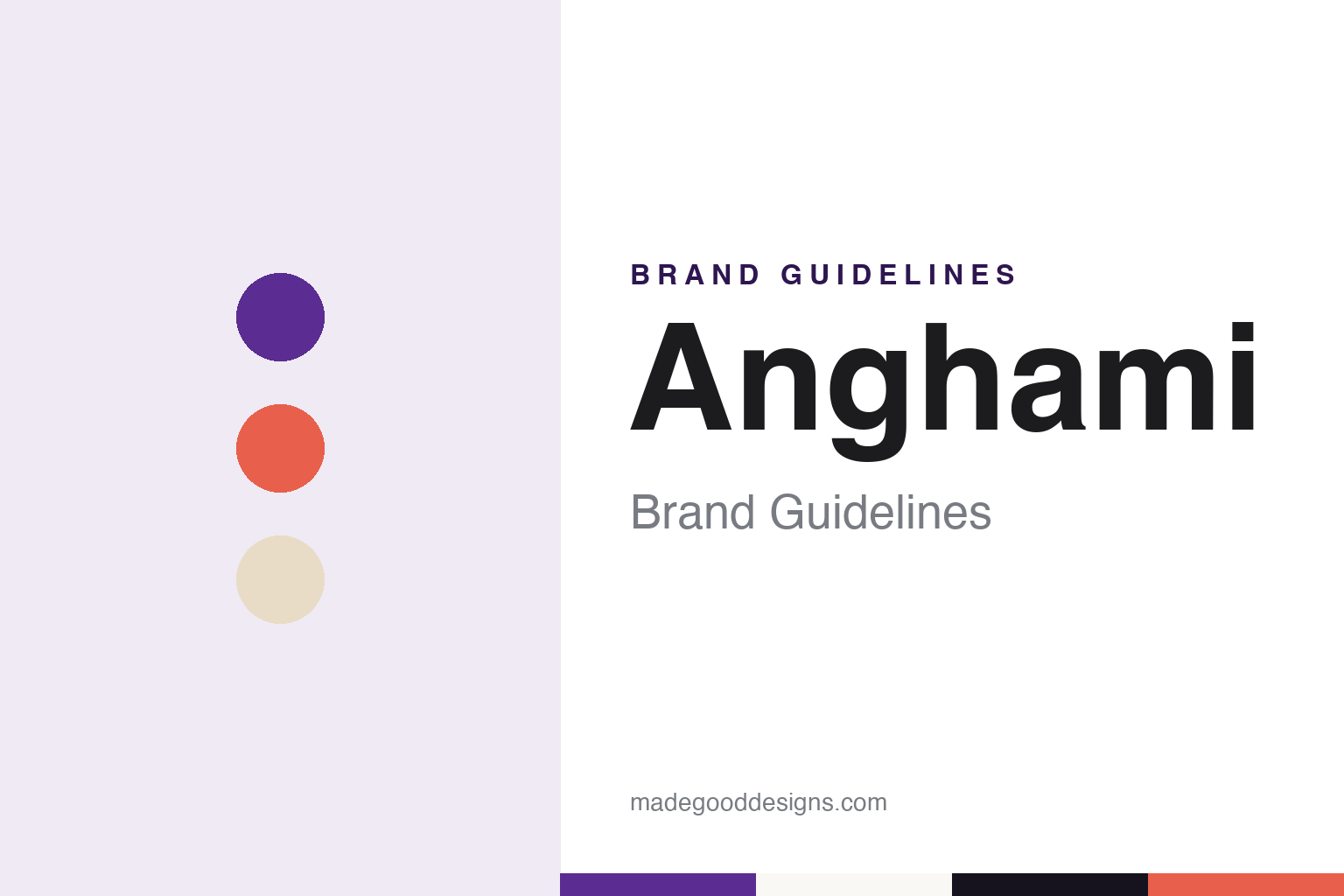
Anghami Brand Guidelines
A ski-day problem, a mobile app and a voice drawn as lines.
Aa
Two constants: a voice violet, signal coral and Gulf sand palette and an open Arabic-Latin sans register. Abstract homage — not an Anghami asset or mark; no logo, app icon, artwork or wordmark is reproduced.
A ski day, an iPod and a legal alternative
Lebanon, 2011–12: two colleagues plan a music app.
Anghami’s name is Arabic. English-language Wikipedia glosses Anghami as “melodic” or “my melodies”, and says the service was founded by Eddy Maroun and Elie Habib in Lebanon and launched in November 2012 as a mobile-only app, with the aim of offering an alternative to music piracy in the Arab world. Wamda, reporting on 21 January 2022, also gave 2012 as the founding year and named the same two founders.
L’Orient-Le Jour, in a feature by Fouad Gemayel published on 13 March 2022, traced the idea to a day of skiing at the Mzaar-Kfardebian resort in early 2011, when Maroun could not get music to sync on his iPod. The newspaper said Maroun was then working at PowerMeMobile, a Lebanese company supplying content to mobile operators, where he recorded minimalist instrumental covers of pop songs on a synthesiser, and that he raised the problem with Habib, the company’s co-founder and chief technology officer. Habib told the paper the two met almost every day at a café in a mall at Dbayeh, north of Beirut, to work out a plan. The paper also noted Habib’s earlier role as chief technology officer of Naharnet, a Lebanese online news service launched in 2000.
The newspaper wrote that no legal streaming or download services were then available in the region. It said the founders put in their own savings and took a bank-guaranteed loan, and that at the beginning of 2012 they secured backing from the venture firm Middle East Venture Partners. That money, it said, allowed the start-up to license catalogues from Universal, Sony and Warner and from regional companies including Rotana, Platinum, Mazzika and Melody, and an exclusive agreement with Rotana let Anghami distribute its catalogue in Lebanon, Saudi Arabia and the United Arab Emirates.
Colour
A web idea becomes a mobile app sold through operators, then moves to Abu Dhabi and Nasdaq.
The format changed before launch. Habib told L’Orient-Le Jour that the team had planned a website with chat rooms where users could discuss music, then switched to a mobile application because apps were where listeners were. That meant building for several systems at once, including iOS, BlackBerry, Android and Symbian. Mobile operators became the main route to listeners: the paper said customers could subscribe through data bundles added to their phone plans, that Orange Jordan was the opening operator partner in December 2012, and Habib described the operators as a “Trojan horse” that introduced Anghami to their users.
The company kept its base in Lebanon through its early years. L’Orient-Le Jour said its long-standing headquarters were at Jal al-Dib, north of Beirut, and that in early 2021 Anghami moved to Abu Dhabi, to the Hub71 technology centre, after receiving support from the Abu Dhabi Investment Office. Habib told the paper the company would remain Lebanese wherever it was. Gulf News reported on 4 February 2022 that Anghami had set up its headquarters and research and development centre in Abu Dhabi the previous year, and Wamda listed offices in Beirut, Cairo, Dubai and Riyadh.
The listing came through a merger. Wamda reported in January 2022 that shareholders of Vistas Media Acquisition Company, a special purpose acquisition company listed on Nasdaq, had voted on 19 January to approve its combination with Anghami, and that the merged company would trade under the ticker ANGH. Gulf News reported on 4 February 2022 that Anghami’s shares had begun trading in the United States, quoting Maroun, as co-founder and co-chief executive, on plans including Anghami Originals, Anghami Labs, live concerts and live radio. L’Orient-Le Jour wrote that the two founders rang an opening bell in New York on 3 February to mark the listing.
Ownership changed again two years later. Wamda reported on 2 April 2024 that OSN Group, owner of the video streaming service OSN+, had completed the purchase of a majority stake in Anghami after regulatory approvals, bringing OSN+’s video library together with Anghami’s catalogue of songs and podcasts. It said Habib would lead the combined business as Anghami’s chief executive, while Joe Kawkabani remained chief executive of OSN Group.
Typography
An app icon, a colour and the formats around them.
For a music streaming or discovery service, the app icon does most of the work a logo does elsewhere. It sits on a phone’s home screen among dozens of others, is seen at the size of a fingertip and has to be recognised before it is read, so these marks tend to reduce to a single symbol, a simple shape or a letter on a flat field. Colour carries even more of the load. A single strong hue can identify a service on a lock screen, in a share card, on a web player and in a corner of a festival poster, and many services treat that colour as their main asset, with typography and illustration arranged to support it rather than compete with it. Because the catalogue itself belongs to artists and labels, the brand usually shows up in the frame around the music: the player, the buttons, the empty states and the motion between screens.
Playlist covers are where a streaming identity is tested at scale. Editorial teams publish hundreds or thousands of playlists, so covers are built as templates, with a fixed type treatment, a colour rule and a slot for a photograph or pattern that can change weekly without breaking the family. Year-end recap campaigns stretch the same system into a shareable format, turning a listener’s own data into cards designed to be posted, and short sonic logos do a similar job for sound in adverts and app openings. Services that court musicians also need an artist-facing layer, with dashboards, promotional assets and upload tools that borrow the consumer palette but speak in a plainer, more practical voice.
Aa
Open Arabic-Latin sans — after the bilingual Arabic and Latin setting of the Anghami app. (Specimen set in Cairo, an Arabic and Latin sans STAND-IN; NOT the Anghami logo, typeface or any Anghami lettering.)
Anghami
Four coloured lines and a line about voices.
Anghami’s current identity dates from 2022. Gulf News reported on 14 March 2022 that a new brand identity had gone live on 3 March across digital and social channels, app stores and the Anghami platform, and that its positioning, visual identity and logo were developed by the London agency BigSmall with Anghami’s in-house team. Habib, quoted as co-founder and chief technology officer, said the package covered a new logo, colour scheme, typeface and tagline, and that an identity was about the sounds a community creates as much as about symbols. Arab News reported the same day that the logo is built from four coloured lines, which the company said represent a “traveling voice”, and that the campaign line in Egypt and the Gulf was “Share your voice, the world is listening”.
Both papers quoted the company’s head of creative, Rana Najjar, who said the flowing lines symbolise the many creative Arabs “painting a beautiful image” of the Arab world. Anghami said the change placed a mission to help Arab youth create and connect with the world at the centre of the brand. Arab News wrote that the identity was unveiled at a party in Dubai hosted by the singer Amr Diab, whose back catalogue and future releases Anghami had recently signed for exclusive streaming, and that the launch included a projection of the new logo and an image of Diab on the Burj Khalifa. The paper said a microphone feature letting Anghami Plus members host their own live radio was rolled out alongside the rebrand.
Earlier extensions also carried the name. Wikipedia says that in August 2021 Anghami announced plans for Anghami Lab, a hybrid entertainment venue planned for cities including Dubai, Riyadh, Cairo, Beirut and London, and Gulf News listed Anghami Labs among the company’s projects at the time of the listing.
For a design guide, Anghami shows how an identity can grow from a single drawn idea, a voice travelling as lines, and be carried across an app, a launch party and a tower facade in the same month. Compare Spotify and Deezer, two streaming services that L’Orient-Le Jour said entered the Arab market at the end of 2018. For this guide we use voice violet, signal coral and Gulf sand with a sans, an unofficial interpretation; no product or logo is reproduced.
Explore & save
Keep Anghami’s identity on hand — save it to a board in the Made Good inspiration library.
Anghami identity set
Pin the Anghami voice violet, signal coral and Gulf sand palette and the open Arabic-Latin sans register to your own board.