Genius Brand Guidelines
A line of text, and a note that explains it.
Aa
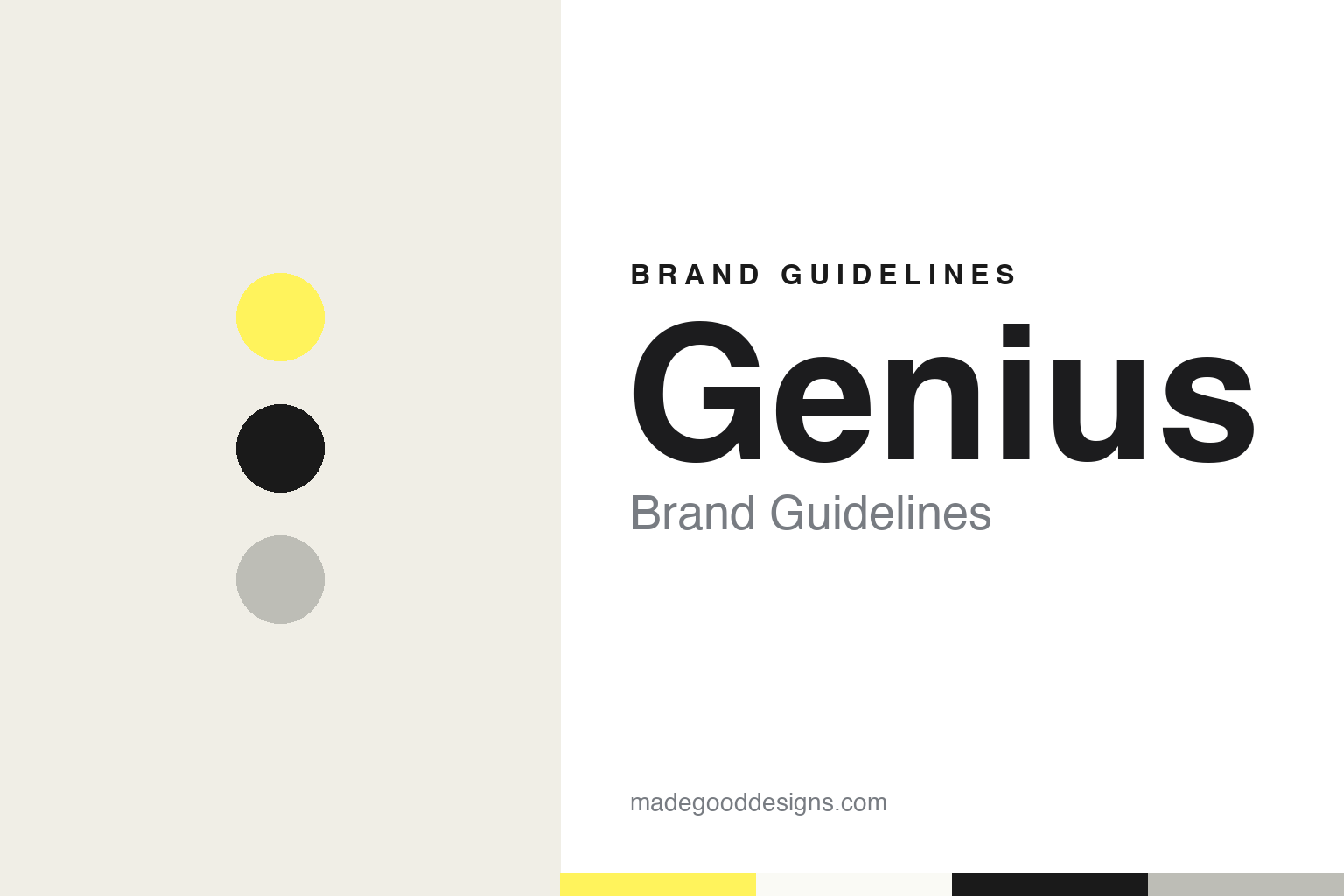
Two constants: a verified yellow, annotation black and margin grey palette and a bold grotesque sans register. Abstract homage — not a Genius asset or mark; no logo, page design, lyric or wordmark is reproduced.
A Cam’ron lyric and a word nobody could spell
Three Yale graduates and a blog about one album, 2009.
Genius started with a single lyric. English-language Wikipedia says the company was founded on 27 August 2009 by Tom Lehman, Ilan Zechory and Mahbod Moghadam, who had met as undergraduates at Yale University. It says the idea came that summer when Lehman asked Moghadam what a line by the rapper Cam’ron meant, and that the founders then left jobs at D.E. Shaw and Google to work on the project full time.
The first name did not last. In a timeline of the company published by VentureBeat on 13 July 2014, Harrison Weber wrote that RapExegesis launched in October 2009 with fewer than ten people annotating rap lyrics, first appearing as a blog that explained Cam’ron’s album Purple Haze, and that it was renamed Rap Genius in December 2009. Wikipedia gives the reason for the change: users found the word “exegesis” hard to spell.
The site’s basic unit was the annotation, a note attached to a specific line of text. VentureBeat records that Rap Genius joined the Y Combinator start-up programme in June 2011. As artists began to take part, the company created verified accounts; Wikipedia names Nas as the first verified artist and lists 50 Cent, RZA and A$AP Rocky among the early arrivals. It also records a visual distinction that became part of the site’s look: annotations by verified artists appear in yellow rather than the standard grey.
Colour
Rock, poetry and news, and then a single word.
The site outgrew its first word in stages. VentureBeat’s timeline dates the launch of Rock Genius, Poetry Genius and News Genius channels to 25 June 2013, and the company’s first iPhone app, already called simply Genius, to 28 January 2014. It records that on 11 July 2014 the company renamed itself Genius and introduced embedded annotations that could be placed on other websites; Wikipedia dates the relaunch to the following day. On 11 July 2014 the investor Ben Horowitz wrote on the Andreessen Horowitz blog that Genius does for everything what Rap Genius did for rap, and that Rap Genius would continue as part of the Genius family. Wikipedia says the founders described the new name as a way to help people see the richness and depth in every line of text.
A visual refresh followed a year later. TechCrunch reported on 4 August 2015, in an article by Jordan Crook, that Genius had launched its first Android app and redesigned its home page and iOS app, bringing a new brand design, a new colour palette and enhanced song pages; Wikipedia connects a redesigned logo to the same period. Wikipedia records that video arrived in 2016 with the Verified series, in which artists decode their own songs on camera, and that live events began in 2017 at the company’s Brooklyn headquarters. Genius lyrics reached other services too: Wikipedia lists a Behind the Lyrics feature on Spotify from 2016, Genius lyrics on Apple Music from October 2018 and an expanded partnership in February 2020 that premiered Verified episodes on Apple Music.
The company has long been a Brooklyn business. Wikipedia says it moved from Williamsburg to Gowanus in 2014. On 27 September 2021 the Los Angeles Business Journal, in a report by Todd Gilchrist, wrote that MediaLab.Ai Inc., a Santa Monica holding company focused on apps and internet media whose properties include Kik, Whisper, Datpiff and Worldstar Hip Hop, had acquired Genius Media Group Inc., confirming the purchase on 16 September 2021. The paper described Genius as a database of transcripts and annotations covering song lyrics, news stories, poetry and other documents, still based in Brooklyn.
Typography
From a lyrics blog to a site that annotates everything.
For a music streaming or discovery service, the app icon does most of the work a logo does elsewhere. It sits on a phone’s home screen among dozens of others, is seen at the size of a fingertip and has to be recognised before it is read, so these marks tend to reduce to a single symbol, a simple shape or a letter on a flat field. Colour carries even more of the load. A single strong hue can identify a service on a lock screen, in a share card, on a web player and in a corner of a festival poster, and many services treat that colour as their main asset, with typography and illustration arranged to support it rather than compete with it. Because the catalogue itself belongs to artists and labels, the brand usually shows up in the frame around the music: the player, the buttons, the empty states and the motion between screens.
Playlist covers are where a streaming identity is tested at scale. Editorial teams publish hundreds or thousands of playlists, so covers are built as templates, with a fixed type treatment, a colour rule and a slot for a photograph or pattern that can change weekly without breaking the family. Year-end recap campaigns stretch the same system into a shareable format, turning a listener’s own data into cards designed to be posted, and short sonic logos do a similar job for sound in adverts and app openings. Services that court musicians also need an artist-facing layer, with dashboards, promotional assets and upload tools that borrow the consumer palette but speak in a plainer, more practical voice.
Aa
Bold grotesque sans — after the direct, editorial register of the Genius site. (Specimen set in Archivo, a grotesque sans STAND-IN; NOT the Genius logo or any Genius lettering.)
Genius
Three names, each one wider than the last.
The Genius name has widened twice. RapExegesis, from October 2009, used a scholarly word for close reading; Rap Genius, from December 2009, kept the genre and replaced the word users struggled to spell; and Genius, from July 2014, dropped the genre altogether as the site spread into rock, poetry and news. In the dated timeline, each rename came after the content had already widened: the Rock, Poetry and News channels were running a year before the name caught up with them, and the first iPhone app carried the single word six months before the website did.
The design devices are tied to the annotation itself. The sourced constant is the difference in colour between ordinary notes and those written by verified artists, which Wikipedia describes as yellow against grey. The embedded annotations of 2014 carried the same device beyond Genius’s own pages, and the Verified video series of 2016 put the idea of an artist explaining a line on camera under the same name. TechCrunch’s 2015 report shows that the brand design and colour palette were reworked alongside the first Android app.
The company behind the name is identified precisely in the 2021 reporting: the Los Angeles Business Journal gave it as Genius Media Group Inc., based in Brooklyn, and described its new owner as a holding company in Santa Monica.
For a design guide, Genius shows how a brand can be built on a single editorial gesture, a note pinned to a line of text, and how one colour can mark out notes written by the artists themselves. Compare Spotify, which carried Genius annotations in its Behind the Lyrics feature, and SoundCloud, another platform built around listeners and artists. For this guide we use verified yellow, annotation black and margin grey with a sans, an unofficial interpretation; no product or logo is reproduced.
Explore & save
Keep Genius’s identity on hand — save it to a board in the Made Good inspiration library.
Genius identity set
Pin the Genius verified yellow, annotation black and margin grey palette and the bold grotesque sans register to your own board.