Chore-Time Brand Guidelines
A feeder built at home in Ohio, a garage in Milford and the first half of CTB.
Aa
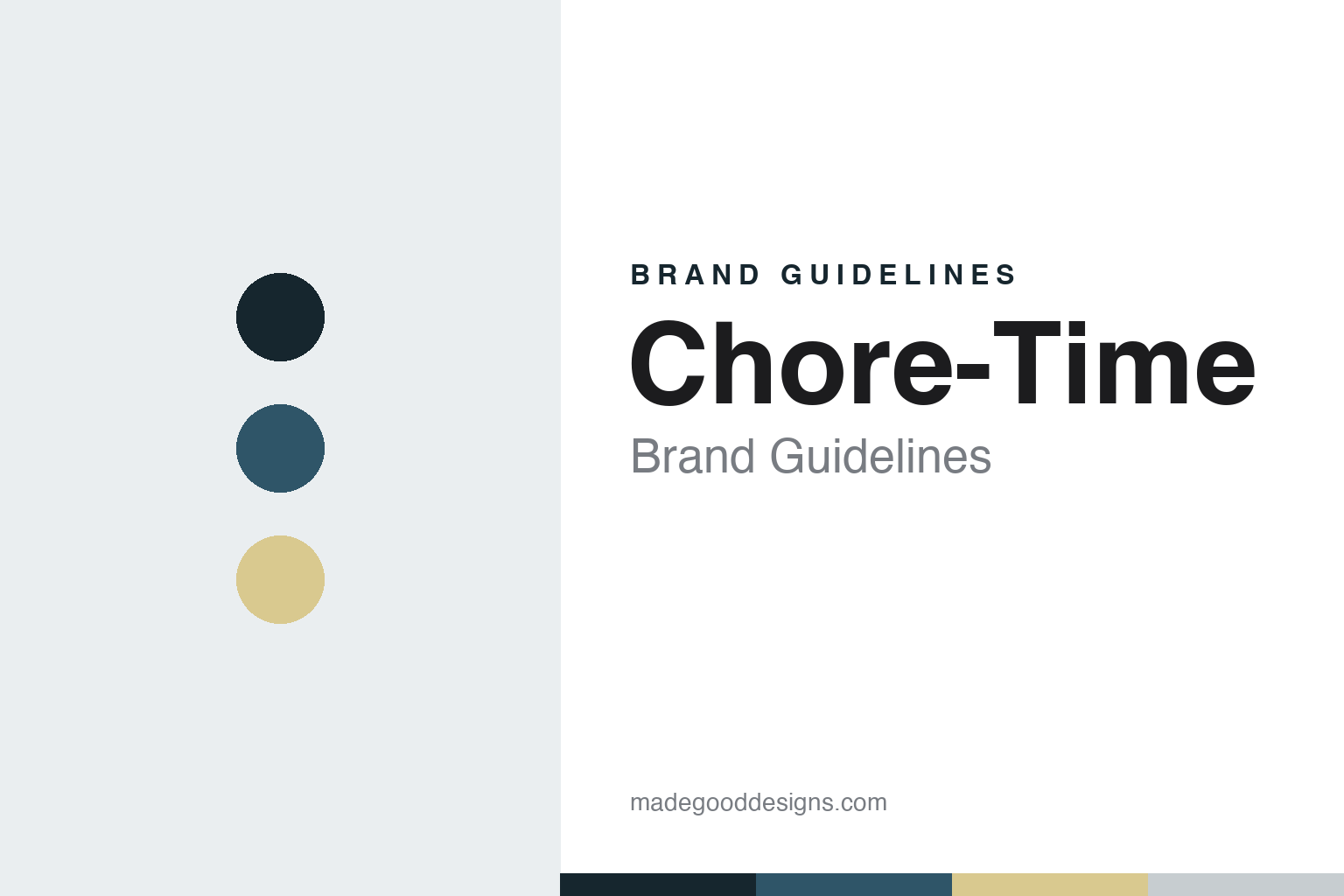
Two constants: a Chore-Time galvanised slate and straw palette and a Condensed catalogue sans register. Abstract homage — not a Chore-Time product or mark; no machine, logo or nameplate is reproduced.
Alliance, Ohio
A feeder built at home.
Chore-Time is an Indiana name with an Ohio start. Its parent, CTB, says Chore-Time Equipment was started in August 1952 in Alliance, Ohio, and moved to Milford, Indiana, in 1954. The founder was Howard S. Brembeck, and the Ohio start is confirmed by Farm and Dairy, which reported in December 2010 that he founded Chore-Time in Alliance to design and build equipment for the care of poultry and livestock.
Brembeck came to the trade through another maker of farm equipment. The International Directory of Company Histories says that during the Depression he took an apprenticeship with Cyclone Manufacturing, an Indiana maker of chicken seed throwers: canvas bags with hand cranks that farmers used to scatter feed around the barnyard. Under the owner, D.E. Speicher, a second cousin, he learned purchasing, design and sales, and by 1944 he was general manager. He then took an executive job with a farm-implement distributor in Alliance.
Eight years later, the directory says, he quit, began working from home on a better chicken feeder and named the business Chore-Time Equipment. He was no newcomer to inventing: Farm and Dairy reported that he held numerous patents, including one for an electric brooder dating back to 1936, and others that improved poultry and hog feeders and livestock waterers.
The move to Indiana was modest. In 1954, the directory says, he rented a run-down garage near Milford to make his product. He was still not satisfied with the feeder. “I still thought there had to be a more efficient way to feed chickens,” he told the Indianapolis Star in August 2000. By the end of the 1950s he had invented a motorised auger that carried feed from the storage bin to the feeder and could go up, down and around corners, and the directory credits that device with setting the business on its path. The same language survives in Chore-Time’s catalogue today: it says its FLEX-AUGER Coreless Auger Feed Delivery System moves feed “up, down, on-the-level, or around corners.”
Colour
Two brands, one set of initials.
The second brand arrived in 1957. Brembeck began making small hopper bins for the bulk storage of feed and formed Brock Manufacturing in Milford to handle them; Farm and Dairy says he founded it with a partner. Brock later moved into farm and commercial grain storage bins.
Europe came next. In 1967, the directory says, Brembeck and another businessman, Forrest Ramser, set up Roxell in Belgium as the European arm of Chore-Time; CTB’s history records its first European office at Maldegem that year. Roxell’s story runs in a loop. It was spun off under separate ownership in 1985, and CTB bought it back in January 1999.
The initials date from 1976, when Brembeck restructured his businesses and merged Chore-Time and Brock into CTB Inc. CTB describes the name as an acronym for its two principal brands at the time. The trade names stayed, and the two were sold abroad together from 1983 through Chore-Time Brock International; “Chore-Time Brock” was still the name on the company’s announcements in Farm and Dairy in 2010.
Ownership then moved quickly. The directory says Brembeck’s grandson, Chris Chocola, joined in 1988 and became chief executive in March 1994, and that Brembeck retired in 1995. Early in 1996 American Securities Capital Partners, a New York private investment firm, came in: the directory says it acquired the company, with the family keeping a minority stake, while CTB’s own history calls it a partnership that formed CTB International Corp. The company went public on Nasdaq in August 1997, the same year it bought the Dutch controls maker Fancom and the grain bin division of Butler Manufacturing. Sibley Industries and Staco followed in 1998.
The listed period was short. English Wikipedia says CTB International signed a merger agreement with Berkshire Hathaway on 19 August 2002, and that the deal closed on 31 October; CTB’s history confirms it became a wholly owned subsidiary that year. Later deals recorded by CTB include the Dutch machinery maker Meyn in 2012 and a controlling interest in M-Tech International, trading as Cat Squared, in 2018.
Typography
How farm technology makers present themselves.
Farm technology makers sell to a small, expert audience, and they tend to show the machine at work rather than on a plinth. A milking robot is photographed in a working barn with a calm herd around it, often under the cool blue light of a modern parlour. A feed robot, usually in clean red and white, glides along a barn aisle with no driver in sight. The pictures make one argument again and again: the work carries on while the farmer is elsewhere.
Poultry and hatchery equipment has a different geometry. Long feed lines and drinker lines run down the length of a house to a vanishing point, and hatchery trays stack into tall, regular grids. These are images of repetition, and they suit a trade in which a single building holds a very long run of identical equipment. Irrigation goes the other way, from inside to overhead: drip lines are shown from the air, running through green rows in thin, straight strokes.
The trade meets face to face at a handful of fairs. EuroTier and Agritechnica in Hanover, World Dairy Expo in Madison, Wisconsin, and the VIV shows for the poultry and livestock industries are where new ranges appear, and some of the awards these companies quote come from such events.
Many of these names are old, and many have changed hands. Family firms, industrial groups and investment companies all appear in this guide, and a founder’s surname often outlives the founder’s company. This guide sets out what can be checked about each brand: who started it, who owns it now, and what it says about where its products are made.
Aa
A condensed sans — the register of a parts catalogue. (Specimen set in Barlow Condensed, a sans STAND-IN; NOT the Chore-Time logo.)
Chore-Time
Every. Day. PERFORMANCE.
Today Chore-Time is not a separate company. Its website calls it a division of CTB, Inc., with its headquarters in Milford, and says CTB has been part of Berkshire Hathaway since 2002. CTB lists it among more than a dozen brands, from Brock and Fancom to Roxell and Meyn, and its About page opens with a line it attributes to Warren Buffett: “You’re helping to feed the world, and nothing is more important than that.”
The range is laid out by bird. Chore-Time’s website sorts its products into broilers, breeders, turkeys and egg production, and within those into feeding, drinking, climate control and, for breeders, nesting systems. The names are a brand signature of their own, set in capitals and carrying trademark signs: FLEX-AUGER, KONAVI, CHORE-TRONICS and TURBO-Cool are four among many. The slogan on the site is “Every. Day. PERFORMANCE.” and one line in its product menu reads “Sometimes Copied…Never Duplicated.” The company says it sells through a network of independent distributors, who install its products.
On manufacturing, Chore-Time says “in-house production of our systems helps us safeguard the quality and integrity of our proprietary designs.” A press release carried by News Now Warsaw on 12 June 2026, says a groundbreaking was held on 10 June for 79,000 square feet of new manufacturing space at Milford, joining an office and factory that date to the company’s early years. Tina Streit, vice president and general manager, attributed the expansion to growth, demand and distributor partnerships, and the release expects it to be operational in the first quarter of 2027. CTB’s history also records a European logistics centre, Chore-Time Europe B.V., set up in 2002 with locations in the Netherlands and Poland.
The town has stayed the same for more than seventy years. Chore-Time has been in Milford since 1954, through family ownership, private investors, a stock listing and Berkshire Hathaway, and the name Brembeck chose in Ohio is still on the products.
For a design guide, Chore-Time shows how a plain, descriptive name can outlast four kinds of ownership. Compare Big Dutchman, the feeder name that began in Michigan and moved to Germany, and Vencomatic, another poultry equipment name. For this guide we use a galvanised slate and a straw yellow with a sans, an unofficial interpretation; no product or logo is reproduced.
Explore & save
Keep Chore-Time’s identity on hand — save it to a board in the Made Good inspiration library.
Chore-Time identity set
Pin the Chore-Time galvanised slate and straw palette and the Condensed catalogue sans register to your own board.