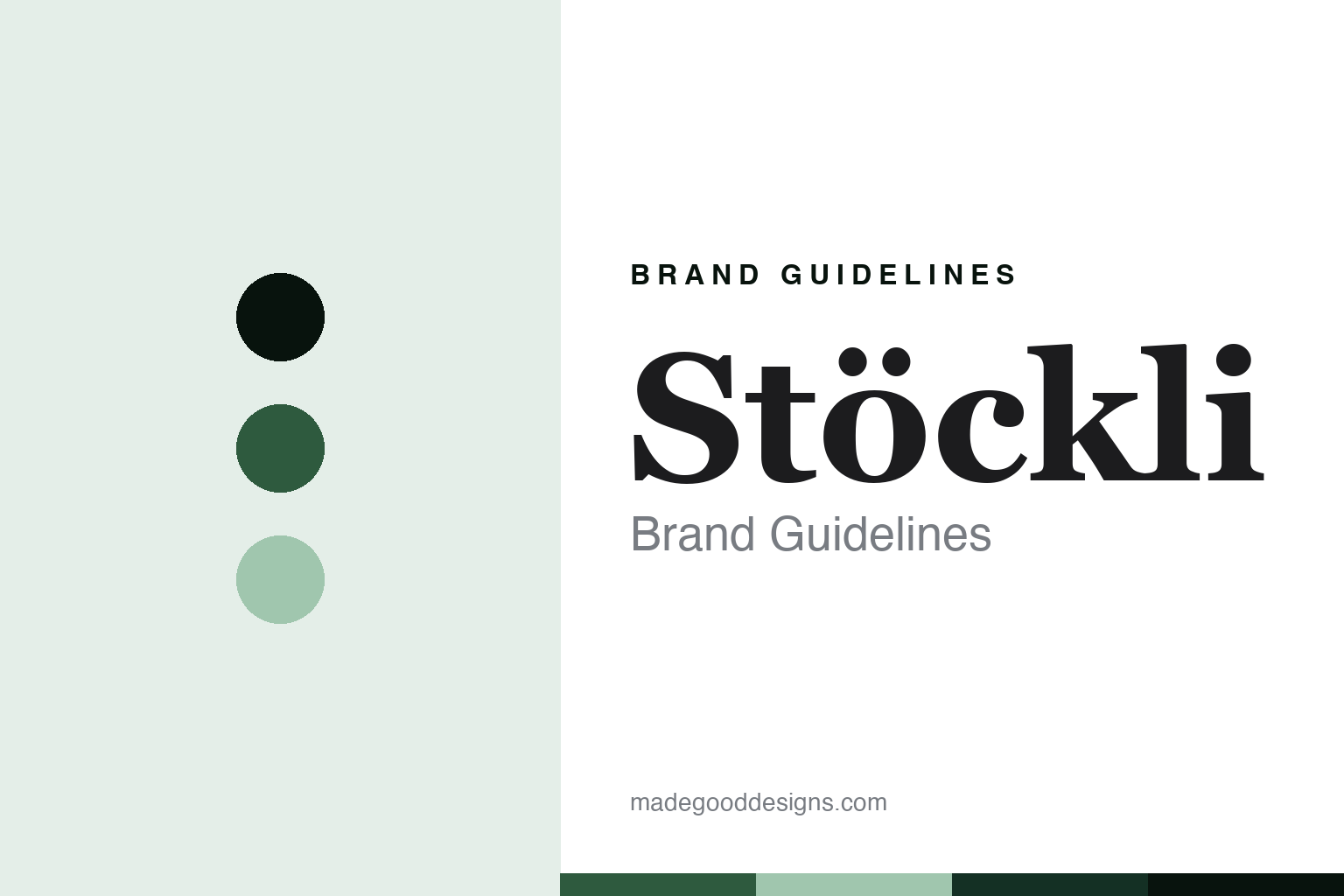
Stöckli Brand Guidelines
Switzerland’s last ski factory.
Aa
Two constants: an alpine-green palette and a handcraft-serif register. Abstract homage — not a Stöckli product or mark.
Switzerland’s last ski factory
Stöckli is the Swiss ski house of 1935 — premium skis handmade in Malters, the only ski factory left in Switzerland.
Stöckli follows Völkl as the Swiss handcraft house — the premium maker that hand-builds every ski in Malters and is, by its own account, the only ski factory remaining in Switzerland. Stöckli makes premium alpine skis, and its answer to a round about ski makers is the round’s rarest made-at-home story: over a hundred and forty hand steps, all in one Swiss plant. A ski, handmade in Switzerland.
Its identity is Switzerland’s last ski factory. Stöckli’s Malters handcraft, its family heritage and its Swiss making are the story here. A ski, from Lucerne. Switzerland’s last ski factory.
(Honest notes, so the story stays precise. Stöckli — at stoeckli.ch — makes premium alpine skis across piste, all-mountain, freeride, touring and race, with ranges such as the Laser, Montero and Stormrider. It was founded in 1935 by Josef Stöckli, who made his first skis from ash wood in his parents’ workshop in Wolhusen; the factory has been in Malters, in the Lucerne region, since 1986. On where it is made — the theme of this round — Stöckli manufactures entirely in Switzerland, at Malters, with over a hundred and forty manual steps per ski, around eighty thousand pairs a year, under the tagline “Handmade – Swiss Made”; it describes itself as the only remaining ski factory in Switzerland, a genuinely rare made-entirely-at-home story. On ownership, it is an independent Swiss company, Stöckli Swiss Sports AG; the claim that it remains family-owned is widely reported, so we frame it as reported. The World Cup racer Marco Odermatt races on Stöckli. Its marks are IP we describe but do not reproduce, and there is no official brand hex; these tones are an unofficial interpretation, and we render no Swiss cross. This is design commentary and does not promote any product.)
Colour
Stöckli lives in an alpine green. Click a swatch to copy the hex.
Stöckli’s identity is handcrafted, premium and Swiss — an alpine green, an ink, a pine, a deep green, and a paper. The palette leans alpine green and pine: a Swiss mountain register that nods to Lucerne forests and high country rather than a loud race palette. It signals a handcraft house that makes entirely at home. The honest caveat: with no published brand hex, these values are an original, unofficial interpretation, not first-party colours.
The lesson is an alpine green signals a handcrafted, Swiss identity. Stöckli’s world is a handcrafted, premium object. For designers, it is a reminder that a deep alpine green and a soft pine can carry a ski maker — the tone of a Swiss mountain. Because these tones can fail as small text, keep type dark and let the colour live in the accents, palette and band. The takeaways: hand-build at home; make the whole ski in-house; keep it independent; and treat any single hex as unofficial.
Typography
The register is a handcraft serif — fine, patient, Swiss.
Stöckli’s identity carries a fine, patient, Swiss spirit — a handcraft house, not a fashion. A handcraft serif captures the mood: precise, elegant and unhurried, the register of a ski built by hand over a hundred and forty steps. Set in an alpine-green palette, the handcraft serif feels fine and patient — exactly the personality Stöckli carries. It is craft rather than a logo, mirroring a wood core and a hand-finished base. (Stöckli’s real wordmark is something we describe but do not reproduce, and the exact typeface is not ours to use.) Because it is not ours to use, the honest description is “a handcraft-serif spirit,” shown here in a stand-in. The type behaves like the ski: fine, patient and Swiss.
Aa
A handcraft-serif spirit — fine and patient. (Specimen set in Cormorant Garamond, a handcraft-serif STAND-IN; NOT the Stöckli logo.)
The ski makers
Stöckli stands for Switzerland’s last ski factory.
Stöckli follows Völkl as the Swiss handcraft house. An alpine-green palette, a handcraft serif and a handmade ski make one thing — Switzerland’s last ski factory — the whole identity: handcrafted, premium and Swiss. The Malters plant is the differentiator, and the all-in-house making is the meaning. The point is a house from 1935 that hand-builds every ski in Switzerland when almost no one else does.
Put to work, the identity is a rare made-at-home craft told straight, as design. A maker in this spirit would hand-build the whole ski at home and keep the company independent, while framing the family claim honestly. A reader in this spirit would keep the facts right: it was founded in 1935 by Josef Stöckli; it makes entirely in Malters, Switzerland, over a hundred and forty hand steps per ski; it calls itself the only ski factory left in Switzerland; and it is an independent Swiss company, family-owned as reported. Stöckli sits at the far end of the round’s where-made thread — the most completely made-at-home of the seven — a Swiss counterpoint to the group-owned giants and the reported-Europe brands. The honest editorial moves are to credit Josef Stöckli, to state the all-Swiss making with confidence, to frame family ownership as reported, and to render no Swiss cross. The lesson Stöckli teaches is that making the whole thing at home, by hand, can be the entire identity: the factory and the handcraft are the brand.
For designers and brand-builders, Stöckli continues the ski makers: hand-build the whole thing — at home. The lessons: keep every step in-house; make domestically when others offshore; stay independent; frame an ownership claim as reported when it is; and never reproduce a logo or a flag. It is also a reminder to stay precise: Stöckli is the Swiss ski house of 1935, premium skis handmade in Malters, the only ski factory left in Switzerland — with the palette here an unofficial interpretation. Read that way, Stöckli is less a ski than a survival: the last Swiss ski factory, hand-building what a whole country once made. The lesson for a brand is that being the last to make something at home, by hand, is among the rarest identities there is — and stating it plainly, without borrowing the flag, is enough. Stöckli made Switzerland’s-last-ski-factory the identity — proof that handcraft at home can be the whole of a brand.
Explore & save
Keep Stöckli’s identity on hand — save it to a board in the Made Good inspiration library.
Stöckli identity set
Pin the alpine-green palette and the handcraft-serif register to your own board.