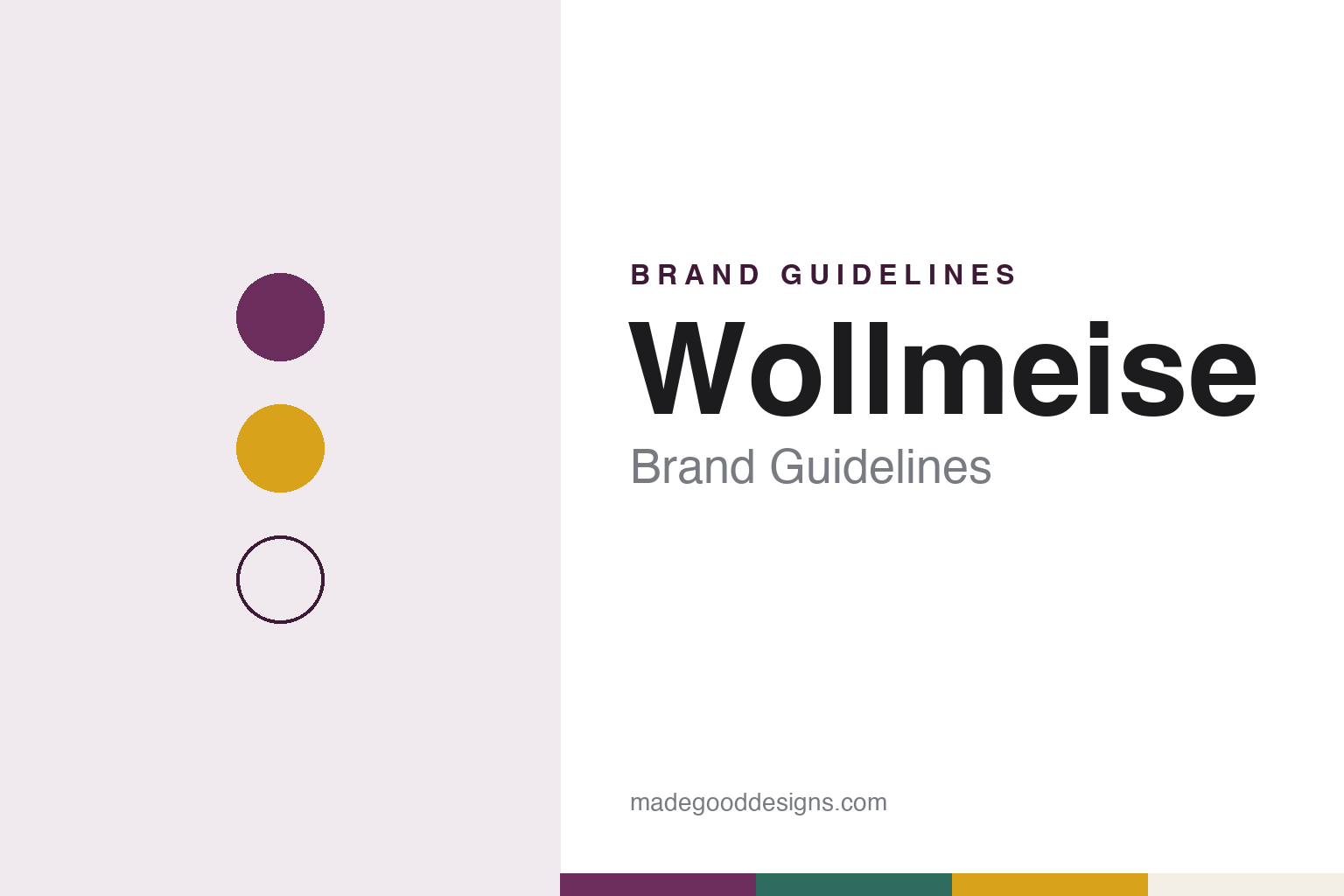
Wollmeise Brand Guidelines
The Bavarian hand-dyer named after a “wool tit.”
Aa
Two constants: a violet, gold and teal palette and a warm display serif register. Abstract homage — not a Wollmeise product or mark; no skein, label or logo is reproduced.
Rohrspatz & Wollmeise
A knitter, a metalworker and a pair of birds.
Wollmeise is not a company name but a nickname. The yarn is sold by Rohrspatz & Wollmeise GmbH of Pfaffenhofen an der Ilm, a Bavarian town north of Munich, and the company says that behind the name stand two people: Claudia Höll-Wellmann, “die Wollmeise,” and Andreas Wellmann, “der Rohrspatz.” It says they have run a joint business since 2002, one inspired by Claudia’s love of wool and Andreas’s enthusiasm for metalwork. The Internet Archive holds copies of the company’s website from December 2002 onward, which fits that date.
The names are bird puns. A Meise is a tit, so a Wollmeise is a “wool tit”; a Rohrspatz is literally a reed sparrow, and in German someone who “schimpft wie ein Rohrspatz” is swearing like a trooper. The 2007 version of the website, in German and English, introduced “the wool tit (lat. Parus lana or Wollmeise)” and explained that Claudia “became” the Wollmeise when the company was founded in 2002. The firm’s name, it said, joined “the beautiful pieces in steel by Rohrspatz and the woolly ideas of the wool tit.” In those years the site advertised garden ironwork — rose arches, plant supports, pavilions and fence panels — alongside the yarn.
The same page told the origin story in the first person. Claudia described herself as a knitter before she was a dyer: her stock of yarn, “even though … enormous,” never had the exact shade she wanted, so she began dyeing her own. She wrote of experimenting for a long time to get “the velvet bluish lilac of violets and not only the ordinary lilac,” of colours that simply happened, like Rhubarb, and of colours that were “a feeling or an imagination” — nobody, she noted, has ever seen dragon’s blood. She also wrote that she wanted to carry out every production step herself. We give all of this as the company’s own account; we found no independent profile of the business in the sources we could check.
Colour
Weekly updates, hundreds of colours.
Wollmeise’s identity is built on colour. The company says it has developed more than 300 colours, with names drawn from nature, moods and its founders’ ideas; its website cites “Spice Market” and “Gewitterhimmel” — thunderstorm sky — as examples. It sells them on a small set of undyed bases, which it calls Pure, Twin, DK, Lace, Blend and Sport, and it says each skein weighs at least 150 grams, heavier than the 50- or 100-gram balls of most mill brands. It describes its DK as a six-ply merino of 19 microns, and its Twin as a “twin” of its superwash sock yarn.
The way the yarn is sold is part of the brand. The company’s FAQ says there is an “Update” every Friday, announced in advance by newsletter and on social media, and its online news page is largely a numbered series of those updates. It says it cannot take pre-orders, because the waiting time would run to several months, and does not take orders by telephone or email. In other words, the yarn appears in batches and buyers come to it, rather than the other way round.
Hand-dyeing also sets the brand’s caveats. The company warns that every skein differs slightly from the others, even when dyed together; that an exact re-dye of a colour is not possible; and that knitters working on a large piece should alternate between two skeins to avoid stripes. Skeins that fall short of its standards — a colour that did not turn out as intended, a knot, a tangle — are sold as “NIPs,” short for “Nobody Is Perfect,” and only in its shop, at fairs and at special sales, it says.
It also has a physical shop in Pfaffenhofen, which it describes as a meeting place with sofas where knitters may hold their knitting groups on Fridays and Saturdays, and which it says stocks colours no longer available online.
Typography
Hand-dyers and the yarn trade.
The seven brands in this group all sell yarn for hand knitting and crochet, and they come from seven countries: Stylecraft from the United Kingdom, Araucania from Chile, Tukuwool from Finland, Cardiff Cashmere from Italy, Wollmeise from Germany, Blue Sky Fibers from the United States and Biggan Design from Australia. What separates them most is not the shape of a ball or the length of a colour card but the question every knitter eventually asks: where does the fibre come from?
Yarn brands answer that question in very different ways. Some tie their identity to the sheep of one country or even one local breed, and put the farm and the flock at the centre of the story. Some build a name on a single luxury fibre such as cashmere, where sourcing and finishing matter as much as colour. Some are defined by the dye pot, turning bought-in yarn into one-of-a-kind hand-dyed skeins, while others make affordable acrylic in large volumes, for knitters who want bright colour, easy washing and a low price.
Each guide separates what independent sources record from what the company says about itself — who founded it, who owns it now, where its fibre is grown and where its yarn is spun — and marks plainly what rests only on the company’s own word.
Aa
A warm display serif for a playful, colour-led brand. (Specimen set in DM Serif Display, a serif STAND-IN; NOT the Wollmeise logo.)
Wollmeise
Dyed in Pfaffenhofen, spun elsewhere.
The company presents its yarn as “Handgefärbt – Made in Germany” — hand-dyed, made in Germany. What that covers is the dyeing. A 2026 job advertisement on its website seeks a production worker for its dye house in Pfaffenhofen, to help “from preparation through the dyeing process to quality control,” which supports the claim that the colour is applied there. The yarn itself is not spun in-house. In its FAQ the company says that, as “a small hand-dyeing business,” it buys its wool through a spinning mill, has only limited influence on the purchasing policy of the spinning group, and that the mill in turn relies on statements from the wool exchanges in Australia and New Zealand; for that reason, it says, it opposes mulesing but cannot guarantee that no such wool is used. It does not name the mill or say where the spinning takes place, and we could not establish either.
The business has stayed in the family. The company says that after 20 years and more than 300 colours the founders handed over to their son Tobias, who has run it since January 2023; its legal notice names Tobias Wellmann as the managing director of Rohrspatz und Wollmeise GmbH, registered at the district court in Ingolstadt. We found no record of outside investors or of a sale.
One practical note for anyone looking the brand up: the obvious web addresses are not the company’s. In 2013 the Internet Archive recorded wollmeise.com as a parked domain offered for sale, and in October 2026 it showed only a hosting company’s “domain reserved” page; wollmeise.de showed a blank placeholder. The brand trades from rohrspatzundwollmeise.de, under the double name.
For a design guide, Wollmeise shows how a hand-dyer can make colour names, scarcity and a weekly ritual into its identity. Compare Hedgehog Fibres, the Cork hand-dyer, and madelinetosh, the Texan one. For this guide we use a violet plum, a rhubarb gold and a storm teal with a serif, an unofficial interpretation; no product or logo is reproduced.
Explore & save
Keep Wollmeise’s identity on hand — save it to a board in the Made Good inspiration library.
Wollmeise identity set
Pin the Wollmeise violet, gold and teal palette and the warm display serif register to your own board.