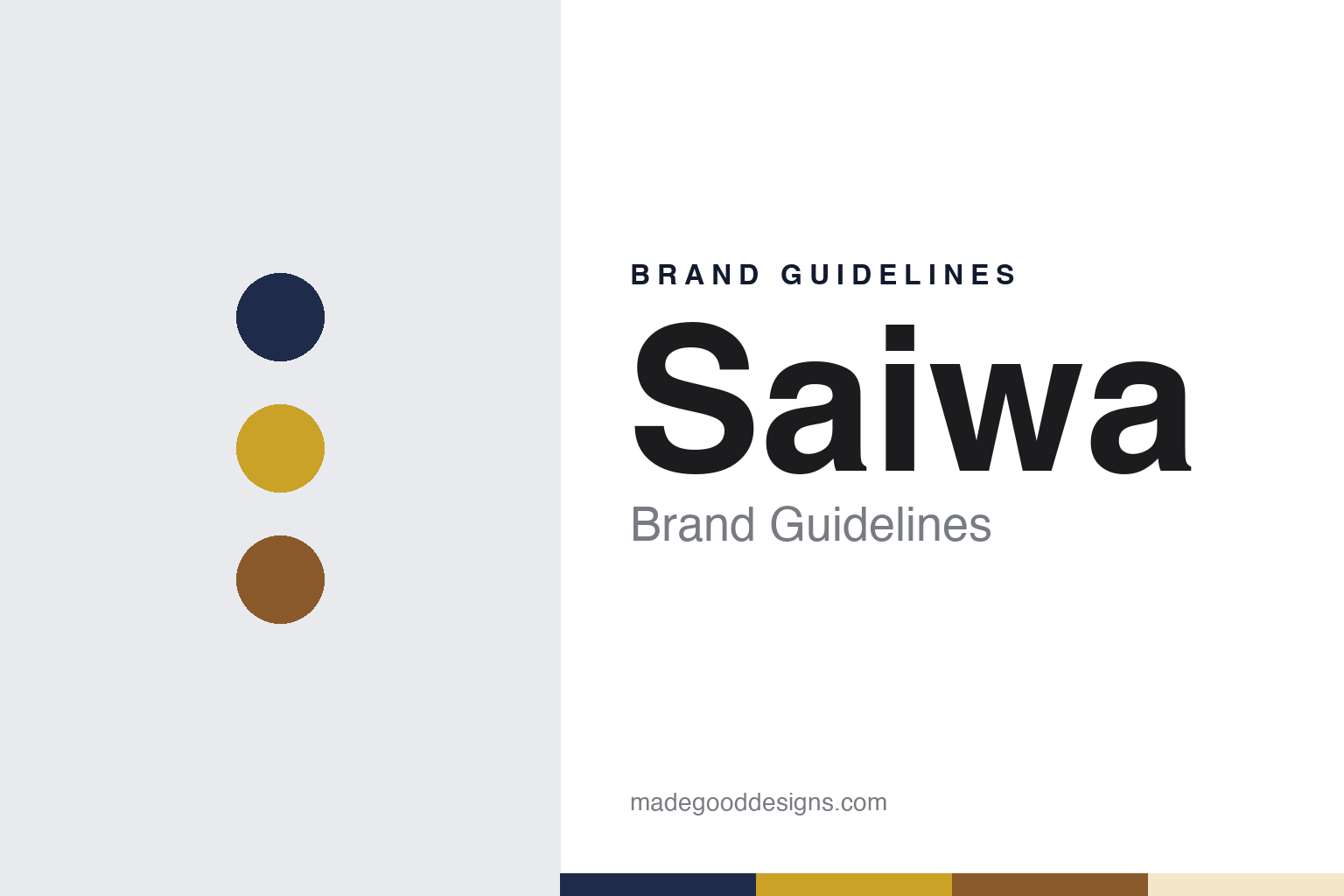
Saiwa Brand Guidelines
The Genoa wafer maker behind Oro Saiwa.
Aa
Two constants: a Saiwa harbour-navy, gold and baked-brown palette and a Genoese biscuit-tin serif register. Abstract homage — not a Saiwa product or mark; no pack, tin, logo or photograph is reproduced.
From via Galata to S.A.I.W.A.
A pastry shop, an English wafer and an acronym.
Saiwa began as a pastry shop in Genoa. In 1900, the historian Lara Piccardo wrote in a 2010 company history for the archive Storiaindustria.it, Pietro Marchese opened a shop in via Galata to make a sweet he had discovered on a trip to Britain: the sugar wafer. Italian Wikipedia gives the same account, and the brand’s own website today opens its timeline with the via Galata shop and Marchese’s wafers. Piccardo describes an Italian market in which sweets were still made for special occasions and biscuits were largely an English preserve; the Genoa shop grew slowly, kept growing through the First World War and, she writes, became one of Italy’s first industrial producers of baked goods.
The name came two decades later. Piccardo says the business moved its registered seat to Corso Giulio Cesare — renamed Corso Gastaldi in 1945 — in 1920, and on 20 December 1922 was registered as S.A.I.W.A., short for Società Accomandita Industria Wafer e Affini, a limited partnership for wafers and related products. She notes that acronym names were a habit of Italian firms from the late nineteenth century, a way of signalling industrial modernity, and that the name was, according to some, coined by the poet Gabriele D’Annunzio; the company’s website, more cautiously, counts D’Annunzio among the shop’s illustrious admirers. Piccardo says the company became a joint-stock company in August 1925.
Between the wars Saiwa grew into a national name. Piccardo writes that it was granted a royal warrant by the House of Savoy, entitling it to raise the royal arms over its factory sign, and that its stationery, postcards, press advertising and tins displayed two crests: the royal arms and that of D’Annunzio as Prince of Montenevoso. When the Fascist regime required foreign-sounding names to be Italianised, she says, the firm had to call itself Saiva, and on the eve of the Second World War it had become Italy’s leading confectionery manufacturer.
Colour
Three foreign owners and a factory in Piedmont.
The war interrupted everything. Piccardo writes that Saiwa’s plants were destroyed on 22–23 October 1942 in the British Bomber Command’s autumn air offensive and that production resumed only after the conflict, when the company returned to its D’Annunzian name. In rebuilding, it installed new ovens and its first packaging machines, making it, in her words, one of the first firms in Italy to pack and distribute biscuits that had until then been sold loose or in tins. From the 1950s, she says, biscuits became an everyday breakfast alternative to bread, and industrial production brought prices within everyone’s reach.
Ownership then left Genoa. In 1965, Piccardo and Italian Wikipedia both say, Saiwa joined the American group Nabisco; a new plant at Locate di Triulzi, near Milan, was built from 1966 and opened in 1969. In 1985 the company built a new production unit at Capriata d’Orba, in the province of Alessandria, and moved Oro Saiwa production there; Italian Wikipedia says it replaced the old Corso Gastaldi factory in Genoa, by then obsolete and hemmed in by housing. In 1989, Piccardo writes, the French group Compagnie Gervais Danone bought Nabisco’s European biscuit companies, Saiwa among them. Italian Wikipedia says Locate di Triulzi was closed between 2001 and 2004 as part of a rationalisation of European biscuit production, while Capriata d’Orba was enlarged.
In 2007 Danone sold its whole European biscuit business, Saiwa included, to Kraft Foods — the same deal that brought France’s LU to the American group. Piccardo says Saiwa then began making and selling Oreo, and Italian Wikipedia says the Nabisco cookie had never before been available in Italy. When Kraft Foods Inc. split its businesses in 2012, the snacks side was renamed Mondelez International, and Italian Wikipedia now describes Saiwa S.r.l. as controlled by Mondelez. The last link with the founding city went in 2016: Genova24 reported that September that Saiwa’s Genoa administrative offices, with 24 staff, would close at the end of October, two employees moving to Milan. The brand’s website says Oro Saiwa is made today at the Capriata d’Orba plant, under Mondelez Italia, and Italian Wikipedia describes it as Saiwa’s only current factory.
Typography
Seven biscuit brands, one country.
The seven brands in this group all make biscuits, and all of them come from Italy: Pavesi, Doria, Galbusera, Gentilini, Colussi, Misura and Saiwa. Italian biscuit brands in general sit at many different points in the trade, from family firms that still carry a founder’s surname to names that now belong to much larger food groups, and a single brand can be sold everywhere from a corner bar to a supermarket shelf.
A biscuit brand’s identity is usually carried less by a single product than by a pack, a name and the breakfast or snack it promises, because the company behind the name may have changed hands, moved its factory or grown far beyond the town where it started. That makes the questions behind each name worth asking plainly: who started it, who owns it now, and where its biscuits are actually baked and packed.
Each guide separates what independent sources record from what the company says about itself — its founding story, its owners over time, where its biscuits are made and how its packaging has changed — and marks plainly what rests only on the company’s own word.
Aa
A Genoese biscuit-tin serif — wafers, royal crests and a gold word on the box. (Specimen set in DM Serif Display, a serif STAND-IN; NOT the Saiwa logo.)
Saiwa
Tins first, then a biscuit called gold.
Saiwa’s packaging history starts with metal. Piccardo writes that, after taking its acronym name, the company paid close attention to packaging, introducing a series of large tins for selling loose biscuits — known as bidoni for their size — and that from October 1934 it made its own tinplate packaging. The company’s website today describes the early S.A.I.W.A. as a pioneer in Italy in selling packaged biscuits.
Its best-known product is a plain biscuit. The brand’s website says the Oro Saiwa mark was born in 1956 and became famous for bringing pastry-shop quality to the supermarket; Piccardo wrote in 2010 that it was still the best-selling biscuit in Italy. In the 1990s, the website says, the line moved into snacks with Oro Ciok, a biscuit joined to a bar of chocolate, which it calls one of the first and best-known single-portion biscuit snacks on the Italian market, and it now sells Oro Ciok and Oro Vitasnella alongside the original. Italian Wikipedia dates the first Oro Saiwa advertising campaigns to the early 1980s, with the line “Sono d’oro i biscotti della Saiwa” — Saiwa’s biscuits are golden. The website says Oro Saiwa, Oro Ciok and Oro Vitasnella now carry a renewed visual identity and communication.
For a design guide, Saiwa shows how a name built on an English wafer, an acronym and a royal crest became, under three foreign owners, a brand carried by one word: gold. Compare LU, the French biscuit maker that followed the same path from Danone to Kraft and Mondelez, and Mulino Bianco, the Barilla brand that Piccardo names as Saiwa’s powerful new rival from 1975. For this guide we use harbour navy, gold and baked brown with a serif, an unofficial interpretation; no product or logo is reproduced.
Explore & save
Keep Saiwa’s identity on hand — save it to a board in the Made Good inspiration library.
Saiwa identity set
Pin the Saiwa harbour-navy, gold and baked-brown palette and the Genoese biscuit-tin serif register to your own board.