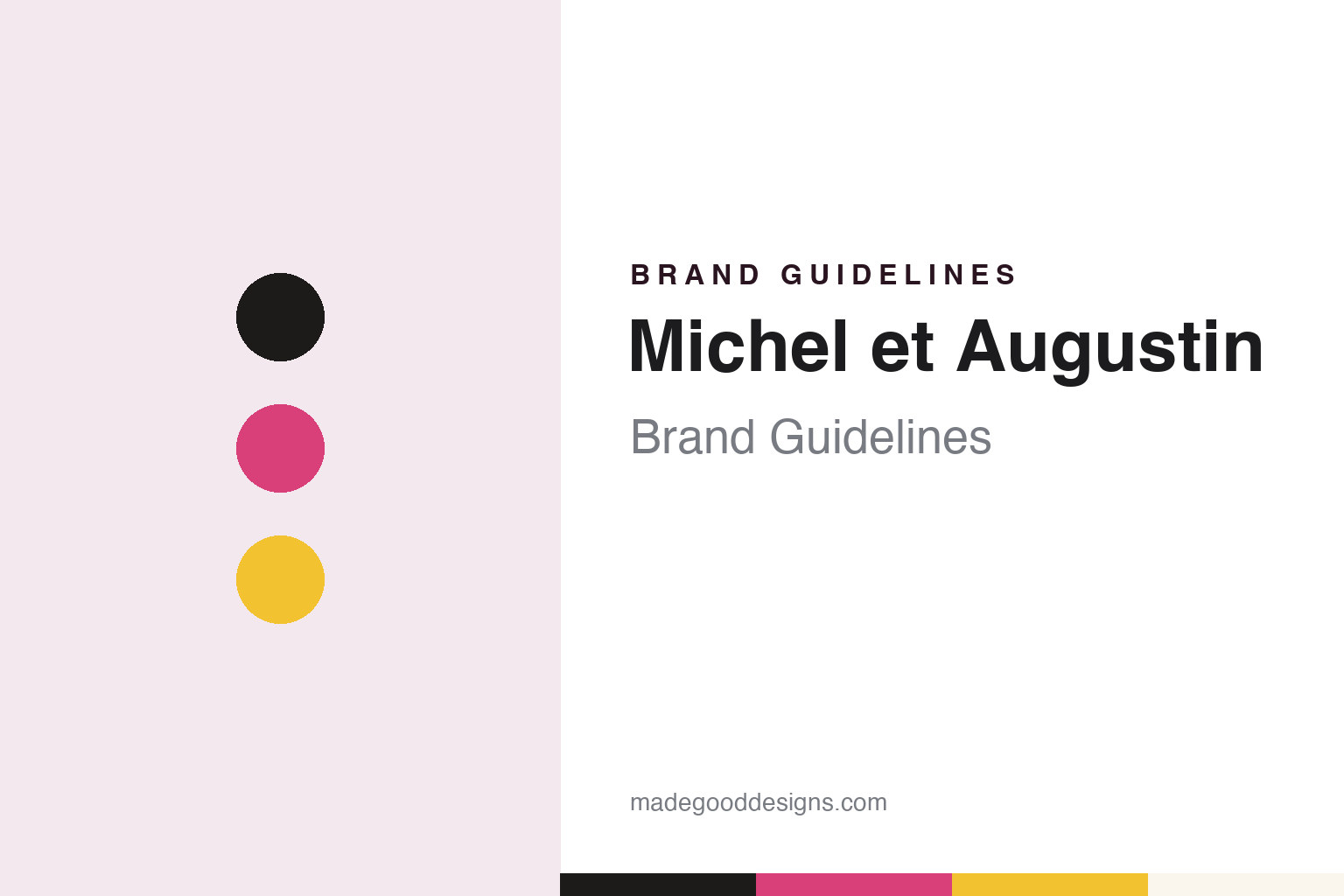
Michel et Augustin Brand Guidelines
Two school friends, a round sablé and a banana tree.
Aa
Two constants: a Michel et Augustin pen-black, pink and banana-yellow palette and a handwritten kitchen-note register. Abstract homage — not a Michel et Augustin product or mark; no pack, biscuit, logo or photograph is reproduced.
From a kitchen to a biscuiterie
Round sablés, baked on borrowed ovens.
Michel et Augustin is a French food brand named after its two founders, Michel de Rovira and Augustin Paluel-Marmont. French Wikipedia says the pair have known each other since school, where they studied together at the Jesuit lycée Saint-Louis de Gonzague-Franklin in Paris’s 16th arrondissement, and that both went on to the business school ESCP; before launching the brand, it says, Augustin took a CAP in baking and Michel a CAP in pastry, the French vocational diplomas for the trades. French Wikipedia records the company’s creation on 26 October 2004 and says the two began with small sablés at the end of that year. QDE, a French business site, reported in May 2026 that the first round sablés came out of Augustin’s kitchen in Paris’s 17th arrondissement in October 2004, and that the venture was financed by the two founders and some forty investors close to them.
The company tells the early story in detail on its own website. It says the kitchen soon became too small, that a baker friend, Arnaud Delmontel, lent them his bakehouse on the rue des Martyrs, that production then moved to another friend’s bakery near Bastille, and that the team later rented an artisanal biscuit factory about two hours from Paris for weekend runs, bagging and heat-sealing the biscuits by hand. It dates its first customer to 8 January 2005, a neighbourhood grocer, and says the founders went door to door in Paris before reaching shops such as La Grande Épicerie and the supermarket chains Monoprix and Carrefour; Michel de Rovira gave January 2005 as the brand’s creation date in a 2015 interview with L’Usine Nouvelle.
The range spread well beyond biscuits. French Wikipedia lists drinking yoghurts from 2006, frozen yoghurts in 2007, aperitif biscuits in 2009, chilled desserts in 2010 and fruit juices and lemonades in 2014, and says the founders acknowledged taking inspiration from the spirit of Ben & Jerry’s, citing Le Monde in 2013. The company says every member of staff takes the CAP in pastry, whatever their job, and Michel de Rovira told L’Usine Nouvelle in 2015 that this was the aim for all employees.
Colour
Four owners in twenty years, and no factory of its own.
Outside money arrived early. French Wikipedia, citing Le Monde of 9 July 2013, says Artémis, the holding company of the Pinault family, acquired 70 per cent of the capital in 2013 to develop the brand abroad; Michel de Rovira told L’Usine Nouvelle in 2015 that Artémis came with a €12 million investment plan. In June 2016 Danone’s investment arm, Danone Manifesto Ventures, took a stake that Le Monde put at 40 per cent and the company’s own timeline puts at 30 per cent; we give both figures. French Wikipedia, citing BFM Business, says Danone raised its holding to 95 per cent on 1 April 2019, and QDE reported that it bought the founders’ remaining 5 per cent in 2020.
Danone then let the brand go. L’Usine Nouvelle reported on 6 December 2023 that Danone had entered exclusive negotiations to sell Michel et Augustin to Ferrero. According to QDE, the buyer was CTH Invest, the Belgian holding company of the Ferrero family, which completed the purchase from Danone at the end of 2024, with Michel et Augustin officially joining the group on 1 March 2025; the price was not disclosed. CTH Invest is also the owner of the Brussels biscuit maker Delacre. QDE also reported that both founders had left the business by then, Augustin Paluel-Marmont in 2020.
The products are made by other companies’ factories. Michel de Rovira told L’Usine Nouvelle in 2015 that the company owned no factories and worked with about ten manufacturers, which it kept confidential, operating some fifteen plants; most were in France, with three exceptions in Portugal, the Netherlands and Spain for particular skills, and he said 90 per cent of its products were made in France. French Wikipedia adds Italy to that list of countries. He said its oldest partners had worked with it since 2009 and that recipes were developed by a team of product managers at head office with pastry chefs and bakers. French Wikipedia says the US subsidiary, based in Brooklyn, launched a croissant-chip range in 2020 that was the brand’s first recipe made outside Europe.
Typography
Seven biscuit brands, one country.
The seven brands in this group all sell biscuits, and they all come from one country, France: Bonne Maman, Gavottes, La Mère Poulard, Fossier, Traou Mad, La Trinitaine and Michel et Augustin. French biscuits in general sit at many different points in the trade, from the packet on a supermarket shelf to the tin sold in a regional shop or a town’s own bakery, and a single company can work at both ends at once.
A biscuit brand’s identity is usually carried by a recipe, a packet and a place, because the name on the front often points to a town, a region or a person even when the biscuit inside is made somewhere else, by someone else. That makes the questions behind each name worth asking plainly: who started it, who owns it now, and where its biscuits are actually baked and packed.
Each guide separates what independent sources record from what the company says about itself — its founding story, its owners over time, where its biscuits are made and how its packaging came about — and marks plainly what rests only on the company’s own word.
Aa
A handwritten kitchen-note register — a brand that writes like two friends passing notes across a bakery table. (Specimen set in Patrick Hand, a handwritten STAND-IN; NOT the Michel et Augustin logo.)
Michel et Augustin
Two first names on the pack, and a banana tree at head office.
Michel et Augustin’s identity was built on its founders’ first names and a cheerful, offbeat voice; the slogan French Wikipedia records is “Les trublions du goût” — roughly, the troublemakers of taste. QDE described the Ben & Jerry’s model the brand followed as two founders on the packaging, an offbeat tone and an immediately recognisable visual grammar. The voice won recognition early: French Wikipedia says the Union des annonceurs, the French advertisers’ association, gave the brand its Prix Phénix for innovation and communication in 2010, and the company says that when it first advertised on television and cinema screens, about ten years in, it made the campaign itself. When the brand went to the United States, Michel de Rovira told L’Usine Nouvelle in 2015, it did not change its recipes but “simply adapted the pack and the logo with a little blue-white-red flag” (our translation).
The company presents its head office as part of the story. It calls its offices La Bananeraie, the banana plantation, and says the name came from a potted banana tree Michel gave Augustin in 2004 to decorate the kitchen where they baked; it says the building in Issy-les-Moulineaux has a large pink staircase, the colour chosen over orange after months of debate and a game of rock-paper-scissors. On packaging, the company says it is making its packs as thin as possible and that moving from nine to twelve packets of aperitif biscuits per shipping case saved 72 tonnes of cardboard; it also says that when a typo slipped onto a bag, it kept the printed bags rather than throwing them away.
For a design guide, Michel et Augustin shows how a brand with no factory of its own made its founders, its office and its tone of voice carry its identity, through a run of four owners. Compare Delacre, its Belgian stablemate under CTH Invest, and LU, the Nantes biscuit maker. For this guide we use pen black, pink and banana yellow with a handwritten sans, an unofficial interpretation; no product or logo is reproduced.
Explore & save
Keep Michel et Augustin’s identity on hand — save it to a board in the Made Good inspiration library.
Michel et Augustin identity set
Pin the Michel et Augustin pen-black, pink and banana-yellow palette and the handwritten kitchen-note register to your own board.