Gamesa Brand Guidelines
Monterrey’s biscuit maker, part of PepsiCo since 1990.
Aa
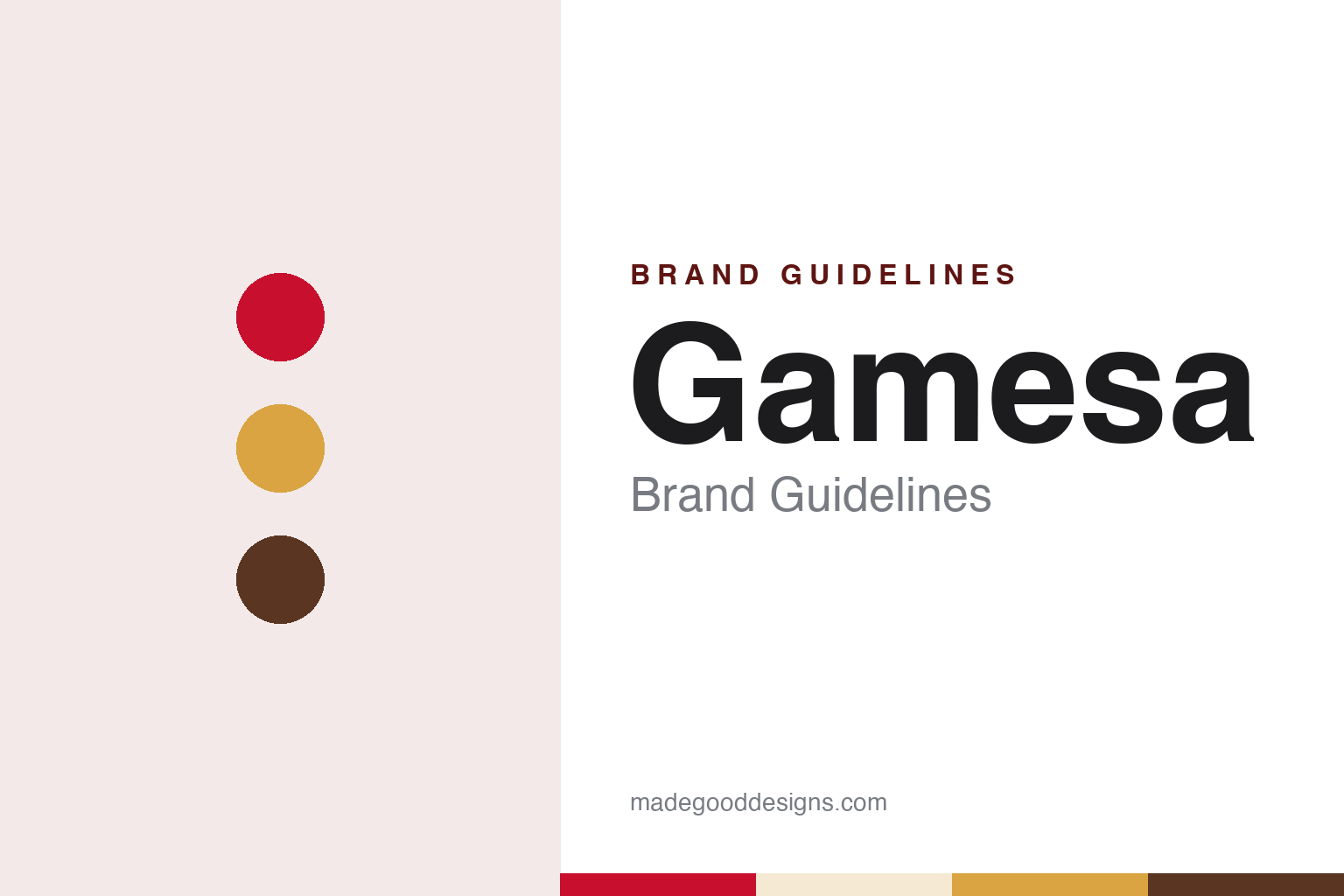
Two constants: a biscuit red, toasted gold and cocoa brown palette and a rounded friendly sans register. Abstract homage — not a Gamesa product or mark; no pack, logo or biscuit is reproduced.
From Lara to Gamesa
A biscuit and pasta factory, three ovens and four names.
Gamesa traces its start to Monterrey, the industrial capital of the northern Mexican state of Nuevo León, in 1921. The company’s own history, as published on its Mexican website in 2019, says the business was born that year when two men from Monterrey bought 50% of the shares of a biscuit and pasta factory called Lara, S.A. The company does not name them. English and Spanish Wikipedia both name the buyers as three brothers, Alberto, Ignacio and Manuel Santos González; English Wikipedia says they bought a majority of the shares, while Spanish Wikipedia gives the same 50% figure as the company.
The early factory was small. The company says that four years after the purchase the business was renamed Fábrica de Galletas y Pastas La Industrial, S.A., and that La Industrial began with three ovens and 150 workers. Spanish Wikipedia says the change of name followed a change of owners, when the Santos brothers bought out the other partners and took the plant for themselves.
Growth followed in other parts of Mexico. In 1948, the company says, La Industrial changed its corporate name to Galletera Mexicana, S.A., the name English Wikipedia translates as “Mexican Biscuit Company.” The new name came with a new factory: the company says Galletera Mexicana grew quickly from that point, beginning with the construction of what it calls the current Planta Monterrey, in San Nicolás de los Garza, a municipality in the Monterrey metropolitan area where Wikipedia places the company’s head office today. In 1978, the company says, Galletera Mexicana changed its name once more and became Gamesa, S.A. — the name its biscuits have carried ever since.
Colour
Marías, Emperador, Chokis and a move north.
Gamesa’s range is sold under a family of biscuit names as well as the company’s own. English Wikipedia lists Marías Gamesa, the company’s version of the Marie biscuit, among its most successful brands, together with Emperador sandwich biscuits, Chokis chocolate-chip cookies and Arcoíris; it also names Mamut, Cremax, Saladitas and Crackets. Wikipedia describes Gamesa as Mexico’s largest manufacturer of cookies, and the company itself says it is the number-one biscuit maker in the country. Its products also include flour and ready-to-eat cereals, English Wikipedia says.
The brand crossed the border in the early 1990s. In June 1992 Advertising Age reported that Gamesa was introducing nine value-priced cookies to the United States market, aimed at Hispanic consumers, with advertising handled by the Dallas agency Market Entry; the magazine said the company hoped for $10 million in US sales by the end of that year. English Wikipedia says Gamesa now sells its cookies in the United States, Central and South America and the Caribbean, and it runs a separate US website, gamesacookies.com.
Production has been modernised along the way. The Mexican trade magazine Industria Alimenticia reported in September 2000 that Gamesa had entered a new era of automation, buying machinery from the Italian company Sasib. On scale, the company said in 2019 that its products were made in nine plants and distributed through more than 100 distribution centres, reaching more than 650,000 customers every week. English Wikipedia describes production facilities in eight Mexican states and one in Colombia, and puts the workforce at about 13,000 in 2023, citing the Gale Business Insights company profile.
Typography
Design and documentation.
The seven brands in this group are all food brands, and all of them come from Mexico and the United States: Goya, Herdez, Bimbo, Maseca, Jumex, Sabritas and Gamesa. Food brands in general sit at many different points in the trade, from family firms that still carry a founder’s surname to names that now belong to much larger food groups, and a single brand can be sold everywhere from a corner shop to a supermarket shelf.
A food brand’s identity is usually carried less by a single product than by a pack, a name and the meal or snack it promises, because the company behind the name may have changed hands, moved its factory or grown far beyond the town where it started. That makes the questions behind each name worth asking plainly: who started it, who owns it now, and where its food is actually made and packed.
Each guide separates what independent sources record from what the company says about itself — its founding story, its owners over time, where its food is made and how its packaging has changed — and marks plainly what rests only on the company’s own word.
Aa
A rounded friendly sans for a biscuit maker from Monterrey. (Specimen set in Baloo 2, a sans STAND-IN; NOT the Gamesa logo.)
Gamesa
A family firm that became part of PepsiCo.
Gamesa stopped being a family business in 1990. The company says that at the beginning of October 1990 it went from being a family company to part of PepsiCo, the American food and drinks group; English and Spanish Wikipedia give the same year. PepsiCo already owned Sabritas, the Mexican snack maker it had bought in 1966, English Wikipedia’s PepsiCo article says, and the two are among PepsiCo’s food businesses headquartered in Mexico. PepsiCo’s annual report filed with the US Securities and Exchange Commission in February 2022 lists Grupo Gamesa, S. de R.L. de C.V. and Gamesa, S. de R.L. de C.V. in Mexico, and Gamesa LLC in Delaware, among its subsidiaries. By 2019 the Mexican Gamesa website was being run by PepsiCo’s Mexican marketing company, whose name appeared in the site’s legal notices.
The PepsiCo years brought new partners into the business. Spanish Wikipedia says that after PepsiCo bought The Quaker Oats Company in 2001, Gamesa took on Quaker’s Mexican operations, forming what it calls Gamesa-Quaker, and that in 2003 the company acquired 75% of the cereal maker Maizoro. The same article says Grupo Gamesa sponsored the Mexican first-division football club C.F. Pachuca for five seasons, from 2008–09 to 2012–13.
The name has a namesake to avoid. Gamesa Corporación Tecnológica, now part of Siemens Gamesa, is a Spanish maker of wind turbines and has no connection with the Monterrey biscuit company; in Spanish Wikipedia the bare word “Gamesa” leads to the wind-turbine business, and the biscuit company appears under the title Grupo Gamesa.
For a design guide, Gamesa shows how a regional biscuit and pasta factory can grow through four corporate names into a national brand whose individual biscuits — Marías, Emperador, Chokis — are sold under their own names alongside the maker’s. Compare Sabritas, its Mexican sister company inside PepsiCo, and Abuelita, another Mexican pantry brand now owned by a multinational. For this guide we use a biscuit red, a toasted gold and a cocoa brown with a rounded sans, an unofficial interpretation; no product or logo is reproduced.
Explore & save
Keep Gamesa’s identity on hand — save it to a board in the Made Good inspiration library.
Gamesa identity set
Pin the Gamesa biscuit red, toasted gold and cocoa brown palette and the rounded friendly sans register to your own board.