Rooh Afza Brand Guidelines
The Old Delhi rose syrup of 1907, made by three Hamdards.
Aa
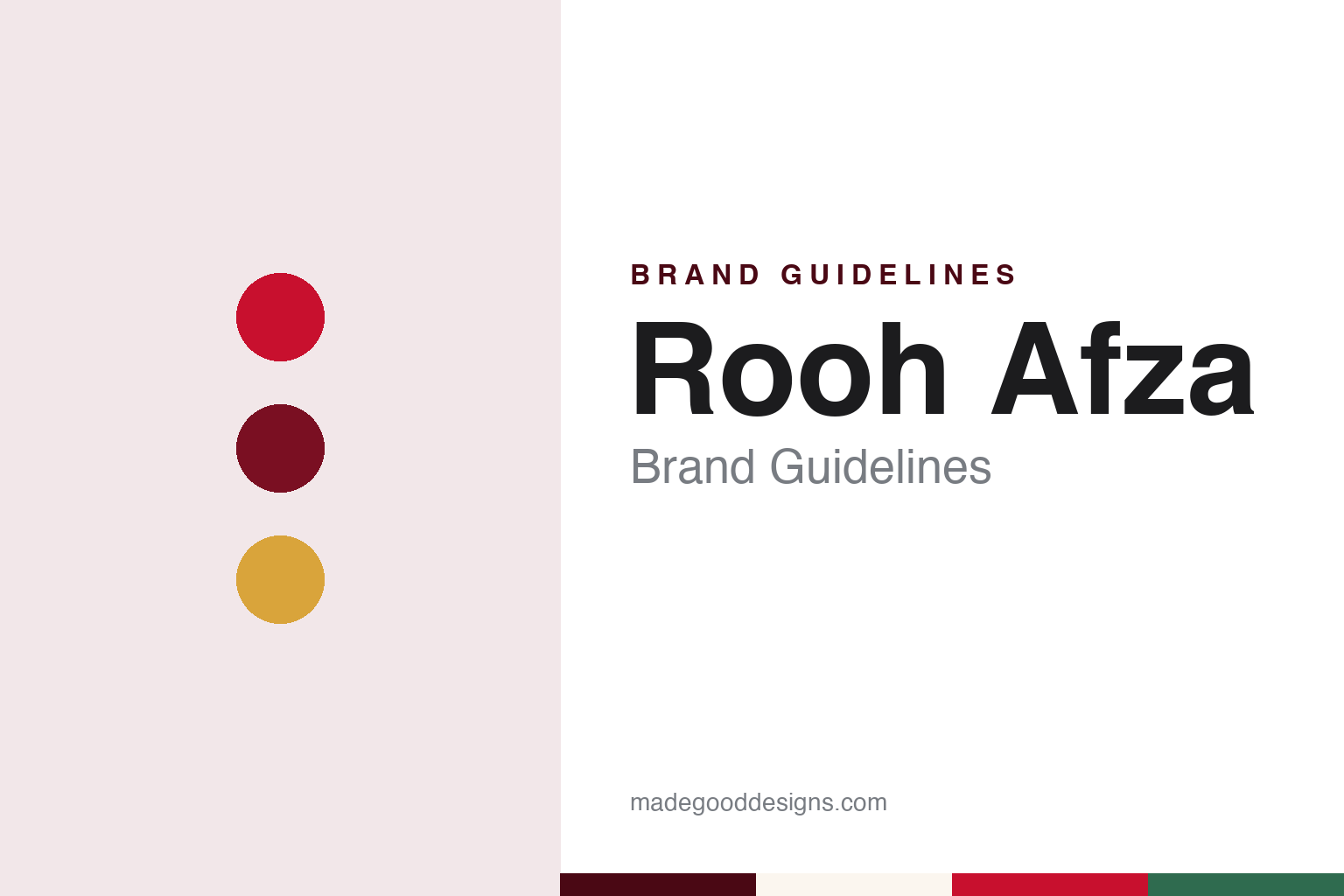
Two constants: a rose red, crimson and saffron gold palette and an ornate display serif register. Abstract homage — not a Rooh Afza product or mark; no bottle, label or logo is reproduced.
A clinic in Old Delhi
A Unani practitioner, a shop and a red syrup.
Rooh Afza comes from Hamdard, a business that began in 1906 as a small clinic in the lanes of Old Delhi, then the capital of British India. Hamdard India says its founder, Hakeem Hafiz Abdul Majeed, was a practitioner of Unani, the Greco-Arabic system of medicine practised across South Asia, and that he called the venture Hamdard, a Persian-derived word the company translates as “a companion in pain.” The clinic was known as Hamdard Dawakhana. English Wikipedia’s article on Hamdard India places its first premises, a herbal shop, at Hauz Qazi.
The syrup followed a year later. Hamdard India’s own list of milestones gives 1907 as the year “Roohafza” was developed, and The Better India, writing in May 2019, also dates the invention to 1907; English Wikipedia’s article on the drink gives 1906, the year of the clinic. The name is Persian; English Wikipedia renders it “soul refresher” and The Better India “soothing to the soul.” Hamdard Pakistan describes the recipe as based on a Unani formulation, but the drink is sold as a sweet concentrate: diluted with cold water or milk it becomes a sharbat, and English Wikipedia notes that it is often served at iftar, the meal that breaks the fast in Ramadan.
From early on the drink had a look of its own. The Better India reports that its first labels were designed by the artist Mirza Noor Ahmad and printed by the Bolton Press in Bombay, and that the syrup was originally packed in a wine bottle; English Wikipedia puts Noor Ahmad’s multicoloured labels at 1910. Its colour has become its shorthand. Hamdard Pakistan has called it “The Original Red Drink,” and the spelling varies with the market: Hamdard Laboratories (Waqf) Pakistan writes Rooh Afza, while Hamdard India uses both Rooh Afza and the one-word RoohAfza on its packs and website.
Colour
Partition, a waqf and three makers.
Majeed died in 1922, a date given both by Hamdard India and by The Better India, which reports that his son Hakeem Abdul Hameed took over the business at the age of 14. Hamdard India says Majeed’s widow, Rabia Begum, kept the institution going with Abdul Hameed’s support, and that Abdul Hameed later brought his younger brother, Hakim Mohammed Said, into the running of the firm. Over the following decades the brothers turned Hamdard into a waqf, an endowment whose income goes to charitable purposes, the company says.
The partition of British India in 1947 divided the business along with the country. English Wikipedia’s article on Hamdard Pakistan says Abdul Hameed stayed in India, while Said moved to Karachi on 9 January 1948 and started Hamdard Laboratories there on a small scale, in the Arambagh area of the old city. The article says the Pakistani company was profitable by 1953, the year Said declared it a waqf. Said also opened a branch in East Pakistan; after Bangladesh became independent in 1971, his daughter Sadia Rashid, later chair of Hamdard Pakistan, has said that he gave it to the people of the new country.
The result is a single brand made by three separate organisations. Today Rooh Afza is produced by Hamdard Laboratories (India), headquartered in New Delhi, by Hamdard Laboratories (Waqf) Pakistan in Karachi and by Hamdard Laboratories (Waqf) Bangladesh. In India, Hamdard says it has three manufacturing units, at Manesar in Haryana, Ghaziabad in Uttar Pradesh and Okhla in Delhi, and that its Rooh Afza unit is at Manesar. Hamdard India’s consumer website lists Rooh Afza first among its foods, ahead of squashes, spices and its other drinks.
Typography
Design and documentation.
The seven brands in this group are all food and drink names from Pakistan and Sri Lanka: Shan, National Foods, Rooh Afza, Olper’s, Tapal, Elephant House and Munchee. Pakistani and Sri Lankan food and drink brands in general sit at many different points in the trade, from family firms that still carry a founder’s name to names that now belong to much larger food and drink groups, and a single brand can be sold everywhere from a corner shop to a supermarket shelf.
A food or drink brand’s identity is usually carried less by a single product than by a pack, a name and the meal, snack or drink it promises, because the company behind the name may have changed hands, moved its production or grown far beyond the place where it started. That makes the questions behind each name worth asking plainly: who started it, who owns it now, and where its products are actually made and packed.
Each guide separates what independent sources record from what the company says about itself — its founding story, its owners over time, where its products are made and how its packaging has changed — and marks plainly what rests only on the company’s own word.
Aa
An ornate display serif for a syrup born in Old Delhi in 1907. (Specimen set in Playfair Display, a serif STAND-IN; NOT the Rooh Afza logo or label lettering.)
Rooh Afza
From “Drink of the East” to cans and cartons.
Rooh Afza’s advertising has been studied in Pakistan’s marketing press. Writing in Dawn’s marketing magazine Aurora in 2018, Syed Qasim Raza said that for its first two decades in Pakistan the brand’s advertising dwelt on the drink’s function, taste and colour and on its identity as a “drink of the East.” In the early 1980s, he wrote, a line claiming that every new syrup was red but not every red syrup was Rooh Afza set the brand up as the pioneer of the red-syrup category against a wave of imitators, and 1985 advertising used captions such as “Splendour of the East.”
Raza dated a broader repositioning to 2017, when Usama Qureshi became chief executive of Hamdard Pakistan: the drink was recast as a family drink for every season and occasion rather than only Ramadan or summer, through a “Zindagi Mubarak” campaign by RG Blue Communications that was extended into Ramzan Mubarak, Dosti Mubarak and Sardi Mubarak. Hamdard Pakistan moved the syrup from glass to PET bottles, Aurora noted, and by 2018 the company listed 800 ml, 1.5 litre and 3 litre PET packs. The Pakistani company also says the American food magazine Saveur named the drink in its list of 100 favourites in 2007.
In India, Hamdard hired the cookery writer Nita Mehta and the actor Juhi Chawla in 2010 to create mocktail and dessert recipes for a marketing campaign, English Wikipedia says. In June 2020 Hamdard Laboratories India launched its first ready-to-drink versions, RoohAfza Fusion, which mixes the syrup with fruit juice, and a RoohAfza Milkshake, Business Insider India and ETRetail reported. Hamdard Pakistan sells a canned Rooh Afza Go and Doodh Rooh Afza, a Rooh Afza milk drink in a 225 ml carton. In January 2023 the Delhi High Court held in a trademark case that the Rooh Afza name carries considerable goodwill, the law firm FoxMandal reported.
For a design guide, Rooh Afza shows how a colour, a Persian name and a decorative label can hold one brand together across three countries and more than a century. Compare Haldiram’s, the Indian snack maker, and National Foods, the Karachi spice and sauce maker. For this guide we use a rose red, a deep crimson and a saffron gold with an ornate serif, an unofficial interpretation; no product or logo is reproduced.
Explore & save
Keep Rooh Afza’s identity on hand — save it to a board in the Made Good inspiration library.
Rooh Afza identity set
Pin the Rooh Afza rose red, crimson and saffron gold palette and the ornate display serif register to your own board.