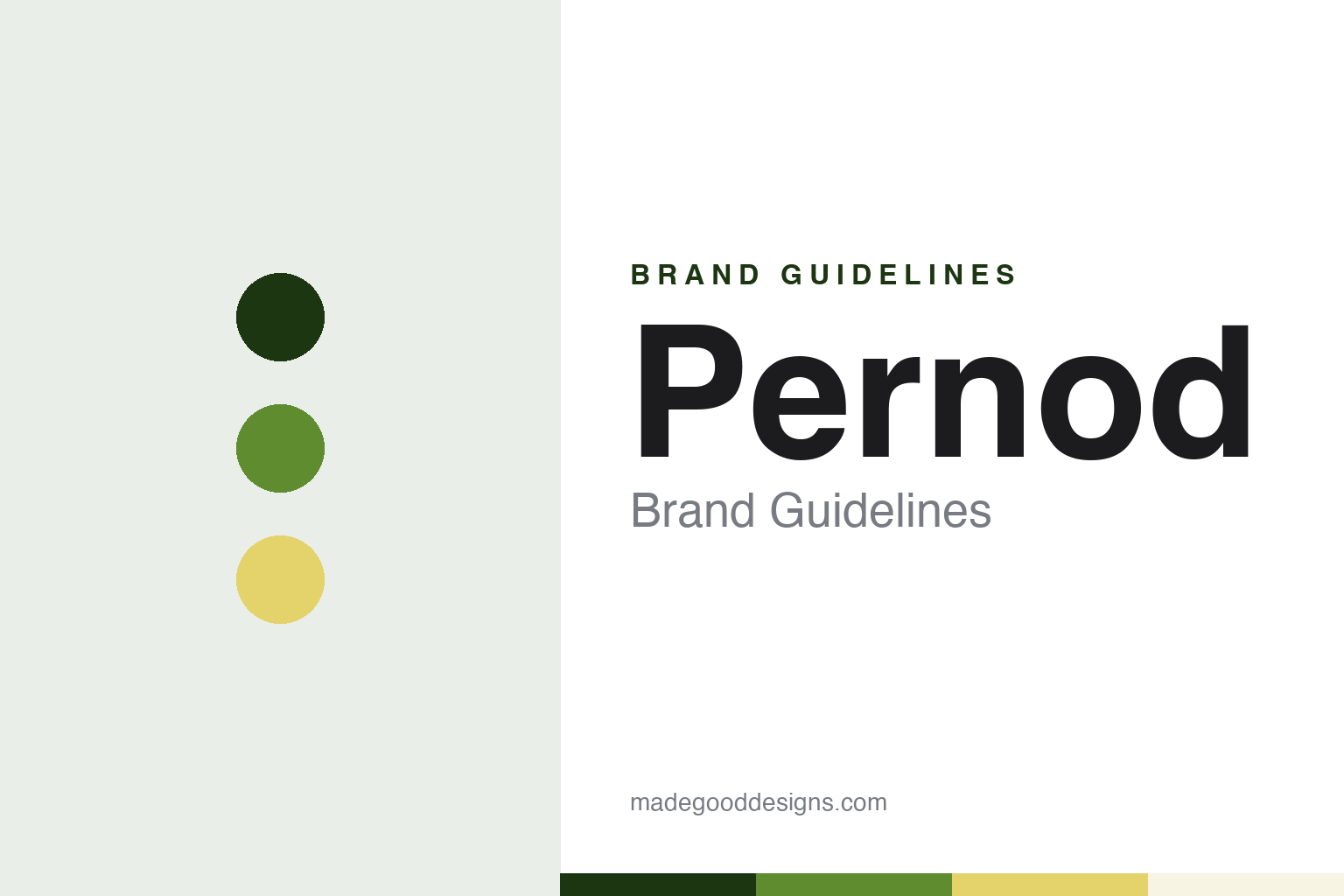
Pernod Brand Guidelines
Two Pernod families, Pontarlier absinthe and an Avignon anise.
Aa
Two constants: an absinthe green, anise yellow and cream palette and a Belle Époque serif register. Abstract homage — not a Pernod product or mark; no bottle, label, poster or logo is reproduced.
Two houses, one name
A Pontarlier absinthe firm and an Avignon anise.
Pernod carries two histories under one name. The first belongs to Pernod Fils, the absinthe house that Henri-Louis Pernod founded in Pontarlier, in the Doubs, in 1805 — a date given by Pernod Ricard and by Jean Watin-Augouard in La Revue des marques (2005). English Wikipedia says Henri-Louis Pernod had opened an absinthe distillery at Couvet, in Switzerland, in 1797 with Daniel-Henri Dubied before building the larger works across the border. Pernod Fils became the best-known absinthe of the nineteenth century; English Wikipedia, citing Barnaby Conrad’s Absinthe: History in a Bottle (1988), says its success spawned imitators with names such as “Pernot” and “Parrot,” and that the distillery was almost destroyed by fire in 1901 and rebuilt, at its peak producing as much as 30,000 litres of absinthe a day for sale around the world. France banned absinthe by a law of 16 March 1915, and the Pontarlier plant closed in 1917, French Wikipedia says. English Wikipedia adds that Pernod Fils absinthe was made on a smaller scale at the Banus distillery in Tarragona, in Spain, where absinthe had not been banned, until production ended in the 1960s.
The second history is the one in the glass today. French Wikipedia, citing Le Dauphiné Libéré (2022), La Provence (2013 and 2016) and La Marseillaise (2017), says the anise apéritif was created in Avignon, at the Montfavet works of a separate firm, Pernod Père et Fils, where Jules-François Pernod and his son Jules-Félix Pernod developed an anise drink the new law allowed. Jules-Félix launched it as “Anis Pernod” in 1918, and French Wikipedia calls it the first industrial anise apéritif made in France. The name became “Pernod” and then “Un Pernod” in 1921, according to La Revue des marques. The two families shared a surname without being related, French Wikipedia says, citing the Institut national de l’audiovisuel (2024), and they had already gone to court over the name before the First World War.
Colour
A lawsuit, a merger and a pastis named after a year.
The two stories met in the late 1920s. In 1926 Pernod Fils joined the Montreuil distillery that Ariste Hémard had founded in 1871, forming Établissements Hémard et Pernod Fils, which registered an “Anis Pernod fils.” Jules-Félix Pernod sued, arguing that his Anis Pernod came first. French Wikipedia, citing Marc Maynègre’s 1991 history of an Avignon quarter, says the Avignon family won in 1928, and on 4 December 1928 the three firms merged as Établissements Pernod, with its seat and production moved to Montreuil.
The range then followed French law. With anise drinks allowed at up to 45% from 1938, the company launched Pernod 45; when the Vichy regime banned spirits above 16% in 1940 it sold an alcohol-free “PSA,” for Pernod Sans Alcool, La Revue des marques reported. Production resumed after the ban was repealed in 1949, although press and poster advertising stayed off-limits until 1951; that year the company launched a pastis labelled Pernod 51, after the year, which it renamed Pastis 51 in 1954 to avoid confusion with Pernod 45.
Pernod itself is not a pastis. Pernod Ricard describes it as a 40% liqueur made from distillates of star anise, fennel and 14 other aromatic plants, among them coriander and mint, with very little liquorice, which the company says distinguishes it from pastis. It also sells a 68% Pernod Absinthe, which it says is made as close as possible to the historical recipe; English Wikipedia says the absinthe was reformulated in 2013 and is produced in Thuir, in the Pyrénées-Orientales. Outside France, La Revue des marques reported, Pernod is often served as a long drink, mixed with bitter lemon, cola or fruit juice.
Typography
Design and documentation.
The seven brands in this group are all spirit names from Mexico, France, Greece and Spain: José Cuervo, Patrón, Ricard, Pernod, Metaxa, Ouzo 12 and Licor 43. Spirit brands in general sit at many different points in the trade, from family firms that still carry a founder’s name to names that now belong to much larger drinks groups, and a single brand can be sold everywhere from a neighbourhood bar to a duty-free shelf.
A spirit brand’s identity is usually carried less by a single bottle than by a label, a name and the drink or ritual it promises, because the company behind the name may have changed hands, moved its production or grown far beyond the place where it started. That makes the questions behind each name worth asking plainly: who started it, who owns it now, and where its spirits are actually made and bottled.
Each guide separates what independent sources record from what the company says about itself — its founding story, its owners over time, where its spirits are made and how its bottles and advertising have changed — and marks plainly what rests only on the company’s own word.
Aa
A Belle Époque serif for a name that goes back to the absinthe posters of the nineteenth century. (Specimen set in Playfair Display, a serif STAND-IN; NOT the Pernod logo.)
Pernod
The Pontarlier line, Suze and Pernod Ricard.
The brand tells its story through the Pontarlier line. On its website Pernod Ricard calls Pernod the oldest French aniseed liqueur, dating it to 1805, says the liqueur was created in 1920, and says it was originally made with grand wormwood at the Pernod Fils factory in Pontarlier. French Wikipedia, citing La Provence (2013) and La Revue des marques, says the Avignon origin was gradually eclipsed after the mergers and the concentration of production around Paris, with bottle labels presenting the drink as heir to Pernod Fils.
The company kept growing after the war. Établissements Pernod took the name Pernod in 1959 and in 1965 bought the Distillerie de la Suze, maker of the gentian apéritif Suze, French Wikipedia says, citing Suze and Les Échos. In 1975 its chairman, Jean Hémard, and Paul Ricard, chairman of Ricard, combined their companies to create Pernod Ricard, with Hémard as its first chairman, French Wikipedia says, citing Les Échos. Pernod remains a brand of that group, alongside Pastis 51, Suze and its old rival Ricard.
For a design guide, Pernod shows how one name can hold two separate family histories, and how a brand chooses which of them to put on the label. Compare it with its partner in the group, Ricard, and with a Swiss herbal liqueur, Appenzeller Alpenbitter. For this guide we use absinthe green, anise yellow and cream with a serif, an unofficial interpretation; no product or logo is reproduced.
Explore & save
Keep Pernod’s identity on hand — save it to a board in the Made Good inspiration library.
Pernod identity set
Pin the Pernod absinthe green, anise yellow and cream palette and the Belle Époque serif register to your own board.