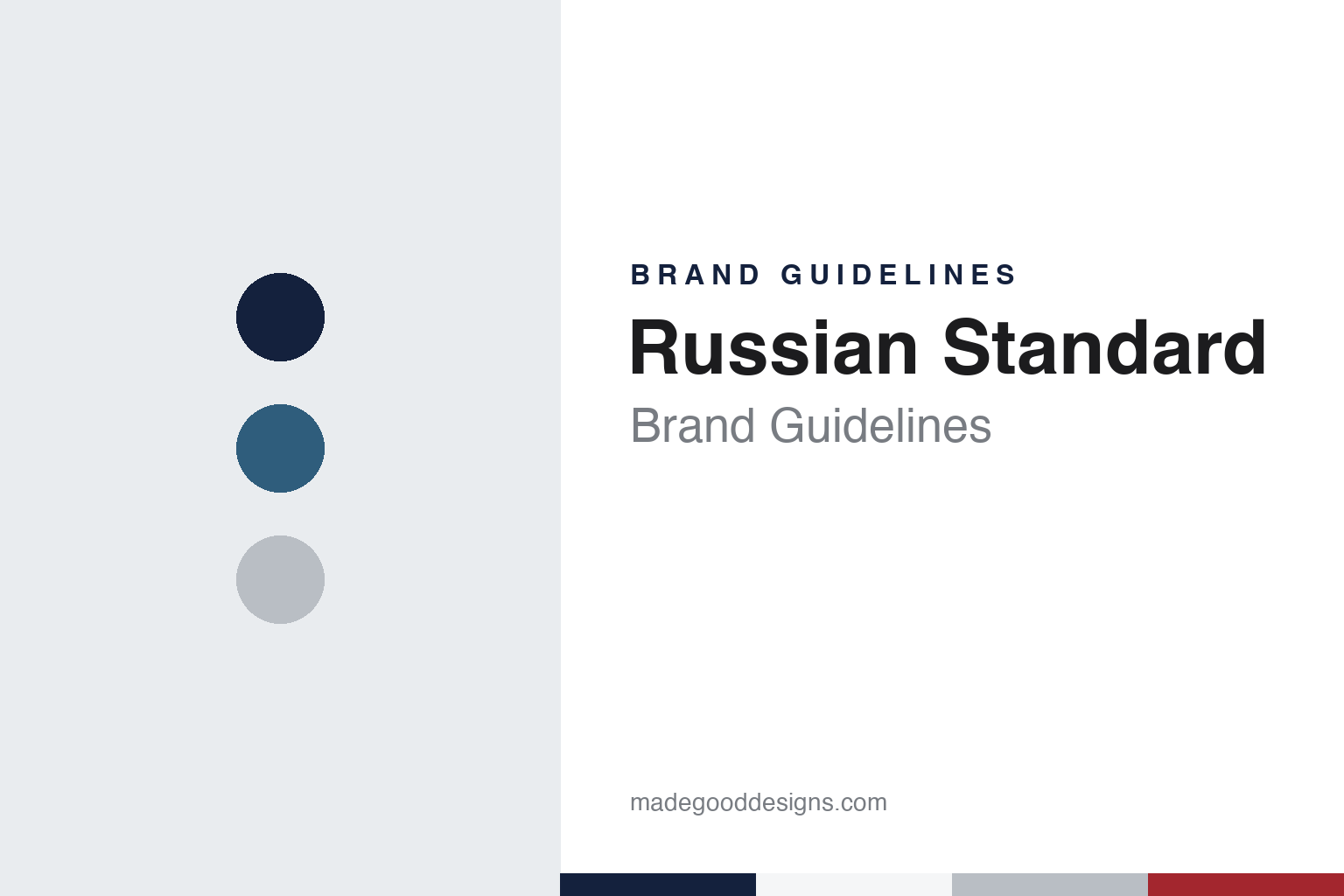
Russian Standard Brand Guidelines
Roustam Tariko’s 1998 premium vodka from St Petersburg.
Aa
Two constants: a night navy, platinum and seal red palette and a classical capitals serif register. Abstract homage — not a Russian Standard product or mark; no bottle, label or logo is reproduced.
A Russian premium vodka
An importer, a gap in the market and a 1998 launch.
Russian Standard — in Russian, Russkiy Standart — is a much younger brand than the Soviet-era names it competes with. It was launched in 1998 by the Russian Standard company of the businessman Roustam Tariko, according to English Wikipedia. The brand sits inside Russian Standard Corporation, a holding company Tariko founded in 1992 and based in Moscow, which the same encyclopedia, citing a 2010 company fact sheet, says also owns Russian Standard Bank, founded in 1999, an insurance business and a spirits distributor. The shared name is the corporation’s main brand.
Tariko came to vodka from importing. English Wikipedia says that in the late 1980s he began bringing Italian chocolates into the Soviet Union and then won an exclusive contract to import Martini, which turned his company, Roust, into a leading importer of premium spirits in Russia. Russian Standard was his attempt to build a domestic premium brand: English Wikipedia says he wondered why the world’s biggest vodka market had no home-grown premium vodka, and that Russian Standard Original quickly became the leading brand of its kind in the country.
The brand’s story leans on history older than the company. Its marketing says that in 1894 the chemist Dmitri Mendeleev was asked to set an imperial quality standard for Russian vodka and that “the Russian Standard was born,” in the words of a supermarket listing quoted by English Wikipedia; its Italian-made sister, The Standard 1894, still refers on its website to “Mendeleev’s iconic vodka recipe from 1894.” A 2011 article on Pravda.ru described the idea that Mendeleev fixed vodka’s strength as a popular myth, noting that his 1865 dissertation dealt with much stronger alcohol solutions and that Russia’s 40 per cent standard dates from 1843.
Colour
Original, Platinum, Imperia and a St Petersburg distillery.
The range grew upwards. Two years after the Russian launch the brand began to expand abroad, adding Russian Standard Platinum in 2001 and the luxury Imperia in 2004, The New York Times reported in February 2006; the first vodka was renamed Original. Later that year, in a premium-vodka tasting for Vanity Fair, the writer Brett Forrest gave Imperia the only A-plus grade.
Production moved into a purpose-built site in 2006, when the company opened a new distillery in St Petersburg with a capacity of four million cases a year, The Moodie Report, a travel-retail trade publication, reported in 2008. The company says the location was chosen largely for the water of Lake Ladoga, which it describes as among the softest naturally available, and that its vodka is made from winter grain from the Russian steppes. It describes a four-stage process of fermenting, distilling and rectifying, filtering and resting, and bottling, with the Original filtered four times through charcoal and the higher tiers given further steps. All of those are the company’s own descriptions.
The name has also been shortened abroad. In some markets the vodka has been sold as The Standard, which English Wikipedia, citing a United States retailer, describes as the former Russian Standard; The Standard 1894, launched in 2024 according to English Wikipedia, says on its website that it is produced in Canelli, Italy, with ingredients sourced in the European Union.
Typography
Design and documentation.
The seven brands in this group are all vodka names: Belvedere, Ketel One, Stolichnaya, Russian Standard, Finlandia, Tito’s and Żubrówka. Vodka brands in general sit at many different points in the trade, from family firms that still carry a founder’s name to names that now belong to much larger drinks groups, and a single brand can be sold everywhere from a corner shop to a duty-free shelf.
A vodka brand’s identity is usually carried less by the spirit itself than by a bottle, a label and the place it names, because the company behind the name may have changed hands, moved its distilling or grown far beyond the town where it started. That makes the questions behind each name worth asking plainly: who started it, who owns it now, and where its vodka is actually distilled and bottled.
Each guide separates what independent sources record from what the company says about itself — its founding story, its owners over time, where its vodka is made and how its bottles and labels have changed — and marks plainly what rests only on the company’s own word.
Aa
A classical capitals serif for a brand that claims a standard. (Specimen set in Marcellus, a serif STAND-IN; NOT the Russian Standard logo.)
Russian Standard
A Moscow holding company and an international spirits arm.
Russian Standard has stayed with its founder. Russian Standard Corporation, the Moscow holding company, is owned by Roustam Tariko, according to English Wikipedia, citing Bloomberg in 2009. In a 2010 fact sheet quoted by English Wikipedia, the corporation described itself as having more than 25,000 employees and operations in more than 70 countries; English Wikipedia, citing Kommersant, describes its distribution business, Roust, as the Russian distributor of premium drinks including Rémy Martin and Jägermeister. In October 2014 Kommersant reported that Tariko had brought his international alcohol businesses together into a single holding under the Roust name. That international arm had grown through acquisition: Roust took over the Central European Distribution Corporation, owner of the Polish bison-grass vodka Żubrówka, in 2013, and Żubrówka has been owned by the Polish Maspex Group since 2022, English Wikipedia says.
Where the vodka is made now depends on which bottle is meant. English Wikipedia says the original Russian version is still made in St Petersburg, while The Standard 1894 says it is produced in Italy. On 26 February 2022 Ohio’s governor, Mike DeWine, directed the state’s commerce department to stop buying and selling vodka made by Russian Standard, cleveland.com reported that day.
The brand also has a long-standing rivalry with Stolichnaya. English Wikipedia says Russian Standard questioned the Russian authenticity of the Stolichnaya sold outside Russia because it was bottled in Latvia, and that Stolichnaya’s then global distributor, Pernod Ricard, insisted it was an authentic Russian vodka.
For a design guide, Russian Standard shows how a new brand can borrow the authority of history through a name, a date and a tiered range. Read our note on the Russian Standard font, and compare Stolichnaya, its older rival, and Żubrówka, once part of the same group. For this guide we use night navy, platinum and seal red with a serif, an unofficial interpretation; no product or logo is reproduced.
Explore & save
Keep Russian Standard’s identity on hand — save it to a board in the Made Good inspiration library.
Russian Standard identity set
Pin the Russian Standard night navy, platinum and seal red palette and the classical capitals serif register to your own board.