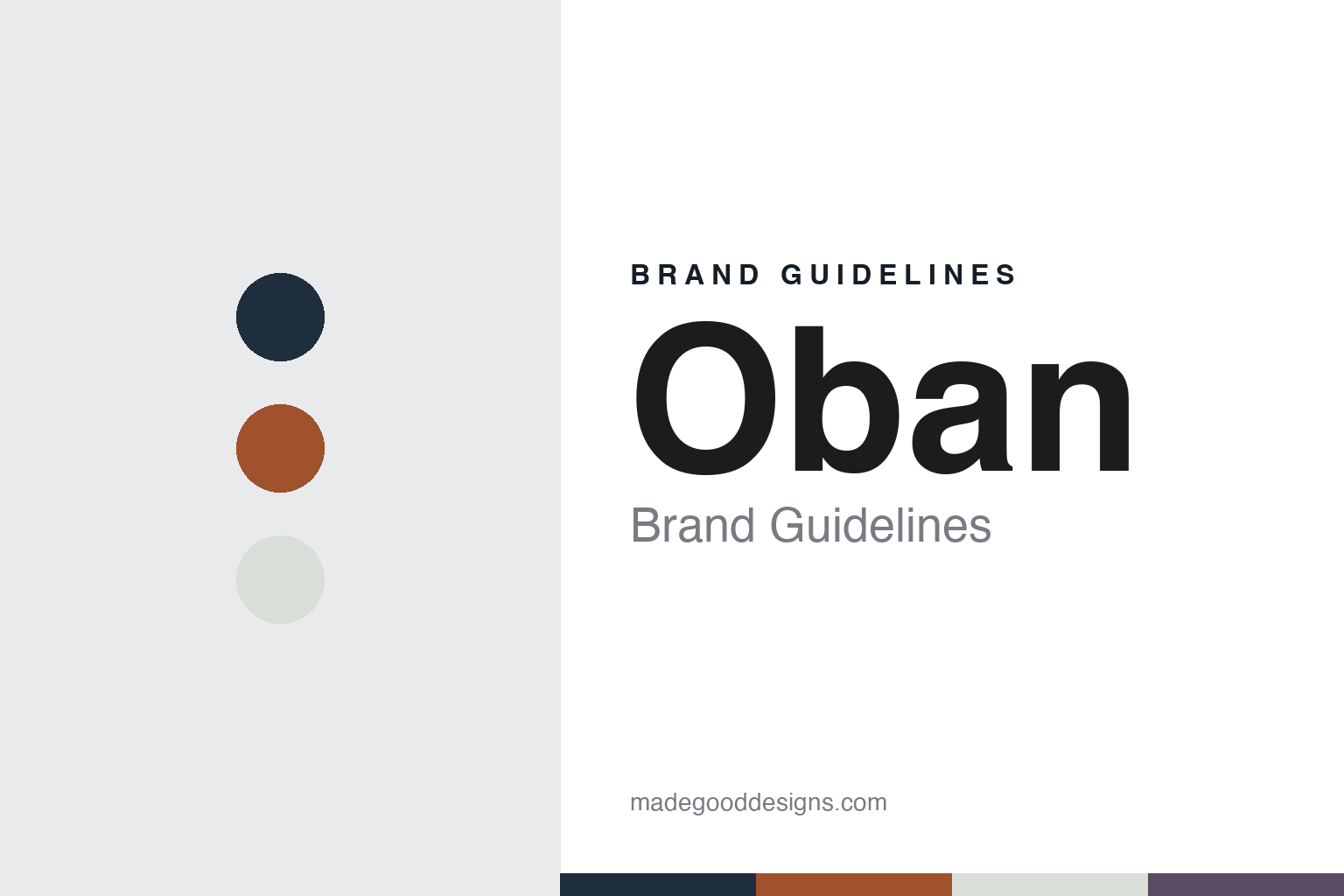
Oban Brand Guidelines
The 1794 West Highland distillery the town grew around.
Aa
Two constants: an Oban navy, copper and mist palette and a Highland serif register. Abstract homage — not an Oban product or mark; no bottle, label or logo is reproduced.
The little bay
A distillery older than its town.
Oban is one of the few Scotch distilleries that came before the town it is named after. Wikipedia and Diageo, which owns it, agree that the brothers John and Hugh Stevenson began distilling on the bay in 1794; Diageo’s malts website says they had set up a brewing company there the year before. The settlement around them was made a burgh of barony in 1811, Wikipedia says, and Diageo titles its own history of the place “the town that whisky built.” The distillery itself is, Diageo says, “barely an acre in size.”
The town’s Gaelic name, An t-Òban, means “the little bay.” It became a Parliamentary burgh in 1833, Wikipedia adds, two decades after the burgh of barony charter. Oban grew as a port and resort: Wikipedia credits a visit by Sir Walter Scott in 1814 with drawing new visitors, and the arrival of the railway in 1880 with bringing trade and tourism; Diageo connects Scott’s visit to his poem The Lord of the Isles and says the railway let the distillery’s whisky reach market more easily. Today it is known as the “Gateway to the Isles,” with ferries to many of the nearby islands — which is also why the name needs care, since “Oban” means the town first and the whisky second.
The Stevensons kept the distillery until 1866, Wikipedia says, when it passed to Peter Cumstie; Diageo’s own history says only that the sale came at some point between 1830 and 1866 and notes that the sources disagree. In 1883 it was bought by Walter Higgin, who rebuilt it, and in 1898 Alexander Edward, owner of the Aultmore distillery, bought him out. Diageo records a fire in 1890 that badly disrupted production in between, and says Higgin promoted the whisky as the finest small whisky in the Highlands. Edward’s first year was difficult: Wikipedia says the distillery took heavy losses when the Leith blending firm Pattisons collapsed.
Colour
Dewar’s, the Distillers Company, and two copper pots.
The twentieth century folded Oban into the large blending houses. Wikipedia says it was sold to Dewar’s in 1923 and joined the Distillers Company in 1925. It was silent from 1931 to 1937, and again from 1969 to 1972 while a new stillhouse was built. That stillhouse holds two pot stills — one wash still and one spirit still — which Diageo describes as “just two copper pots.” Diageo also says the distillery’s oldest machine is its mill, made by the firm of Boby in the 1930s; it dates the new stillhouse to 1972. Through later mergers Oban passed to Diageo, formed in 1997 by the merger of Guinness and Grand Metropolitan, which owns Oban today.
Oban’s place on the shelf came with the Classic Malts. Launched by United Distillers in 1988, the selection grouped six single malts — Dalwhinnie, Talisker, Cragganmore, Oban, Lagavulin and Glenkinchie — each presented as the voice of a region, with Oban as the West Highland malt. Wikipedia dates the launch of the 14-year-old to 1988; Diageo’s own history gives 1989 for Oban’s selection, the same year, Wikipedia says, that a new visitors’ centre opened at the distillery.
The 14-year-old remains the core whisky. The Distillers Edition is finished in casks that had held Montilla Fino, and in December 2014 a whisky without an age statement called Little Bay — the English meaning of the town’s Gaelic name — joined the range. Limited releases have included an 18-year-old, a rare 32-year-old and, in 2023, an 11-year-old matured in Caribbean rum casks for Diageo’s Special Releases, Wikipedia says.
Typography
Design and documentation.
The seven brands in this group are all Scotch single malts: The Balvenie, Glenfarclas, Aberlour, Bowmore, Bruichladdich, Oban and Springbank. Single malt brands in general sit at many different points in the trade, from family companies that still own their distillery to names that now belong to much larger drinks groups, and a single brand can be sold everywhere from a corner shop to a specialist whisky bar.
A single malt’s identity is usually carried less by a single bottle than by a label, a name and the place it promises, because the company behind the name may have changed hands, changed how it makes its whisky or grown far beyond the place where it started. That makes the questions behind each name worth asking plainly: who started it, who owns it now, and where its whisky is actually distilled, matured and bottled.
Each guide separates what independent sources record from what the company says about itself — its founding story, its owners over time, where its whisky is made and how its labels have changed — and marks plainly what rests only on the company’s own word.
Aa
A Highland serif for a harbour distillery. (Specimen set in Cormorant Garamond, a serif STAND-IN; NOT the Oban logo.)
Oban
A town’s name on a bottle.
Today Oban is one of Diageo’s malt distilleries, with a capacity Wikipedia gives as 670,000 litres a year from its two stills. The Classic Malts selection it helped launch has since grown beyond the original six, taking in distilleries such as Caol Ila, Cardhu, Clynelish and Royal Lochnagar, and Diageo presents Oban on its malts website alongside them.
Diageo’s history of the distillery doubles as a history of the town. Alongside the whisky it records the first Argyllshire Gathering in 1871, which established Oban’s Highland Games, the founding of local schooling with the help of the Duke of Argyll in 1862, and the start of work on McCaig’s Tower in 1897 — Wikipedia gives 1895 in one place and 1897 in another. The shared name runs both ways: the town’s story, from the railway of 1880 to the ferries to the isles, is part of the distillery’s story too.
For a design guide, Oban shows how a distillery can borrow the identity of a whole town — its name, its bay and two centuries of shared history. Compare Springbank, another west-coast distillery tied to its town, and Tanqueray, a Diageo stablemate. For this guide we use firth navy, still copper and sea mist with a serif, an unofficial interpretation; no product or logo is reproduced.
Explore & save
Keep Oban’s identity on hand — save it to a board in the Made Good inspiration library.
Oban identity set
Pin the Oban navy, copper and mist palette and the Highland serif register to your own board.