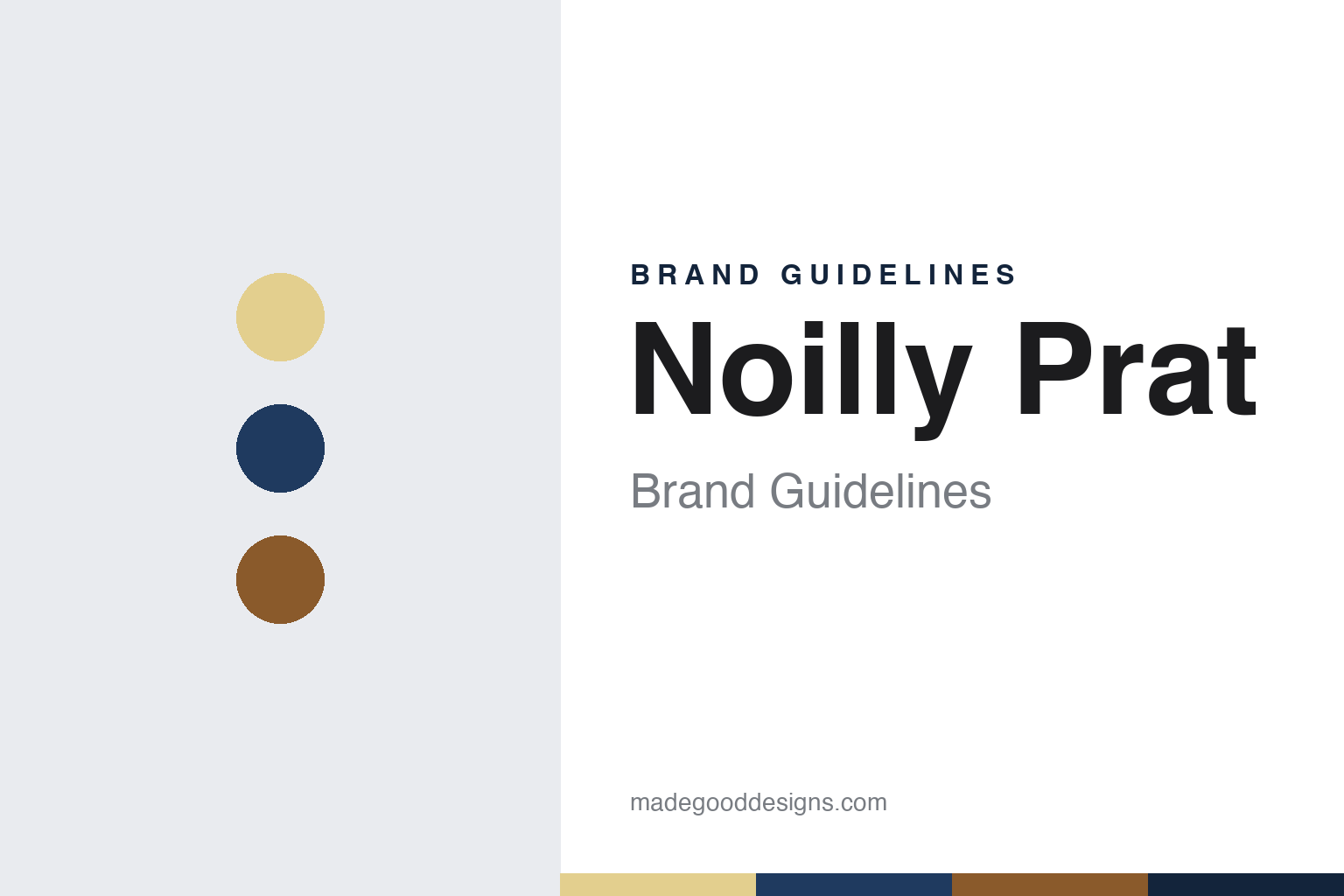
Noilly Prat Brand Guidelines
The dry vermouth that ages its wine in barrels under the Languedoc sky.
Aa
Two constants: a Noilly Prat straw, blue and oak palette and a high-contrast serif register. Abstract homage — not a Noilly Prat product or mark; no bottle, label or logo is reproduced.
Lyon, Marseille, Marseillan
A wine merchant, his son and a son-in-law from the Algerian trade.
Noilly Prat is a French vermouth house based in Marseillan, a small port on the Étang de Thau in the Hérault, in the Languedoc. The company dates its story to 1813, when, its own history says, Joseph Noilly was running an established wine and spirits business in Lyon; English Wikipedia credits him with developing the first formula that year. The Oxford Companion to Spirits & Cocktails (2021) instead dates the house to 1855, so both years appear on the brand’s story depending on whether the recipe or the company is counted.
The company’s timeline sets out the handovers. Joseph’s son Louis Noilly took over the business in 1828. In 1837 Claude Prat — called Claudius in English Wikipedia and the Oxford Companion — joined as a sales representative for Algeria, and in 1844 he married Louis’s daughter, Anne-Rosine. Demand for vermouth led to a dedicated production site in Marseille in 1843, and in 1855 Louis and his son-in-law formally created Noilly Prat & Cie. The company says its earliest known trademark registration dates from 1856.
In 1859 a site for ageing the base wines opened in Marseillan. From 1865, the company says, Anne-Rosine ran the family business; the Oxford Companion says she led it for more than forty years, and the company names her sons Louis and Jean as her successors in 1902. The house won a gold medal at the 1878 Paris Universal Exhibition, the company says, and between 1899 and 1901 it bought the land in Marseillan on which it built the Enclos Sainte-Anne and the Sainte-Anne cellars.
Colour
Wine left out in the weather, on purpose.
Noilly Prat’s signature is a process rather than a picture. English Wikipedia describes how the house sets out to imitate what happened to wine shipped long distances in barrels exposed to the weather. It is made from white grapes grown around Marseillan, chiefly Picpoul de Pinet and Clairette. After months in large oak casks indoors, the wine is moved into smaller barrels that stand outside in the walled Enclos for about a year, exposed to sun, wind and winter cold, and part of it evaporates. French Wikipedia describes hundreds of oak casks, between twenty and sixty years old, standing in the open air.
The wines are then blended, softened with a little mistelle and macerated with around twenty herbs and spices. The recipe is kept secret, but English Wikipedia names camomile, bitter orange peel, nutmeg, coriander and cloves among them. The same article says the finished vermouth is shipped from Marseillan to Beaucaire, in the Gard, for bottling by Martini & Rossi.
The range grew slowly. The company dates Noilly Prat Rouge to 1955 and Ambré to 1986; the Oxford Companion gives 1956 for the red and lists an Extra Dry from 1955, and says the Original Dry was among the first dry vermouths to be exported. The company also says Noilly Prat was cited in 1911 as an ingredient in one of the first Martini cocktails, the drink with which it is most often linked. English Wikipedia says the cellars in Marseillan are open to visitors for part of the year.
Typography
Aperitif wines and the poster tradition.
The seven brands in this group are aperitif, vermouth and liqueur names: Lillet, Suze, Dubonnet, Noilly Prat, Carpano, Cocchi and Licor Beirão. Aperitif, vermouth and liqueur brands in general sit at many different points in the trade, from family houses that still carry a founder’s name to labels that now belong to much larger drinks groups, and a single brand can be sold everywhere from a corner shop to a cocktail bar.
An aperitif, vermouth or liqueur brand’s identity is usually carried less by a single bottle than by a label, a name and the place it promises, because the company behind the name may have changed hands, moved its production or grown far beyond the place where it started. That makes the questions behind each name worth asking plainly: who started it, who owns it now, and where it is actually made and bottled.
Each guide separates what independent sources record from what the company says about itself — its founding story, its owners over time, where its drinks are made and how its labels have changed — and marks plainly what rests only on the company’s own word.
Aa
A high-contrast serif for a nineteenth-century wine house. (Specimen set in Playfair Display, a serif STAND-IN; NOT the Noilly Prat logo.)
From family to group
A cognac house, an Italian vermouth maker and a rum company.
The family era ended in 1970, and accounts of what came next differ. A description published with the French national audiovisual institute’s INA regional archive says the firm was bought that year by the cognac house Martell and resold in 1977 to the Italian vermouth maker Martini & Rossi; French Wikipedia gives the same sequence, citing Les Echos. English Wikipedia and the Oxford Companion instead date Martini & Rossi’s acquisition of the brand to 1971. Both accounts agree on what followed: in 1992 Bacardi bought Martini & Rossi, bringing Noilly Prat into what became Bacardi-Martini, according to the Oxford Companion and INA. Today the brand belongs to Martini & Rossi, a Bacardi subsidiary, and production remains in Marseillan.
Exports have long mattered. French Wikipedia, citing Les Echos, says around 80% of production went abroad in 2000, and that the vermouth became popular in France’s overseas territories, while in mainland France its main customers were cooks. English Wikipedia quotes the chef Rick Stein, in his BBC series French Odyssey, calling it the best wine he had found for fish sauces.
In the United States the brand once sold a separate, paler Extra Dry. In January 2009 The Wall Street Journal columnist Eric Felten reported that it was being replaced there by the original dry recipe used elsewhere, with a new bottle, under the headline “Bad News for Martini Drinkers.” English Wikipedia says the Extra Dry returned to American shelves late in 2012.
For a design guide, Noilly Prat shows how a place and a process — barrels in a walled yard by a lagoon — can be the identity, more than any single mark. Compare Martini, the Turin vermouth that is now its sister brand, and Cinzano, another historic vermouth house; see also our note on the Noilly Prat font. For this guide we use straw, Thau blue and cask oak with a serif, an unofficial interpretation; no product or logo is reproduced.
Explore & save
Keep Noilly Prat’s identity on hand — save it to a board in the Made Good inspiration library.
Noilly Prat identity set
Pin the Noilly Prat straw, Thau blue and cask oak palette and the high-contrast serif register to your own board.


