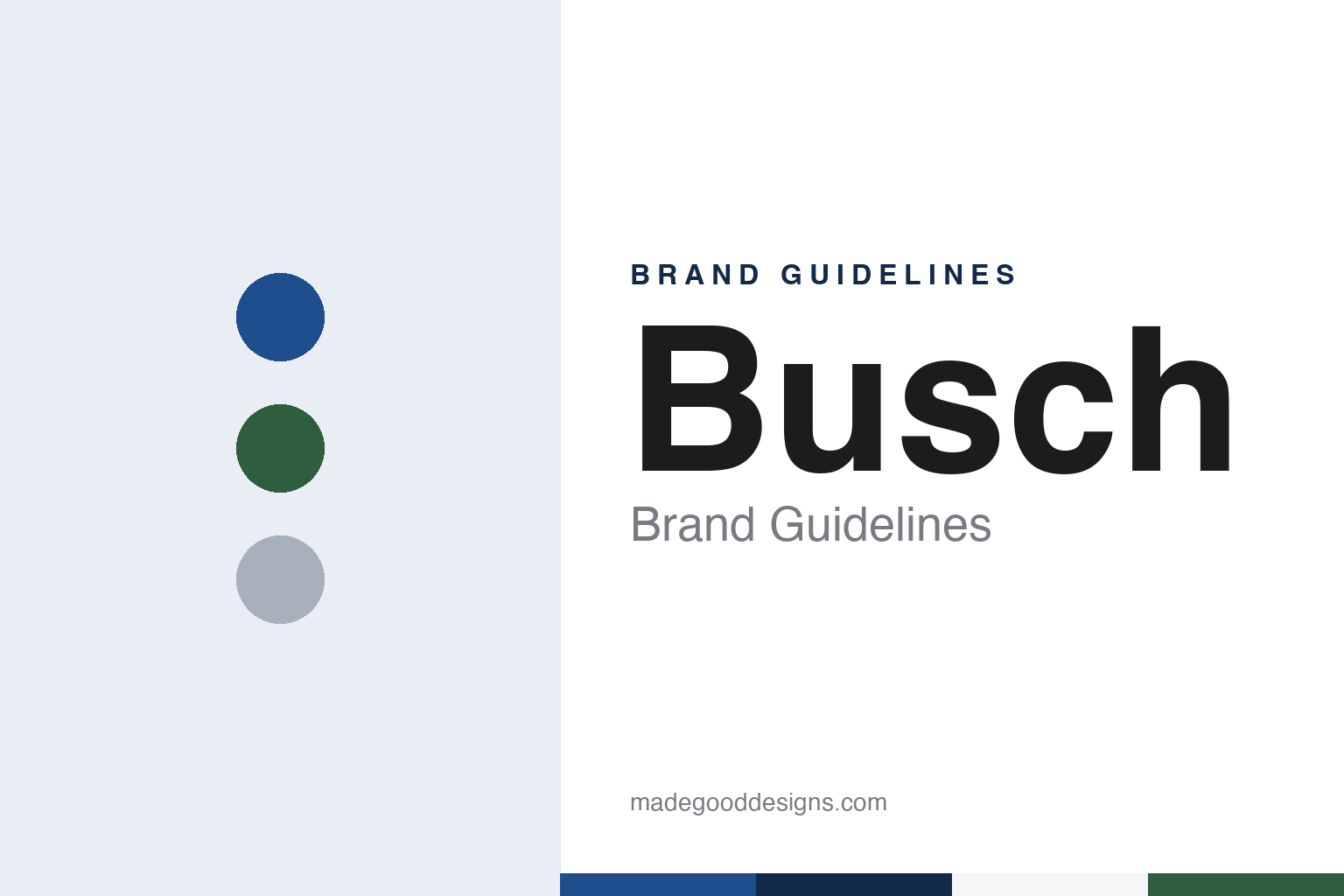
Busch Brand Guidelines
Anheuser-Busch’s mountain lager, launched 1955 as Busch Bavarian.
Aa
Two constants: a mountain blue, pine green and snow white palette and a condensed grotesque sans register. Abstract homage — not a Busch product or mark; no label, logo or can is reproduced.
A beer named after a ballpark
How a baseball ruling put the family name on a lager.
Busch is a lager brewed by Anheuser-Busch, the St. Louis brewer whose history English Wikipedia traces to the Bavarian Brewery opened in South St. Louis in 1852. Eberhard Anheuser bought into that brewery in 1860, and his son-in-law Adolphus Busch became a partner in 1869. The company introduced the beer now called Busch in 1955 as Busch Bavarian Beer, a date given both in the company’s own brand timeline and by the Society for American Baseball Research (SABR).
The reason it carries the family name is a baseball story. English Wikipedia’s history of Sportsman’s Park says Anheuser-Busch bought the St. Louis Cardinals in February 1953 and bought the ballpark that April. The brewery first wanted to call it Budweiser Stadium; Commissioner Ford Frick vetoed a ballpark named after a beer, so the company’s president, August “Gussie” Busch Jr., named it Busch Stadium after himself. English Wikipedia says Busch Jr. had led Anheuser-Busch as president since 1946. SABR’s history of the park, by Scott Ferkovich, sums up what followed: instead of naming the ballpark after a beer, the brewery named a beer after the ballpark. Busch Bavarian arrived two years later, and English Wikipedia notes that it got around the commissioner’s ruling, so that the ballpark carried a beer’s name after all.
The name has to be read with some care. Busch Stadium is the name of the Cardinals’ ballpark, Busch Gardens is a theme-park chain that Anheuser-Busch InBev announced on 7 October 2009 it would sell to the Blackstone Group, and the Busch family is a story in its own right; this guide is about the beer.
Colour
Mountains, a slogan and a sound.
From the start the brand leaned on mountain air. The company’s own timeline says Busch Bavarian was sold in 1955 with the line “Clear and Bright as Mountain Air.” When the beer was renamed Busch Beer in 1979 — a change also recorded by English Wikipedia — the company says it was given a lighter, sweeter taste and a new slogan, “Head for the Mountains,” together with a spoken “Buschhhhh” that the brand calls its sound of refreshment. The brand’s website still uses the line “The Sound of Refreshment” and invites visitors to head for the mountains.
That mountain theme carries through the extensions. The company says Busch Light Draft arrived in 1989 as the brand’s first light beer and lost the word “Draft” in 1994; Busch NA, a non-alcoholic version, followed in 1994 with the slogan “Mountain of Real Beer Taste,” and Busch Ice in 1995 with “Brave the Cold.” English Wikipedia gives the same years for Busch Light and Busch Ice and lists Busch at 4.3% alcohol by volume, Busch Light at 4.1% and Busch Ice at 5.9%, brewed with American and imported hops and a mix of malt and corn.
Outdoors imagery has since become a packaging habit. The company dates its first camouflage cans to 2006, and in September 2026 Anheuser-Busch announced limited-edition hunting cans under the headline “20 Years of the Hunt.” The brand site also presents a farming programme, “For the Farmers,” a NASCAR page and the line “This is Busch Country,” alongside fishing and country music.
Motor racing gave the name national reach. English Wikipedia’s history of NASCAR’s second-tier series says Anheuser-Busch’s Busch brand became its sponsor in 1984, when it was named the Busch Grand National Series; it became simply the Busch Series in 2003, and Anheuser-Busch ended the sponsorship after the 2007 season, when Nationwide Insurance took over.
Typography
Design and documentation.
The seven brands in this group are all American beer names: Busch, Natural Light, Keystone Light, Rolling Rock, Bell’s, Deschutes and Allagash. American beer brands in general sit at many different points in the trade, from independent breweries that still carry a founder’s name to labels that now belong to much larger brewing groups, and a single brand can be sold everywhere from a corner shop to a stadium bar.
A beer brand’s identity is usually carried less by a single bottle or can than by a label, a name and the place it promises, because the company behind the name may have changed hands, moved its brewing or grown far beyond the town where it started. That makes the questions behind each name worth asking plainly: who started it, who owns it now, and where its beer is actually brewed and packaged.
Each guide separates what independent sources record from what the company says about itself — its founding story, its owners over time, where its beer is brewed and how its labels have changed — and marks plainly what rests only on the company’s own word.
Aa
A condensed grotesque sans for a mountain lager. (Specimen set in Oswald, a sans-serif STAND-IN; NOT the Busch logo.)
Busch
A family name inside a global brewer.
The company behind Busch changed hands in 2008. English Wikipedia says the brewer InBev made its offer for Anheuser-Busch on 12 June 2008, the two sides agreed terms on 13 July, and the takeover was completed on 18 November 2008, creating Anheuser-Busch InBev. Anheuser-Busch continues as a wholly owned subsidiary with its headquarters in St. Louis, and English Wikipedia lists Busch among the American brands it produces, alongside Natural Light and Michelob, the super-premium lager Adolphus Busch introduced in 1896.
The range keeps moving. English Wikipedia records Busch Light Apple as a limited summer release in 2020 that came back in 2021 and again in 2025, with Anheuser-Busch announcing another return in April 2026; a Busch Light Lime followed for a limited time in 25 states in June 2025, MLive reported. In September 2020 the brand released Dog Brew, a non-alcoholic broth for dogs, ABC27 reported.
Today the brand site groups four core beers under the Busch name — Busch, Busch Light, Busch Ice and Busch NA — and calls the original lager “our most classic taste of refreshment.”
For a design guide, Busch shows how one idea — the mountains, carried from a 1955 slogan through a 1979 rename to light, ice and non-alcoholic versions and seasonal camouflage cans — can give a lager a consistent picture for seven decades. Compare Michelob, Anheuser-Busch’s older super-premium lager, and Keystone Light, a rival American light lager. For this guide we use mountain blue, pine green and snow white with a condensed sans, an unofficial interpretation; no product or logo is reproduced.
Explore & save
Keep Busch’s identity on hand — save it to a board in the Made Good inspiration library.
Busch identity set
Pin the Busch mountain blue, pine green and snow white palette and the condensed grotesque sans register to your own board.