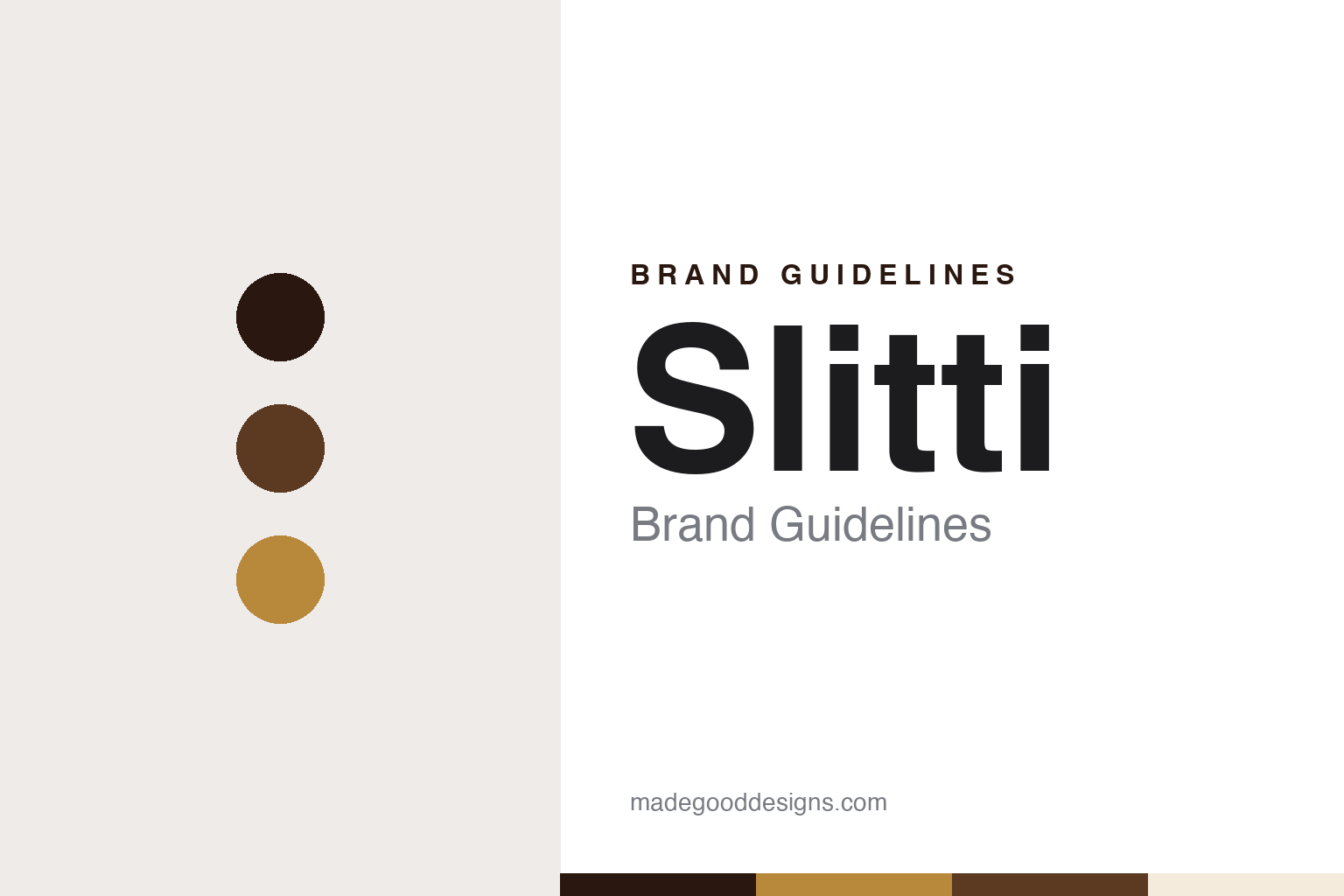
Slitti Brand Guidelines
The Tuscan coffee roaster that turned to chocolate.
Aa
Two constants: a Slitti espresso, cacao and gilt palette and a bottega display serif register. Abstract homage — not a Slitti product or mark; no bar, box, logo or photograph is reproduced.
Coffee first
A roastery in the Valdinievole.
Slitti is a family chocolate and coffee business in Monsummano Terme, a town in the Valdinievole in the province of Pistoia, between Florence and Lucca. It began not with cocoa but with coffee. The company says that in 1969 Luciano Slitti, whom it describes as a man of demanding taste, opened his own coffee roastery because he was not satisfied with the coffee his trading partners supplied, and began roasting his own blends. The company’s history page places that first roastery in neighbouring Montecatini Terme; the Italian food magazine La Gazzetta del Gusto, in a 2024 profile, and Italian Wikipedia place it in Monsummano Terme. Either way, the business has been rooted in the same corner of Tuscany from the start, and its factory and shop are in Monsummano today.
The second generation took over in 1988. The company says Luciano passed control to his son Andrea Slitti that year, when Slitti was already a respected name in coffee, and that Andrea’s brother Daniele joined him a few years later. La Gazzetta del Gusto says Andrea had begun teaching himself chocolate-making in the 1980s. In 1990, by the company’s account, he extended production to chocolate, and in 1993 he entered his first competition. The 2024 profile says that debut was in France, where he was the only Italian competing, and that he won a Grand Prix International de La Chocolaterie; we give that as the magazine’s account.
Coffee never left the business. Slitti still sells roasted coffee under its own name, from espresso blends for bars to ground single origins, capsules and pods, alongside its chocolate. The company quotes Andrea Slitti on how the two fit together: “I was born and raised in the world of coffee. Then I fell in love with chocolate.” The sources we checked describe Slitti as family-run and record no sale to an outside group or parent company.
Colour
Bars, spreads and spoons.
Slitti is best known in Italy for its prizes. The company says it has been awarded more than 200 times since 1993; a 2024 article in the trade site Foodonomy gave the figure as more than 180. Some of those awards can be checked independently. The Tavoletta d’Oro, awarded by the Compagnia del Cioccolato, an Italian chocolate association, lists Slitti among its winners for its GranCacao 73% dark bar in 2021 and 2022, its LatteNero 45% milk bar in 2021, and its Riccosa hazelnut and cacao spread in both years. In 2023 the association’s list names three more Slitti winners: sambuca-filled Calabacita figs, a filled bar called Gin Primo, and a Turkish-coffee praline, which links the chocolate back to the family’s first trade.
The range is broad. La Gazzetta del Gusto describes the bars as the backbone of the brand: GranCacao, a line of dark chocolate running up to 100% cocoa; Gran Bouquet, which pairs cacao with spices and coffee; and LatteNero, which it says Andrea Slitti created in 2000 as a new kind of milk chocolate made from three types of cocoa. It lists four hazelnut spreads — Slittosa, Riccosa, Gianera and Nocciolata — made with Piedmont’s Tonda Gentile Trilobata hazelnuts, and more than forty pralines, each cut and decorated by hand. The same profile credits Slitti with inventing the chocolate teaspoons that, it says, have since been copied everywhere; that is the magazine’s claim rather than a documented first.
In 2024 Slitti launched Fino de Aroma, a line of single-origin dark bars. Foodonomy reported five origins — Madagascar, Hispaniola, Ecuador, Peru and Venezuela — and said they come from a roasting and processing method Andrea Slitti developed in the Monsummano workshop. La Gazzetta del Gusto described the bars as 75% cocoa and named the growing areas, including Ambanja in Madagascar and the Satipo province of Peru.
Where the chocolate is made is straightforward: in Monsummano Terme. The 2024 profile describes the factory as a timber building with solar panels and water and heat recovery, and says the cocoa beans that arrive there come mainly from Ecuador, Peru, Venezuela, Jamaica and Madagascar, with Andrea Slitti following each stage from bean selection to finished chocolate.
Typography
Couverture and confectionery.
The seven brands in this group all make chocolate, and they come from three countries: Cacao Barry from France, Callebaut from Belgium, and Venchi, Caffarel, Majani, Guido Gobino and Slitti from Italy. They stand on either side of one of the oldest divides in the chocolate trade: between the chocolate that other people work with and the chocolate that is sold finished.
On one side is industrial couverture, chocolate made with enough cocoa butter to melt, temper and coat well, and sold in blocks, callets and pistoles to pastry chefs, chocolatiers, bakers and food manufacturers. A couverture brand often reaches the public second-hand, through a dessert, a bonbon or a filled biscuit, and its identity has to work on a sack in a professional kitchen as much as on a shelf. On the other side are confectionery houses, the Italian ones especially, whose names are on the box itself: pralines, gianduja, hazelnut spreads and filled bars, sold in their own shops and in fine-food stores, where the wrapper, the shop and the family name carry the brand.
Each guide separates what independent sources record from what the company says about itself — who founded it, who owns it now, where its beans come from and where its chocolate is made — and marks plainly what rests only on the company’s own word.
Aa
A bottega display serif — a shop sign over a Tuscan counter. (Specimen set in Playfair Display, a serif STAND-IN; NOT the Slitti logo.)
Slitti
A coffee bar and a chocolate counter.
For most of its history Slitti sold from Monsummano, where it has a shop as well as its factory. In February 2023, Foodonomy reported, it opened its first flagship store in Florence, on Piazza dell’Olio: a space of more than 150 square metres built around a coffee counter, a chocolate display holding more than forty pralines, a pastry counter and a retail corner. La Gazzetta del Gusto said the shop also serves gelato made by Daniele Slitti, whom it calls the family’s pastry chef, and that Slitti chocolate is sold in shops in more than twenty countries. The company now also runs guided tastings in both towns.
The brand’s two sides are easy to read in that layout. The coffee bar carries the 1969 roastery; the chocolate cases carry the business Andrea Slitti built from 1990. Unlike the large couverture houses, Slitti’s name reaches the public directly, on its own bars, jars and boxes, and through a shop that sells a cup of espresso as readily as a praline.
For a design guide, Slitti shows how a family firm can carry two trades under one surname, letting a roastery’s dark browns and a chocolatier’s gilt share the same counter. Compare Amedei, another maker from the stretch of Tuscany that La Gazzetta del Gusto calls the Chocolate Valley, and Guido Gobino, a Turin house that has shared Tavoletta d’Oro honours with Slitti. For this guide we use espresso brown, cacao and gilt with a serif, an unofficial interpretation; no product or logo is reproduced.
Explore & save
Keep Slitti’s identity on hand — save it to a board in the Made Good inspiration library.
Slitti identity set
Pin the Slitti espresso, cacao and gilt palette and the bottega display serif register to your own board.