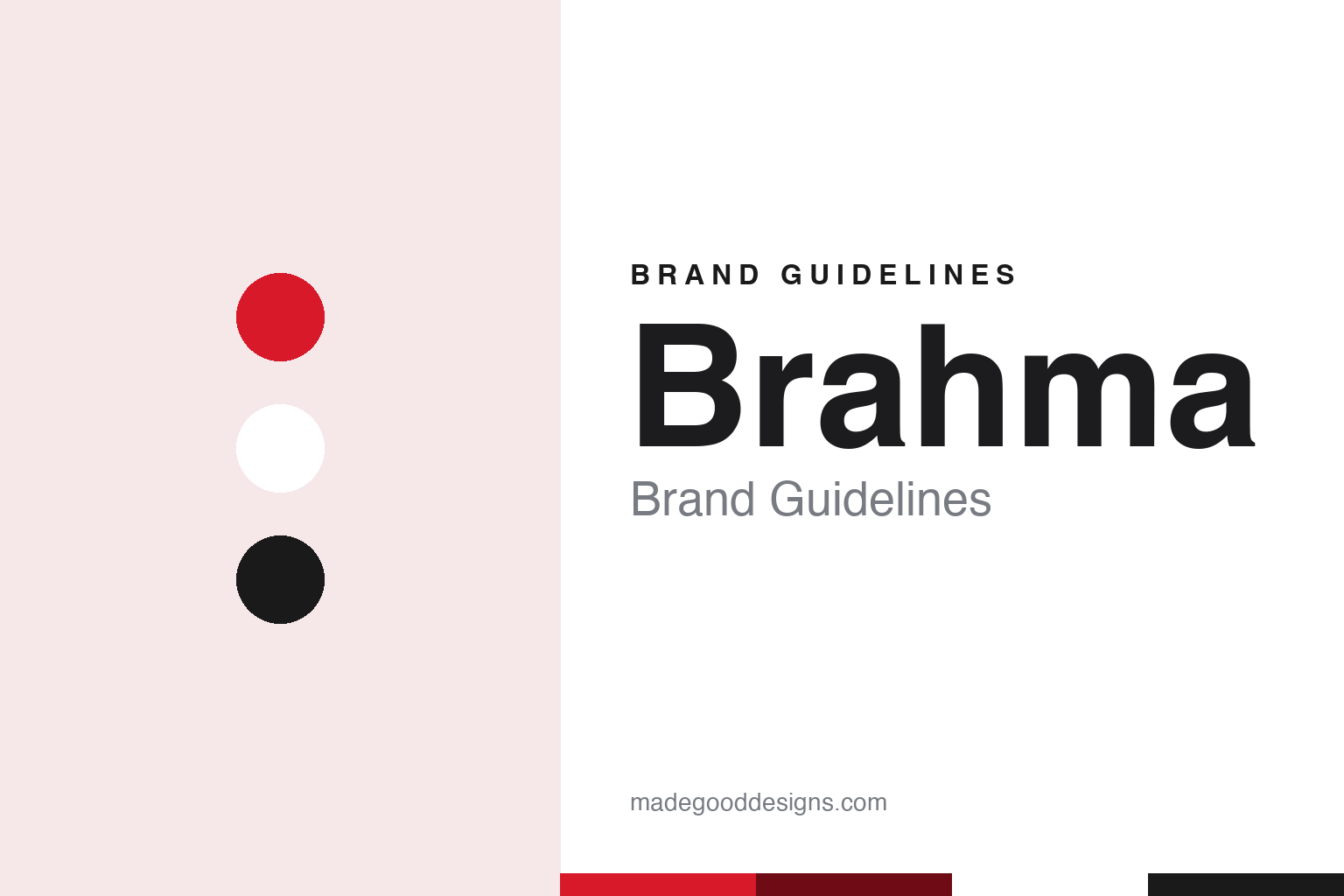
Brahma Brand Guidelines
Rio de Janeiro’s 1888 beer, from Villiger’s brewery to Ambev.
Aa
Two constants: a Brahma red, oxblood and white palette and a heavy grotesque sans register. Abstract homage — not a Brahma product or mark; no can, label or logo is reproduced.
Villiger’s brewery
A Swiss brewer in Rio, a bank in the 1990s, and Ambev.
Brahma was founded in Rio de Janeiro in 1888. Portuguese Wikipedia, citing Ambev’s own history, names the company as the Manufactura de Cerveja Brahma Villiger & Companhia and its creator as the Swiss-born brewer Joseph Villiger. The Jornal do Brasil reported in November 2024 that it was at the Bar Luiz, the downtown Rio bar founded in 1887, that Brahma sold its first draught beer in 1888. Where the name came from has never been settled: Portuguese Wikipedia sets out three theories — the Hindu god Brahma, the composer Johannes Brahms, and the English inventor Joseph Bramah, whose hand-operated beer engine is said to have inspired it.
The International Directory of Company Histories (volume 57, 2004) traces the early changes. It says Georg Maschke & Cia bought the brewery in 1894, that Brahma launched a Malzbier in 1914, and that in 1934 it released Brahma Chopp in bottles. Over the following decades Brahma bought other brewers, the same reference says, including Astra in 1971 and the Skol and Caracu brands in 1980.
A new set of owners arrived around 1990. English Wikipedia says Jorge Paulo Lemann, Carlos Alberto Sicupira and Marcel Telles bought the Companhia Cervejaria Brahma in 1989; the International Directory of Company Histories dates Banco Garantia’s majority stake to 1990 and says Telles became chief executive and restructured the company.
The great rival was Antarctica of São Paulo. On 1 July 1999 Brahma and the Companhia Antarctica Paulista merged to form Ambev, Folha de S.Paulo reported the next day, and English Wikipedia says Brazil’s competition authority CADE approved the merger on 30 March 2000. In 2004 Ambev combined with the Belgian brewer Interbrew to create InBev, which agreed to buy Anheuser-Busch in July 2008 and became Anheuser-Busch InBev. Ambev, based in São Paulo, has been part of that group since 2004 and is today a subsidiary of AB InBev.
Colour
Jingles, slogans and a colour fought over in court.
Brahma has been an advertiser for almost a century. Portuguese Wikipedia records that the launch of bottled Brahma Chopp in the 1930s was backed by the radio jingle “Chopp em Garrafa,” made by the agency of Bastos Tigre and sung by Orlando Silva. The same article lists the slogans that followed, among them “A Número 1” from 1991, “Refresca até pensamento” from 1999 to 2004, and the idea of the “Brahmeiro,” the loyal Brahma drinker, which runs through campaigns from 2008 onward.
When the beer was made a global brand, its identity was redrawn. Marketing Week reported on 31 March 2005 that the consultancy FutureBrand had developed a visual brand identity and packaging for Brahma, which InBev intended to turn into a “global beer.” English Wikipedia dates the internationally sold Brahma lager to 2004.
Ambev has also gone to court over colour. Migalhas reported on 12 April 2011 that Ambev had sued Grupo Petrópolis in January 2011, arguing that a red can of its Itaipava beer, a limited edition linked to the Stock Car racing series, imitated Brahma’s and would confuse drinkers; a Rio business court lifted the injunction it had won on 6 April 2011. The Rio de Janeiro state court later sided with Ambev, finding parasitic competition, but in January 2015 the Third Panel of Brazil’s Superior Court of Justice ruled by majority for Petrópolis, IstoÉ Dinheiro reported on 8 January 2015. The rapporteur, Minister João Otávio de Noronha, held that no one has an exclusive right to a colour and that the names Brahma and Itaipava were distinctive enough to avoid confusion. The same report said Brahma had launched its red can a few months before the dispute began.
Packaging has changed often along the way. Portuguese Wikipedia’s timeline of the brand records Brahma Extra in aluminium cans in 1989, twist-cap long-neck bottles in 1993, packaging that reacts to temperature in 2000, and a 300 ml returnable bottle in 2009.
Typography
Design and documentation.
The seven beers in this group come from Latin America and the Caribbean: Polar, Cusqueña, Pilsen Callao, Brahma, Medalla, Kalik and Banks. Several have long histories. Pilsen Callao was first brewed in 1863 at a brewery that Federico Bindels founded in the Peruvian port of Callao, Spanish Wikipedia says, and Brahma was first made by a Rio de Janeiro brewery founded in 1888, according to English Wikipedia. Cusqueña goes back to a branch of the Arequipa brewer Günther & Tidow opened in Cusco on 1 October 1908, Spanish Wikipedia says. Cervecería Polar began brewing at Antímano, west of Caracas, on 14 March 1941; Cervecería India, now the Compañía Cervecera de Puerto Rico, was founded in Mayagüez in 1937 by the Valdés Cobián brothers; and Banks (Barbados) Breweries opened at Wildey in September 1961, all according to English Wikipedia. Kalik is the newcomer: English Wikipedia dates the Bahamian lager to 1988.
Their ownership has gone in very different directions. Two are still made by companies based in their home markets: Polar belongs to Empresas Polar, the privately held Venezuelan group whose president is Lorenzo Mendoza, and Medalla Light, which English Wikipedia dates to 1980, is made by the Compañía Cervecera de Puerto Rico, run since 2017 by Grace Marie Valdés. Brahma has been part of Ambev since the company was created in 1999 from the merger of Brahma and Antarctica, and Ambev is now a subsidiary of Anheuser-Busch InBev, English Wikipedia says. In Peru, Backus and Johnston bought 62 per cent of the Compañía Nacional de Cerveza, the maker of Pilsen Callao, in 1994, and Cervesur, the maker of Cusqueña, joined the Backus group in 2000, Spanish Wikipedia says; Backus was part of SABMiller from 2005 and has belonged to AB InBev since AB InBev’s takeover of SABMiller in 2016, according to English Wikipedia. Kalik is brewed in Nassau by Commonwealth Brewery, which its 2011 financial statements describe as a subsidiary of Heineken; they record that Heineken’s purchase of the shares held by its Bahamian partner took effect on 17 May 2010, and that the company was listed on the Bahamas International Securities Exchange on 24 May 2011. Banks passed from Barbadian ownership to an Ambev subsidiary in December 2015, according to Ambev’s filing with the US Securities and Exchange Commission, and since 31 July 2025 KOSCAB Holdings, a Coca-Cola bottler, has held the majority of SLU Beverages, which controls Banks Holdings, Nation News reported.
A beer brand’s identity is usually carried less by a single bottle than by a label, a name and the place it promises, because the company behind the name may have changed hands or moved its brewing. Each guide separates what independent sources record from what the brewer says about itself — its founding story, its owners over time, where its beer is brewed and how its labels, cans and advertising have changed — and marks plainly what rests only on the company’s own word.
Aa
A heavy grotesque sans for a bold wordmark on a red can. (Specimen set in Archivo Black, a sans-serif STAND-IN; NOT the Brahma logo.)
Brahma
One name across a family of beers.
Brahma is a family of products rather than a single beer. Portuguese Wikipedia lists Brahma Chopp, the lager Brahma Extra, launched in 1943, the dark Brahma Malzbier, and the alcohol-free Brahma Zero, renamed in 2013 from Liber Zero Zero; English Wikipedia adds that the brand is sold in Guatemala and other Central American countries as Brahva. Portuguese Wikipedia says the brand is sold in around thirty countries, while English Wikipedia says it is produced mainly for the Brazilian market.
The name sits next to others in the same house. Ambev also owns Guaraná Antarctica, the soft drink from the former rival it merged with, and the Brahma name has itself drawn criticism: English Wikipedia notes that in 2020 an interfaith coalition asked the company to drop the name of the Hindu god from the brand.
For a design guide, Brahma shows how a beer can turn a single colour into an asset worth defending, and how a nineteenth-century Rio brewery’s name can be rebuilt as an international identity without losing its Brazilian loyalists. Compare Guaraná Antarctica, the São Paulo soda from the other half of Ambev, and Quilmes, the Argentine lager. For this guide we use Brahma red, oxblood and white with a heavy sans, an unofficial interpretation; no product or logo is reproduced.
Explore & save
Keep Brahma’s identity on hand — save it to a board in the Made Good inspiration library.
Brahma identity set
Pin the Brahma red, oxblood and white palette and the heavy grotesque sans register to your own board.


