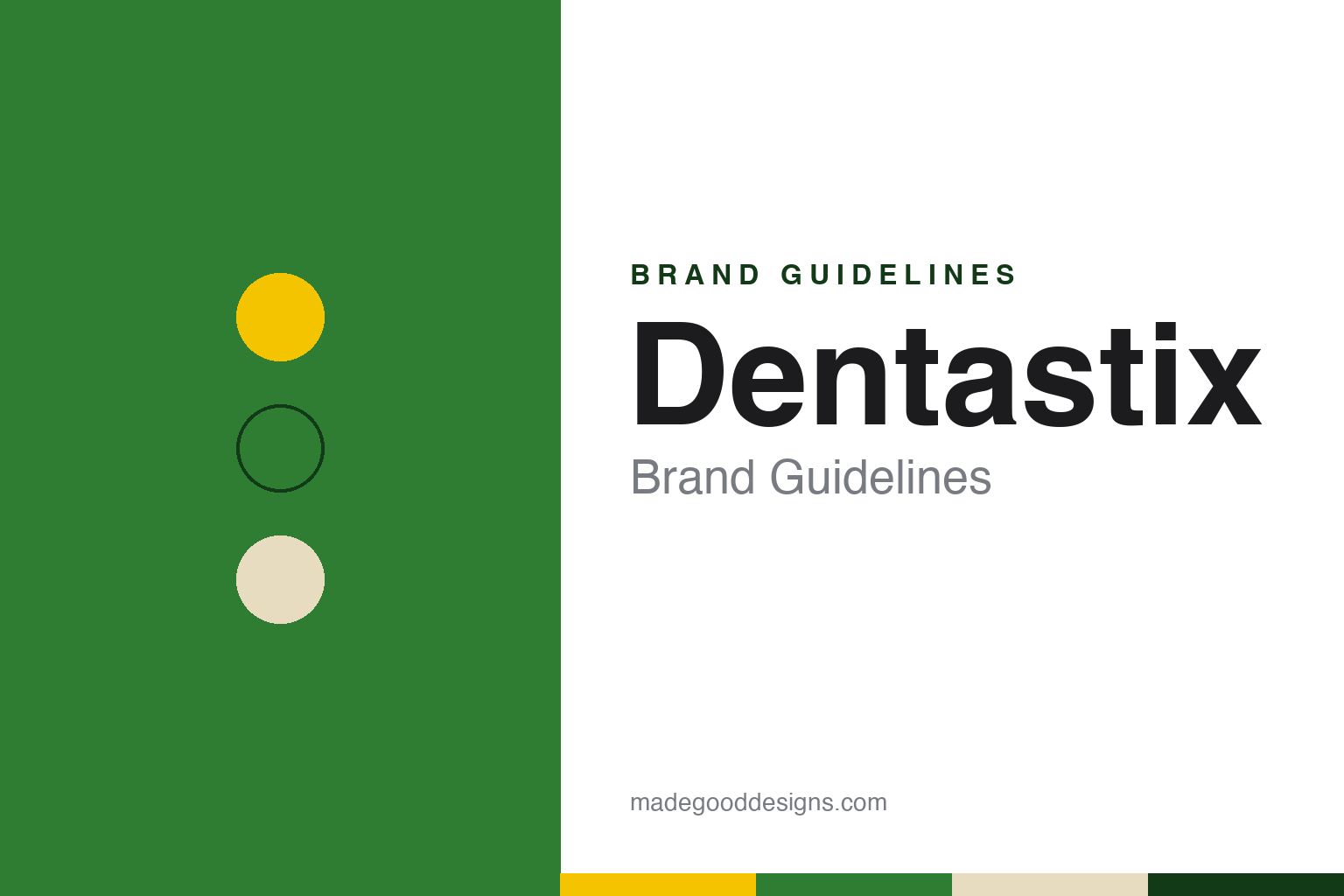
Dentastix Brand Guidelines
The X-shaped chew from Mars’s Pedigree range.
Aa
Two constants: a yellow and green palette and a rounded sans register. Abstract homage — not a Dentastix or Pedigree product or mark; no chew, pack or logo is reproduced.
A Pedigree line
A treat brand that lives inside a dog-food brand.
Dentastix is not a company but a product line. It is sold under Pedigree, the dog-food brand of Mars, and on packs and in trade announcements it usually appears as Pedigree Dentastix. Pedigree’s own history page dates the line to 2001, listing “Dentastix Launch” in its timeline between the pouch packaging it introduced in 2000 and an adult dry food in 2003.
Pedigree itself reached the United States through an acquisition. Mars took over Kal Kan Foods of Los Angeles in 1968, and in 1988 Kal Kan renamed its dog food Pedigree, the name Mars already used outside the United States, English Wikipedia says, citing the Chicago Tribune of August 1988. Pedigree’s timeline puts it the same way: in 1988 “we brought all of our trusted recipes together under the Pedigree name.” Pedigree is part of Mars Petcare, a division of the American group Mars, Incorporated, according to English Wikipedia.
The Dentastix name has its own legal record in the United States. The word mark DENTASTIX was filed with the US Patent and Trademark Office on 1 March 2002 as an intent-to-use application for “pet food,” and registered on 30 November 2004. The record gives 15 September 2003 as the date of first use in US commerce, names Mars, Incorporated as the owner, and shows the registration renewed, with a status date of February 2025. The mark is registered in standard characters, without a claim to any particular lettering or colour.
Colour
A cross-shaped stick, then bitesize chunks.
The product’s most recognisable feature is its shape. Pedigree’s US website describes the original stick as having a “distinctive X-shape,” and sells it in versions sorted by the size of the dog — toy and small, medium and large — in flavours that include original (chicken), beef, bacon and a “fresh” variety. The ingredient list for the original large stick begins with rice flour, wheat starch and glycerin, according to the same site. Most of the US range is listed in pouches, with one boxed pack.
On Pedigree’s US site, Dentastix sits as one treat line among several, next to Chewy Chunx, Jumbone, MarroBone, Tasty Biscuits and Twisty Chews. The site’s footer credits “Mars or Affiliates.”
In Britain the line was extended in June 2020, when Mars Petcare launched Pedigree Dentastix Chewy Chunx, a bitesize version, from 15 June, the trade magazine Wholesale Manager reported. It came in chicken and beef flavours, in mini and maxi sizes for smaller and larger dogs, and Scottish Grocer reported in July 2020 that the launch was backed by a social-media and television campaign. Arthur Renault, then marketing portfolio director at Mars Petcare, told the trade press the company knew “a one size fits all approach doesn’t work.”
Advertising has played with the product itself. In September 2019 the marketing database WARC published a case study on Pedigree SelfieSTIX, a promotion that let dog owners in New Zealand take selfies with their dogs — a pun on the Dentastix name.
Typography
Dog treats and the companies behind them.
The seven brands in this group are all dog treat names: Greenies, Zuke’s, Milk-Bone, Dentastix, Beggin’, WHIMZEES and Pet Munchies. Dog treat brands in general sit at many different points in the pet trade, from founder-run businesses that began with a single recipe to names that now belong to much larger pet food groups, and a single brand can be sold everywhere from a supermarket aisle to a veterinary practice or an online shop.
A dog treat brand’s identity is usually carried less by the treat itself than by a pack, a name and a character or colour that owners learn to recognise, because the company behind the name may have changed hands, moved its production or grown far beyond the place where it started. That makes the questions behind each name worth asking plainly: who started it, who owns it now, and where its treats are actually made.
Each guide separates what independent sources record from what the company says about itself — its founding story, its owners over time, where its treats are made and how its packs have changed — and marks plainly what rests only on the company’s own word.
Aa
A soft, rounded sans for a friendly pet-treat register. (Specimen set in Fredoka, a rounded-sans STAND-IN; NOT the Dentastix or Pedigree logo.)
Dentastix
A sub-brand built on a shape and a name.
Dentastix shows a different kind of brand from a stand-alone company. It has no separate corporate history: it was launched inside Pedigree, a Mars brand, and has stayed with Mars since. Ownership is therefore straightforward. Mars, Incorporated — a Delaware corporation based in McLean, Virginia, according to the trademark record — holds the US mark, and Pedigree’s US website credits Mars or its affiliates.
What the line has developed instead is a recognisable product format and a family of extensions. The X-shaped stick is the core, sold in sizes matched to the dog; Chewy Chunx brought a bitesize format to British shops in 2020; and the US range now includes several flavours under the same name. The SelfieSTIX promotion of 2019 borrowed the ending of the name for a pun.
The pet-food business behind it is old. English Wikipedia says Mars Limited, then based in Slough, bought the Manchester firm Chappel Brothers, maker of Chappie dog food, in 1934, citing Kenneth Hudson’s Industrial History from the Air of 1984; the Pal and Lassie dog-food brands followed in the 1950s, according to a Mars Petcare history page cited by the same article. In the United States, Mars renamed Kal Kan’s Pedigree Select as Cesar in 1998, Advertising Age reported. Dentastix was added to that portfolio three years later, as a treat rather than a meal.
Mars also owns Greenies, another dog chew brand, so the company has two separately named chew brands; Dentastix is sold under the Pedigree name.
For a design guide, Dentastix shows how a sub-brand can be built on a single product shape and a coined name, with the parent brand doing the reassuring. Compare Pedigree, the Mars dog-food brand it belongs to, and Greenies, the other Mars chew. For this guide we use Pedigree yellow, leaf green and chew beige with a rounded sans, an unofficial interpretation; no product or logo is reproduced.
Explore & save
Keep Dentastix’s identity on hand — save it to a board in the Made Good inspiration library.
Dentastix identity set
Pin the Dentastix yellow and green palette and the rounded-sans register to your own board.