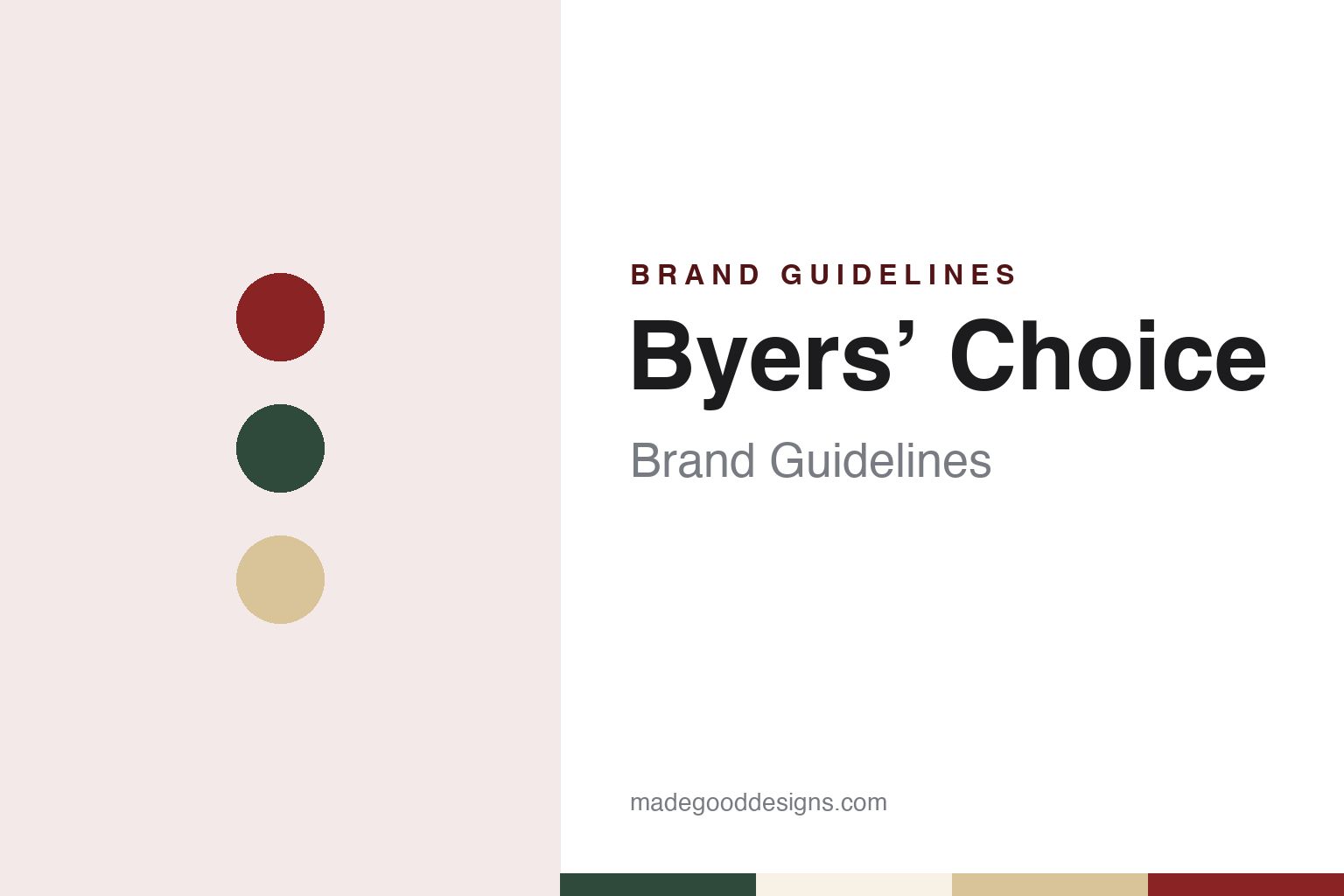
Byers’ Choice Brand Guidelines
Victorian singers, made by hand in Pennsylvania.
Aa
Two constants: a caroler red, holly green and muslin palette and a Victorian serif register. Abstract homage — not a Byers’ Choice product or mark; no figure or logo is reproduced.
Shop windows in London
A family craft that outgrew the kitchen table.
Byers’ Choice started with a single maker. English Wikipedia describes Byers’ Choice Ltd. as a family-owned and family-operated maker of Christmas figures and holiday decorations based in Chalfont, Pennsylvania, known for its line of Carolers, citing a 2014 article from the Pittsburgh Post-Gazette. It says Joyce Byers, a former fashion designer and artist, made her first Carolers after a trip to London, where she had seen winter scenes on display in shop windows; Wikipedia attributes the account to a December 2000 profile in Collector Editions.
Back in Pennsylvania, Wikipedia says, she built her first figures from wire, newspaper, fabric and clay she found around the house. She used them to decorate her own home at Christmas, and when visitors asked where they came from, she spent the following autumns making more as gifts, helped by her husband Robert and their two sons.
The hobby turned into a trade. Wikipedia says that in the early 1970s Joyce offered some of her figures at a local Women’s Exchange and then at other local stores, and that within a few years the family could no longer keep up and hired art students to help in the summers. Citing Giftware Magazine from October 1998, it says the family and their helpers set up shop in their barnyard, among sheep and geese. Wikipedia says the company was formally created in 1978 and soon hired a national sales representative to sell the Carolers across the United States.
Colour
Wire, tissue, clay and cloth.
The construction of a Caroler has stayed close to the original kitchen-table method. Wikipedia says Joyce Byers designs each line, sculpting an original head that becomes the mould for the heads in that line and designing the clothing that serves as the template for every figure in it. The body of each Caroler, it says, is tissue paper wrapped around a skeleton of bent wire.
The heads are cast from those moulds in clay. Wikipedia, citing the Eastern Pennsylvania Business Journal in 2003, says artisans add details such as nostrils and lips as each head comes out of the mould, then paint it and add the eyes, eyebrows and colour. The heads and bodies then go to dressers, who clothe each figure in fabric cut to Joyce’s designs before attaching the head and hair. Wikipedia says a stamp on the base of every Caroler marks it as a Byers’ Choice piece, and that the company manufactures its products in the United States.
The range has widened well beyond Victorian carolling, although Wikipedia says the company still makes traditional figures close to the original Victorian-style Carolers, and that Joyce Byers gives each line its own style. Wikipedia lists pieces for Easter, Halloween and Thanksgiving, figures drawn from Charles Dickens’s A Christmas Carol and the ballet The Nutcracker, and a line of antique automobile models. The company’s own website groups its products today under headings including Carolers, Snowmen, Advent Calendars and a German Handcrafted range, and offers a custom-design service. Its collection headings include the Twelve Days of Christmas, Cries of London, Nativity, Historical and Salvation Army figures, with separate sections for display accessories and for Caroler care and storage.
Typography
Design and documentation.
Christmas decor and ornament brands occupy an unusual corner of the home trade. Their products are bought for a few weeks of the year but kept for many more, unpacked from the same boxes each December and often handed down within a family, so a name in this field is asked to stand for continuity as much as for novelty.
Much of the category leans on borrowed tradition: mouth-blown glass, carved figures, village scenes and old-fashioned lettering that point back to older European workshop traditions. Behind that look, the companies themselves may be family firms, importers, designers who work with makers elsewhere, or businesses that have changed owners several times, and the place a brand calls home is not always the place its pieces are made.
Each guide separates what independent sources record from what a company says about itself — who founded it and where, who owns it now, where its pieces are produced and how its packaging and marks have looked over time — and marks plainly what rests only on the company’s own word.
Aa
A bookish transitional serif. (Specimen set in Libre Baskerville, a serif STAND-IN; NOT the Byers’ Choice logo.)
Byers’ Choice
A family business with partner lines and a foundation.
Byers’ Choice has remained in the family. English Wikipedia describes it as family-owned and family-operated and as a privately held company, with Joyce Byers as founder and her husband, Robert Byers Sr., as co-founder; it says their sons Robert and Jeffrey Byers have been involved in running it. Wikipedia also describes the company as a Subchapter S corporation, and says Robert Byers Sr., though retired, has directed its philanthropic efforts. The company’s website gives its home as Chalfont, Pennsylvania, where it runs a visitor centre.
Partnerships have shaped several of its figures. Wikipedia says that in 1992 the company worked with the Salvation Army on a Caroler showing the organisation’s red kettle and bell ringer, that it still makes Salvation Army Carolers, and that it donates a portion of the proceeds from their sale to the charity. It also says Byers’ Choice worked with the Colonial Williamsburg Foundation on a line of figures depicting characters from Revolutionary-era Virginia, sold by the foundation and other retailers.
The family set up a charity of its own. Wikipedia says the Byers family started the Byers’ Foundation in 1986, and that it has given to the Salvation Army, the YMCA, Covenant House and Habitat for Humanity. The company also appears in legal textbooks: Wikipedia says a case brought after an unrelated party registered the domain name buyerschoice.com is used as an example in books on United States internet law, including Jonathan D. Hart’s field guides of 2005 and 2008.
For a design guide, Byers’ Choice shows how a handmade product can carry a brand on its own, with a consistent face, costume and scale doing the work a logo does elsewhere. Compare a collectible village maker in our Department 56 brand guidelines and a glass-ornament brand in our Christopher Radko brand guidelines. For this guide we use caroler red, holly green and muslin with a serif, an unofficial interpretation; no product or logo is reproduced.
Explore & save
Keep Byers’ Choice’s identity on hand — save it to a board in the Made Good inspiration library.
Byers’ Choice identity set
Pin the Byers’ Choice caroler red, holly green and muslin palette and the Victorian serif register to your own board.


