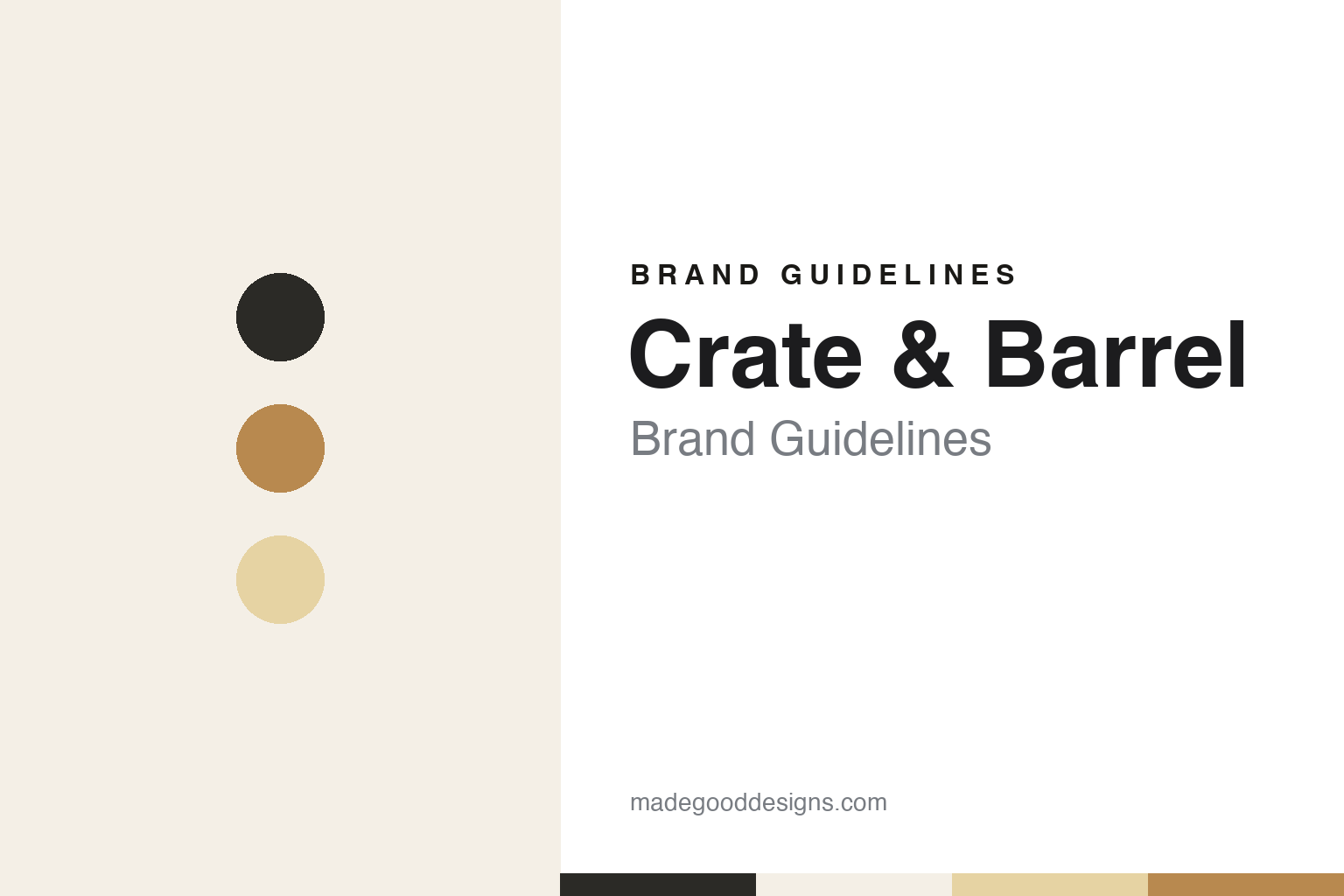
Crate & Barrel Brand Guidelines
A Chicago shop that turned its packing cases into a display, a name and a way of selling.
Aa
Two constants: a near-black, barrel oak and excelsior straw palette and a clean geometric sans register. Abstract homage — not a Crate & Barrel product or mark; no store, catalogue or logo is reproduced.
A shop in Chicago’s Old Town
Imported glass and china, stacked on their own packing cases.
Crate & Barrel began as one shop on the North Side of Chicago. English Wikipedia says Gordon and Carole Segal opened the original store on 7 December 1962, citing a 1995 report in The New York Times. The shop occupied part of an old elevator factory on North Wells Street in Old Town, a neighbourhood Wikipedia describes as bohemian at the time, citing Inc. magazine in 1985 and the trade title Retail Traffic in 2001. The company trades as Crate & Barrel, a name it styles as one word with an ampersand in the middle, and Wikipedia gives its legal name as Euromarket Designs, Inc.
The buying model came first. Wikipedia places the opening against a growth in world trade in home furnishings in the early 1960s, and says the Segals sought out small European companies that had no representation in America, buying directly from their factories so that the goods could reach shoppers without a wholesaler’s markup. According to the same article, direct imports from Europe have remained central to the range, alongside glass and textiles from Thailand, Mexico and India.
The name came from the shop fittings. Wikipedia says the Segals took it from the materials they first used to display the goods in their Chicago store. Citing Gordon Segal’s interview on the podcast How I Built This, it says a friend suggested calling the business “Barrel and Crate”, and that Carole Segal thought the words should be reversed. The couple turned over the crates and barrels that the merchandise had arrived in, let the wood excelsior packing spill out, and stacked china and glass on top. Wikipedia says the arrangement underlined the shop’s main selling point: that the products were direct imports.
A store visit shaped what came next. Wikipedia says that in 1966 Gordon Segal and the designer Lon Habkirk visited the Design Research store in Cambridge, Massachusetts, which had an “enormous influence” on their approach to retailing. It quotes Habkirk as saying that eventually they took the whole idea and turned it into a formula that could be repeated from store to store.
Colour
From the Chicago suburbs to Manhattan, and into German ownership.
The chain grew slowly at first. Wikipedia says a second store opened in 1968 at the Plaza del Lago shopping centre in suburban Wilmette, Illinois, and a third in Oak Brook in 1971. The company’s debut outside the Chicago area came in 1977 at Chestnut Hill, Massachusetts. In 1979, Wikipedia says, Crate & Barrel opened a store in Cambridge in the building that had been designed for the recently closed Design Research, the shop it had so admired; The Harvard Crimson reported in November 2008 that this store was to close, and Wikipedia says it shut in 2009.
New York followed in the 1990s. The New York Times reported in March 1995 on the opening of the company’s first Manhattan store. Three years later the ownership changed. Wikipedia says the Segals sold a majority stake to the German mail-order group Otto in 1998, and The New York Times confirmed in June 2003 that Gordon Segal had sold a majority stake to the privately held Otto Versand of Germany in 1998, while keeping creative control of the business. Wikipedia, citing Forbes in 2014, says Otto became the sole owner in 2011, so the Otto Group has owned Crate & Barrel outright since that year.
Leadership passed from the founders in stages. Wikipedia says Barbara Turf, first hired in 1968, succeeded Gordon Segal as chief executive in May 2008, and that she retired in 2012 and was replaced by Sascha Bopp. After Bopp left in August 2014, it says, the Otto Group asked Segal to return as a consultant while a successor was found. Doug Diemoz, who had worked at Restoration Hardware and Williams-Sonoma, became chief executive on 1 August 2015, the Chicago Tribune reported, and left in April 2017. Neela Montgomery then led the company until August 2020. The Chicago Business Journal reported on 7 July 2020 that Janet Hayes, formerly president of the Williams Sonoma brand, would take over; Wikipedia gives her start date as 1 August 2020 and says Sergio Bucher became chairman of Crate & Barrel Holdings in February 2020.
Store formats changed as well. Wikipedia says the Michigan Avenue flagship on Chicago’s Magnificent Mile closed in January 2018 and that the building later reopened as a Starbucks roastery, citing Forbes in 2019. In 2019 the company opened The Table at Crate, a restaurant run with the Cornerstone Restaurant Group, inside its Oak Brook store.
Typography
Design and documentation.
The brands in this group are American home-furnishings retailers: store and catalogue chains that sell furniture, tableware, lighting and decorative goods under their own names. A retailer of this kind usually designs or commissions much of what it sells and has it made by outside suppliers, so the name on the shopping bag is often the same name that appears on the product itself.
For a home-furnishings retailer, identity is carried less by any single object than by the whole experience around it: the wordmark over the door, the catalogue that arrives in the post, the way a room is staged on the shop floor or on a website, and the bag a customer carries home. Because these companies are often owned by larger groups, sold, merged or rebuilt after hard years, the questions behind each name are worth asking plainly: who started it, who owns it now, and where the goods it sells are designed and made.
Each guide separates what independent sources record from what the company says about itself, covering its founding story, its owners over time and how its stores and catalogues have changed, and it marks plainly what rests only on the company’s own word.
Aa
A clean geometric sans, plain and even, like a label stencilled on a packing case. (Specimen set in Jost, a sans STAND-IN; NOT the Crate & Barrel logo.)
Crate & Barrel
Sister brands, franchise partners and a vignette style of display.
The company has added sister brands around the original name. Wikipedia says Crate & Barrel created CB2, a home-furnishings division aimed at younger adults, in 2000. It says the children’s brand The Land of Nod, acquired in 2001, had closed all its stores by the end of spring 2018, and the Chicago Tribune reported in February 2018 that Crate & Barrel would replace it with Crate & Kids, which Wikipedia says launched online and in stores on 7 March 2018. In June 2019 the San Francisco Business Journal reported that Crate & Barrel was buying Hudson Grace, a San Francisco home décor, entertaining and gift brand.
Outside the United States the name has largely travelled through partners. The New York Times reported in November 2008 that the company had opened a store at Yorkdale Shopping Centre in Toronto that September, which Wikipedia describes as its first outside the United States. Gulf News reported on 30 September 2009 that the Al Tayer Group would open Crate & Barrel stores in Dubai under a franchise agreement. Wikipedia says the brand reached Singapore in January 2013 with a store on two floors of ION Orchard, Peru in 2015, Colombia in December 2016 through a franchise agreement with Falabella, and Costa Rica in July 2017. Wikipedia lists the company’s headquarters in Northbrook, Illinois.
The way the goods are shown is part of the identity. Wikipedia says Crate & Barrel presents its housewares and furniture in a “vignette” style, grouping items together as they might appear in a home. The same article credits the original Old Town displays, built from upturned packing cases and wood excelsior, with making the case for direct imports on the shop floor; in both approaches the arrangement of the goods carries the message.
For a design guide, Crate & Barrel shows how a name can come straight from the shop floor: two plain nouns for the containers the stock arrived in, joined by an ampersand, describe the founders’ promise of goods imported directly from the maker. Compare its younger sister brand in our CB2 brand guidelines and a long-time rival in our Pottery Barn brand guidelines. For this guide we use near-black, barrel oak and excelsior straw with a geometric sans, an unofficial interpretation; no product or logo is reproduced.
Explore & save
Keep Crate & Barrel’s identity on hand — save it to a board in the Made Good inspiration library.
Crate & Barrel identity set
Pin the Crate & Barrel near-black, barrel oak and excelsior straw palette and the crate sans register to your own board.


