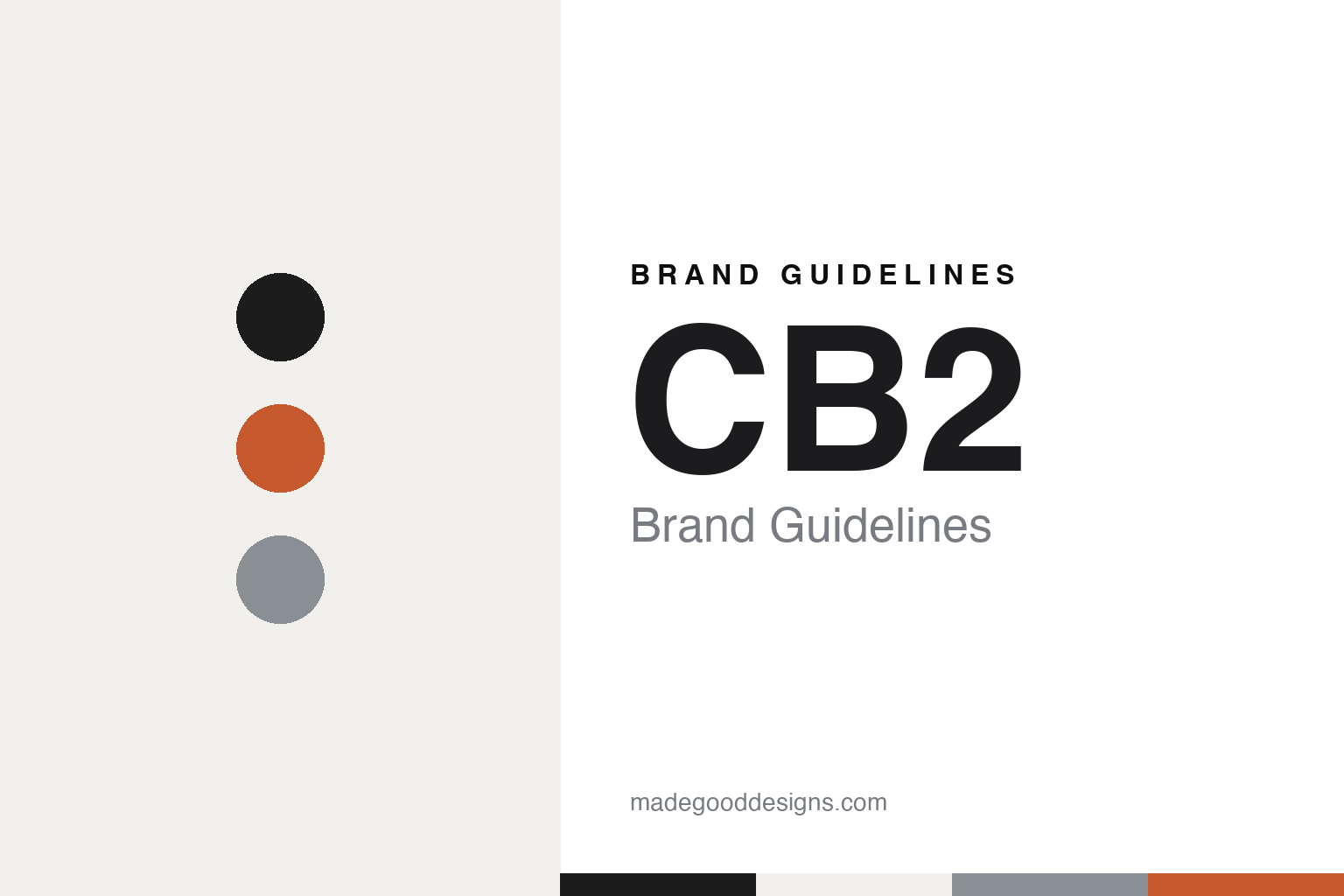
CB2 Brand Guidelines
A smaller, sharper sibling that started with gift-shop novelties and grew into a modern furniture brand.
Aa
Two constants: a loft black, rust orange and mesh steel palette and a compact grotesque register. Abstract homage — not a CB2 product or mark; no store, catalogue or logo is reproduced.
A younger store in Lakeview
Crate & Barrel’s founders try a hipper, more urban format.
CB2 began as an experiment inside an established retailer. The New York Times reported on 22 June 2003 that CB2, an offshoot of the Crate and Barrel chain founded by Gordon and Carole Segal, had opened in January 2000, and Reuters reported in November 2007 that Crate and Barrel opened its first CB2 store in 2000 in Chicago. English Wikipedia, in its article on the parent company, describes CB2 as a home-furnishings division aimed at young adults and also gives 2000 as the year it was created.
The original shop had a look of its own. The New York Times described it in 2003 as an industrial-looking building with an angular, mesh metal awning in the Lakeview section of Chicago, set between a Trader Joe’s market and a noisy elevated-train stop. The paper said that, like its parent, the store was neat, colourful and meticulously organised, but that CB2 set out to be hipper and more urban than Crate and Barrel, so as to reach younger shoppers who might be bored or intimidated by the original chain.
The early stock leaned towards wit. The 2003 article listed tongue-in-cheek products that the paper said would never be found at Crate and Barrel, among them a book of 1950s-style postcards, suede pillows, drinking glasses printed with cocktail recipes and eye masks sold as a hangover remedy. It reported that when CB2 opened some of its merchandise was shared with Crate and Barrel, but that the overlap had narrowed as the store came to understand its customers: college students decorating dorm rooms, recent graduates in their own apartments and newlyweds in their first homes.
Growth was deliberately slow. The New York Times wrote in 2003 that people had been asking Gordon Segal for three years when he planned to open a second CB2, and that he answered “when he’s good and ready”. The paper noted that it had taken him six years to open the second Crate and Barrel, in 1968, and said he intended the same patient approach for CB2, keeping the concept in what it called an incubator while he watched its results.
Colour
From novelty goods to furniture for smaller spaces.
The concept was rebuilt before it was expanded. In an interview with Reuters published on 6 November 2007, Gordon Segal said CB2 had originally been pitched at young shoppers furnishing their first apartments, but that the company had found its intended customers were older than expected. He also said the first store had carried too many small “clever” décor items, which did not generate enough sales on their own.
Reuters reported that the retailer responded by adding more furniture, aimed at a wider range of shoppers looking for stylish, contemporary pieces at affordable prices. By 2007, the report said, CB2 sold modern furniture such as sleek sofas and storage systems designed for smaller spaces like apartments and lofts, alongside décor that included striped rugs, paper and wire flowers and decorative heads. According to Segal, sales were helped by launching a website in 2004 and a catalogue in January 2006, so that the brand could reach customers well beyond its Chicago shops.
The New York opening marked a change of scale. Reuters said Crate and Barrel was opening its first New York CB2 store on Tuesday 6 November 2007, describing it as the retailer’s first CB2 store outside Chicago. Segal used the occasion to explain the pace. “We grow carefully. We grow deliberately,” he told the agency, adding that the company was not rushing to build a quick success story. Reuters reported that a San Francisco store was planned for early 2008, that sites were being scouted in other American cities, and that Crate and Barrel expected to open both Crate and Barrel and CB2 stores in Canada.
The ownership sits with the parent. The New York Times reported in 2003 that Segal had sold a majority stake in Crate and Barrel to the German mail-order company Otto Versand in 1998 while keeping creative control, and English Wikipedia, citing Forbes, says the Otto Group became the sole owner of Crate & Barrel in 2011. CB2 has therefore been part of an Otto Group business throughout its life, run as a sister brand to Crate & Barrel rather than as a separate company.
Typography
Design and documentation.
The brands in this group are American home-furnishings retailers: store and catalogue chains that sell furniture, tableware, lighting and decorative goods under their own names. A retailer of this kind usually designs or commissions much of what it sells and has it made by outside suppliers, so the name on the shopping bag is often the same name that appears on the product itself.
For a home-furnishings retailer, identity is carried less by any single object than by the whole experience around it: the wordmark over the door, the catalogue that arrives in the post, the way a room is staged on the shop floor or on a website, and the bag a customer carries home. Because these companies are often owned by larger groups, sold, merged or rebuilt after hard years, the questions behind each name are worth asking plainly: who started it, who owns it now, and where the goods it sells are designed and made.
Each guide separates what independent sources record from what the company says about itself, covering its founding story, its owners over time and how its stores and catalogues have changed, and it marks plainly what rests only on the company’s own word.
Aa
A compact, slightly condensed grotesque for short, confident labels. (Specimen set in Archivo, a sans STAND-IN; NOT the CB2 logo.)
CB2
A two-character name that travels through partners.
CB2 has followed its parent abroad through franchise partners. A press release from the Dubai-based group Majid Al Futtaim, published on Zawya on 30 June 2022, announced the opening of its first bricks-and-mortar CB2 store in the region, on level 2 of the Mall of the Emirates in Dubai, after a temporary pop-up in the same mall. The release described the offer as a curated collection of contemporary furniture and décor.
The brand also sits inside a wider family. English Wikipedia lists CB2 as one of the sister brands of Crate & Barrel, alongside the children’s business that replaced The Land of Nod with Crate & Kids in 2018, and the San Francisco décor and gift brand Hudson Grace, which Crate & Barrel acquired in 2019. Wikipedia gives the parent company’s headquarters as Northbrook, Illinois, and names Janet Hayes as chief executive of Crate & Barrel Holdings from August 2020.
The name itself is the clearest link to the parent. CB2 is formed from the initials of Crate & Barrel and a numeral. The New York Times in 2003 set the brand’s original Lakeview store, with its mesh metal awning beside the elevated tracks, against the parent chain’s more established customers, and Reuters in 2007 described the move from small décor items towards modern furniture for compact rooms.
For a design guide, CB2 shows how a spin-off can borrow its parent’s authority with two letters and then build a separate personality through store design and range. Compare the parent brand in our Crate & Barrel brand guidelines and the flat-pack furniture retailer in our IKEA brand guidelines. For this guide we use loft black, rust orange and mesh steel with a compact sans, an unofficial interpretation; no product or logo is reproduced.
Explore & save
Keep CB2’s identity on hand — save it to a board in the Made Good inspiration library.
CB2 identity set
Pin the CB2 loft black, rust orange and mesh steel palette and the CB2 grotesque register to your own board.


