Annieglass Brand Guidelines
Clear glass, a hand-painted gold rim and a name that joins the maker to the material.
Aa
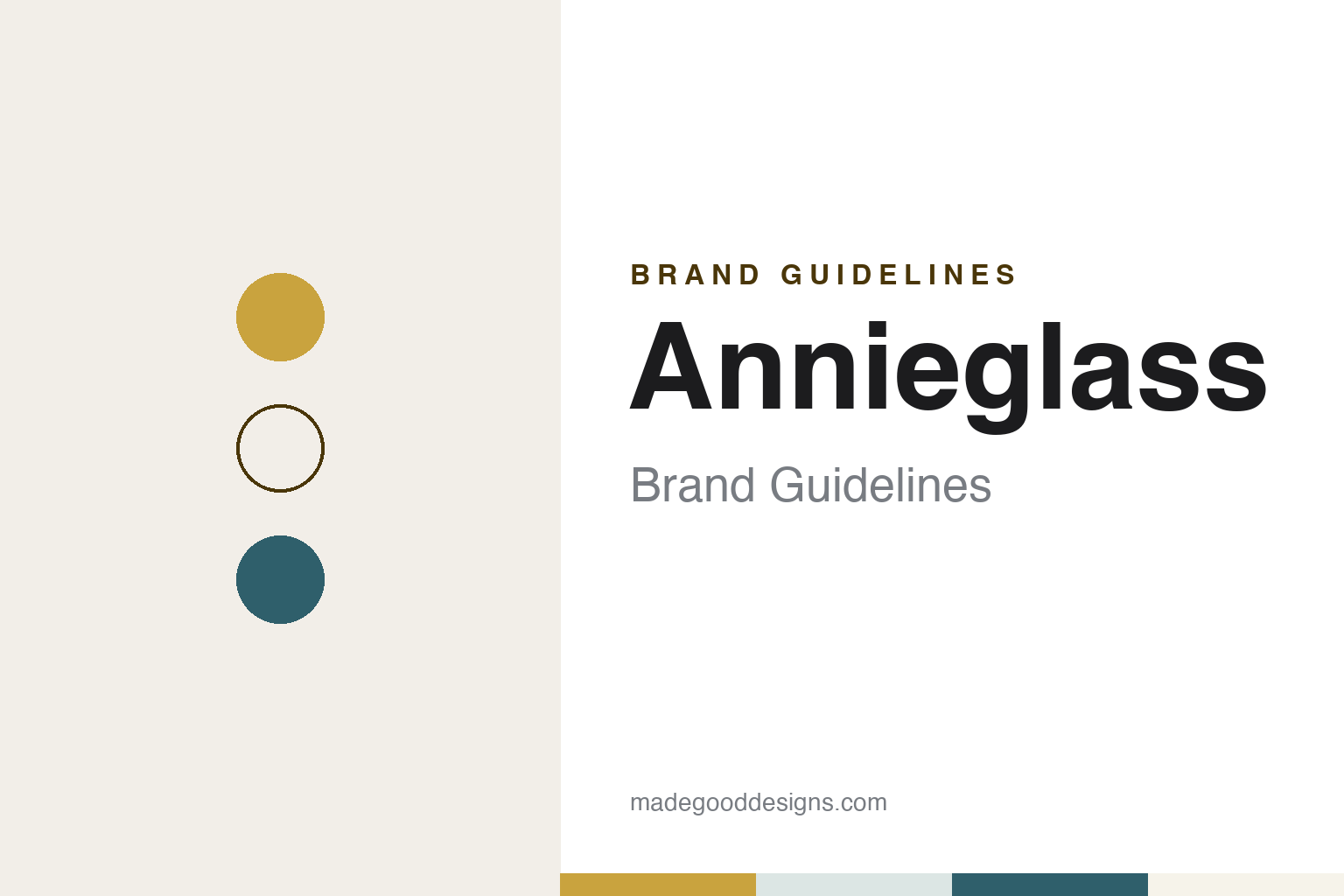
Two constants: a gilded-rim, clear-glass and bay-blue palette and a classical old-style serif register. Abstract homage — not an Annieglass product or mark; no plate, signature or logo is reproduced.
A studio built on a gold rim
Santa Cruz, 1983, and a plate inspired by ancient Italian relics.
Annieglass is the glass tableware studio of Ann Morhauser, known as Annie, an American glass artist based in California. The Smithsonian American Art Museum, whose artist record for Morhauser notes that she is also known as Annieglass, says she founded the Annieglass Studio in 1983. English Wikipedia, citing the Silicon Valley Business Journal of 5 September 2019, places that start in Santa Cruz, California.
The studio began with one design. The Smithsonian describes it as “Roman Antique” glassware: simple circles of clear glass with hand-painted gold rims, inspired by ancient Italian relics. The museum adds that Morhauser considers the whole table as she designs, picturing her pieces mixed with modern and antique china, porcelain and crystal.
The company tells a similar story in its own timeline. Annieglass says Morhauser started the business officially in 1983 with a self-funded kiln, after developing her signature “slumping” technique for glass tableware, and that the first Roman Antique plate was made that same year. The Craftsmanship Initiative, in a profile published in December 2017, called Roman Antique her earliest hit and described the line as glassware edged with platinum or 24k gold.
The company says it opened its first Annieglass shop in downtown Santa Cruz in 1994, and that in 1996 it bought a warehouse in Watsonville, a town on Monterey Bay, to serve as office, factory and outlet store. Wikipedia, again citing the 2019 Silicon Valley Business Journal report, also dates the move of the headquarters to Watsonville to 1996. The Craftsmanship Initiative described the Watsonville studio in 2017 as housed in a cavernous building that had once been a Seventh Day Adventist warehouse.
Colour
Clay molds, flat glass, painted edges and the heat of a kiln.
Every Annieglass piece is made by slumping. Wikipedia, citing a KSBW report of 23 October 2022, describes the method: gold, colour or platinum is applied to glass, which is then fired in a kiln over a ceramic mold, so that heat and gravity fuse the metal or colour to the glass and let the glass sink into the mold’s shape. The Craftsmanship Initiative gave the same outline in 2017: ceramic molds are made and textured, a piece of glass cut to the shape of the mold is laid on top, and the kiln’s heat does the rest.
The company describes each step on its own process page. Annieglass says each collection begins as an idea carved into clay, and that Morhauser carves each mold herself. Flat sheet glass is cut by hand or, for more complicated shapes, by waterjet. Patterns such as Birdsong are screen-printed onto the flat glass, while the edges of designs such as Mod and Roman Antique are hand-painted before firing, which the company says seals the gold and platinum into the glass. The Craftsmanship Initiative reported that Morhauser turned to waterjet cutting after 2000, as a way to keep handmade production competitive with imported goods.
The finished pieces carry a mark. Annieglass says every piece is hand-engraved on the back with the studio signature, along with a kiln code that records when the piece was made and a product code that follows the word “USA”. The engraving doubles as a service: the company offers personal engraved messages on any piece.
The studio has stayed in Watsonville. The company says the warehouse has grown to hold a retail store, a wine and craft bar opened in 2017, and factory space, and that the store sells full collections, discounted seconds and the work of other local artisans. It says Morhauser introduces new designs twice a year. Annieglass also says scrap glass is remelted into its Elements trivets and trays, that it packs orders in biodegradable materials, and that the studio converted to solar power in 2025. It describes itself as a woman- and family-owned business.
The Craftsmanship Initiative reported in 2017 that two of Morhauser’s gold-edged oval platters are on permanent display in the Luce Foundation Collection of American Craft at the Smithsonian American Art Museum; the company names them as Coquina and Tiburon from its Shells collection and says both are still made in Watsonville.
Typography
Design and documentation.
The houses in this group make tableware and giftware: pottery, glass and metal pieces meant for the table, the sideboard and the gift box. Some began as a single maker’s studio, some as importers or shops, and some now belong to larger home-goods groups, so the name on the base of a plate does not always tell you who owns the business or where the piece was made.
A tableware house’s identity is usually carried less by a logo than by the pieces themselves: a repeated pattern, a recognisable edge or glaze, a stamp or signature on the underside, and the boxes, catalogues and showrooms that present them. Because a design can stay in production for many years while ownership and factories change, the plain questions are worth asking for each name: who started it, who owns it now, and where its pieces are actually made and decorated.
Each guide separates what independent sources record from what the company says about itself — its founding story, its owners over time, where its pieces are made and how its marks and patterns have changed — and marks plainly what rests only on the company’s own word.
Aa
A classical old-style serif in the spirit of a gold-rimmed plate inspired by Roman relics. (Specimen set in Cormorant Garamond, a serif STAND-IN; NOT the Annieglass logo or signature.)
Annieglass
A gold line, a maker’s name and a mark on the back.
Annieglass’s identity starts with the name. It joins the founder’s first name to her material in one word, so the company reads as a person and a craft at once, and the Smithsonian lists “Annieglass” as another name for the artist herself.
The most recognisable element is a line rather than a logo. Roman Antique, as the Smithsonian describes it, is a plain circle of clear glass finished with a hand-painted gold rim. The company says the edges of other designs, such as Mod, are also hand-painted in gold or platinum before firing.
The engraved signature on the back of each piece acts as a second mark. The company says it is a studio signature cut by hand, with a kiln code and a product code beside it, so every plate carries its own record of where and when it was fired.
Place is part of the picture too. The company ties its blue glass and rippled textures to Monterey Bay near its coastal studio, and keeps Watsonville at the centre of its story as the place where pieces are slumped, engraved and sold.
For a design guide, Annieglass shows how a small studio can build an identity from a single repeatable detail — a gold or platinum edge on clear glass — backed by a maker’s name and a signature engraved on every piece. Compare another American maker of handmade glass in our Simon Pearce brand guidelines and a studio built around its founder’s name in our Michael Aram brand guidelines. For this guide we use gilded gold, clear-glass grey and Monterey Bay blue with a classical serif, an unofficial interpretation; no product or logo is reproduced.
Explore & save
Keep Annieglass’s identity on hand — save it to a board in the Made Good inspiration library.
Annieglass identity set
Pin the Annieglass gilded-rim, clear-glass and bay-blue palette and the classical serif register to your own board.