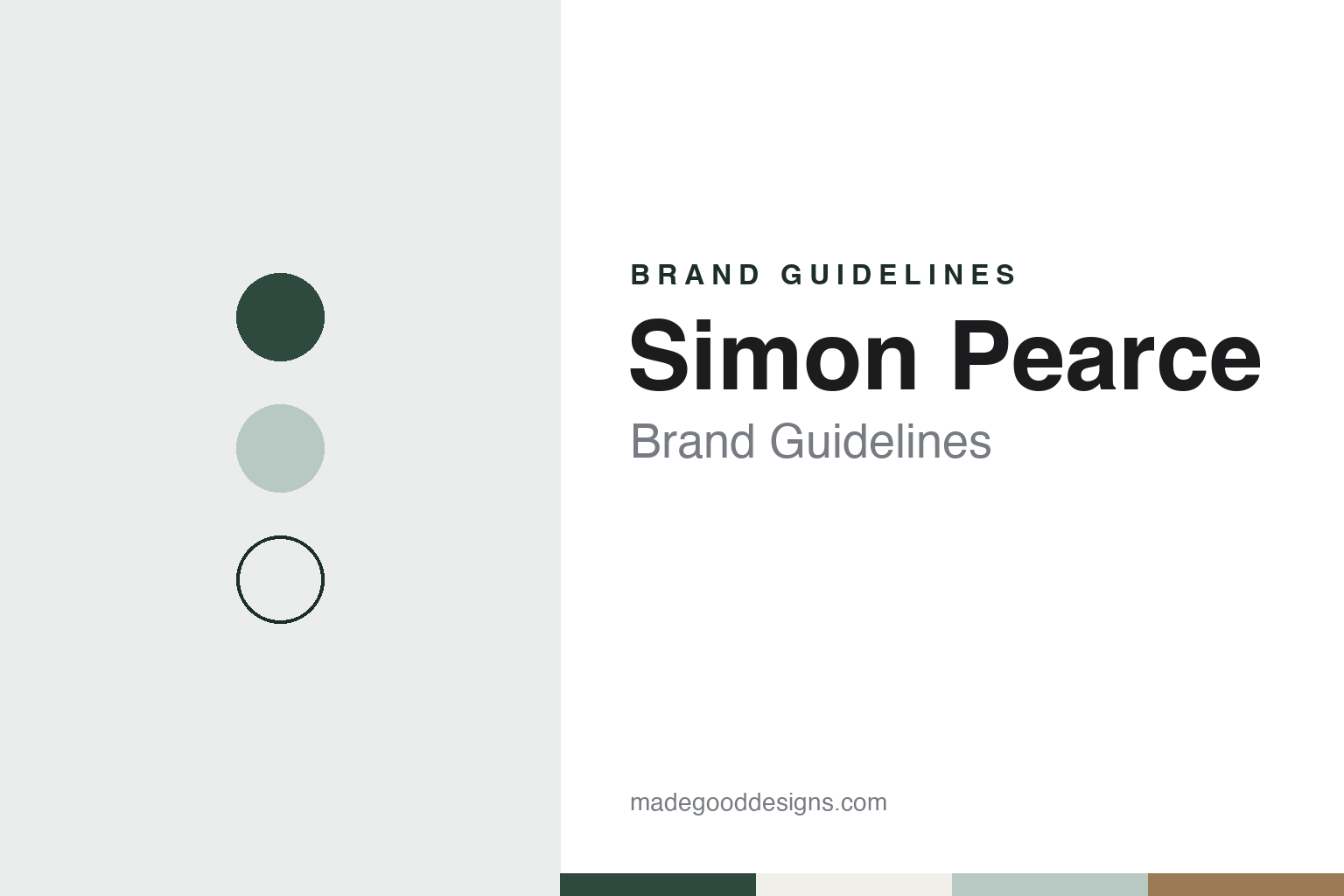
Simon Pearce Brand Guidelines
An Irish workshop, a Vermont river mill and a pontil mark left on purpose.
Aa
Two constants: an evergreen, clear-glass and mill-white palette and a quiet book serif register. Abstract homage — not a Simon Pearce product or mark; no glass, pottery or logo is reproduced.
From Kilkenny to the Ottauquechee
A potter’s training, a glass workshop in Ireland and a river mill in Vermont.
Simon Pearce is both a person and a company. English Wikipedia describes Simon Pearce as an Irish-American entrepreneur in glassblowing and pottery who learned his trade in Italy and in Kilkenny, Ireland. The Valley News of Lebanon, New Hampshire, reported on 5 December 2024 that he founded the company in 1971, and Edible Vermont, in an article by Deb Ivy published on 27 September 2022, placed that founding in Kilkenny.
The route to glass came through pottery. The Christian Science Monitor, in a profile by Keith Henderson dated 16 September 1985, reported that Pearce had apprenticed as a potter and planned to follow his father into that trade, then became drawn to old handmade Irish “pub glass”. The paper said he wrote to European glassmakers asking for apprenticeships, spent time at a Dutch glass factory in Amsterdam, and learned the craft in Scandinavia, where, in his words, glassmakers “opened their doors”. By 1971, the Monitor said, he had set up a small glass factory in Ireland.
The move to the United States followed. The 1985 profile said Pearce first visited the country in 1975 and noticed old river mills whose water power was no longer used, which gave him the idea of a hydro-powered glass factory. He and his wife, Pia, bought an old mill in Quechee, Vermont. Wikipedia dates his first US factory there to 1981; Edible Vermont describes the building as an old woollen mill on the banks of the Ottauquechee River, where Pearce installed a hydro-powered turbine to offset the energy used in glassmaking. Glassmaking began in the mill’s basement, the 2022 article said, and the Simon Pearce Restaurant opened a few years later.
The Quechee building became the public face of the business. Wikipedia notes that the site is part of the Quechee Historic Mill District and that it became a showroom, restaurant and glassblowing demonstration facility. The Monitor recorded in 1985 that the company was already selling pottery alongside glass, and that Pearce had brought experienced glassblowers from Ireland and was training American apprentices.
Colour
Two Vermont sites, a Maryland workshop and a new partner.
Simon Pearce makes its glass in its own workshops in the United States. The Valley News reported in December 2024 that the company operates workshops in Quechee and Windsor, Vermont, and in Oakland, Maryland; Wikipedia lists the Maryland facility in nearby Mountain Lake Park. The same newspaper described the Windsor site as home to the corporate office, a warehouse and a glassblowing production studio, and Quechee as a studio, store and restaurant in a refurbished historic mill, with a lower-level glassblowing workshop that the public can watch. Edible Vermont wrote in 2022 that Windsor also houses a pottery workshop where clay pieces are thrown by hand and dinnerware is glazed and fired, with a catwalk from which visitors can watch.
The process is central to how the brand presents itself. Edible Vermont described glass gathered from the furnace on a pontil iron, many designs made by two artisans working in tandem, one gathering and one shaping, and shaping done with custom tools and handcrafted fruitwood moulds. The company’s “Our Story” page says it uses a “time-honored Scandinavian glass recipe” and that every piece is shaped by hand, not by machine.
Ownership changed in part in 2024. The Valley News reported on 5 December 2024 that SBJ Capital, a firm based in Walnut Creek, California, that invests in small and mid-size family businesses, had made an investment in Simon Pearce, which the partners described as a “strategic partnership”. The paper said the terms were not disclosed, and that the company did not say who held a majority position. Chief executive Jay Benson, who joined in 2016 and became CEO in 2018, stayed in the role, and both he and Simon Pearce remained on the board. Benson told the paper the company had no plans to move its Windsor headquarters or its manufacturing sites in Quechee and Oakland. Simon Pearce said that he and Pia wanted to avoid the generational conflicts common in family companies.
The founder has also written about the work. Wikipedia records that his book, Simon Pearce: Design for Living, was published in the autumn of 2016.
Typography
Design and documentation.
The houses in this group make tableware and giftware: pottery, glass and metal pieces meant for the table, the sideboard and the gift box. Some began as a single maker’s studio, some as importers or shops, and some now belong to larger home-goods groups, so the name on the base of a plate does not always tell you who owns the business or where the piece was made.
A tableware house’s identity is usually carried less by a logo than by the pieces themselves: a repeated pattern, a recognisable edge or glaze, a stamp or signature on the underside, and the boxes, catalogues and showrooms that present them. Because a design can stay in production for many years while ownership and factories change, the plain questions are worth asking for each name: who started it, who owns it now, and where its pieces are actually made and decorated.
Each guide separates what independent sources record from what the company says about itself — its founding story, its owners over time, where its pieces are made and how its marks and patterns have changed — and marks plainly what rests only on the company’s own word.
Aa
A calm book serif in the spirit of a founder’s signature name and a Vermont workshop. (Specimen set in EB Garamond, a serif STAND-IN; NOT the Simon Pearce logo.)
Simon Pearce
A founder’s name, a mill and the mark of the maker.
Simon Pearce’s identity begins with the founder’s own name, used as the brand, and with places. The building in Quechee, a former woollen mill on the Ottauquechee River with a restaurant overlooking the falls, gives the company a setting that customers can visit, and its own site invites them to watch glassblowing and pottery demonstrations at its workshops. The company’s collections carry Vermont names such as Ascutney, Barre, Woodbury and Hartland, which keep the state in front of the customer on every product page.
The clearest signature is a small mark on the base of the glass. The company’s “Our Story” page explains that turning a piece over reveals the pontil mark, the trace left by the hand that shaped it, and says it leaves the mark there on purpose “to celebrate perfect imperfection”. That idea is repeated in the founder’s line, quoted by the company and by Edible Vermont in 2022, that the human hand cannot do anything perfectly “and that’s the beauty of it.” The same thought drives the brand’s language about natural materials and pieces made to last rather than to follow a season.
Form follows the same restraint. The glass is generally clear and simply shaped, the pottery is thrown by hand with visible throwing marks, and the company describes its Belmont dinnerware as having a spiral throw mark. The glass evergreen tree, which the company calls “the one that started it all”, has become a seasonal emblem, with its own page on the company’s site.
The story of the business is part of the identity as well. The Christian Science Monitor in 1985 framed Pearce as a craftsman who wanted functional but individual tableware, and the 2024 Valley News report on SBJ Capital’s investment presented the deal as a way to keep the brand and its workshops in Vermont.
For a design guide, Simon Pearce shows how a maker’s name, a working mill and a deliberately visible maker’s mark can stand in for a graphic identity. Compare another Irish glass name in our Waterford brand guidelines and an American tableware house built on mouth-blown glass in our Juliska brand guidelines. For this guide we use evergreen, clear glass and mill white with a serif, an unofficial interpretation; no product or logo is reproduced.
Explore & save
Keep Simon Pearce’s identity on hand — save it to a board in the Made Good inspiration library.
Simon Pearce identity set
Pin the Simon Pearce evergreen, clear-glass and mill-white palette and the quiet serif register to your own board.