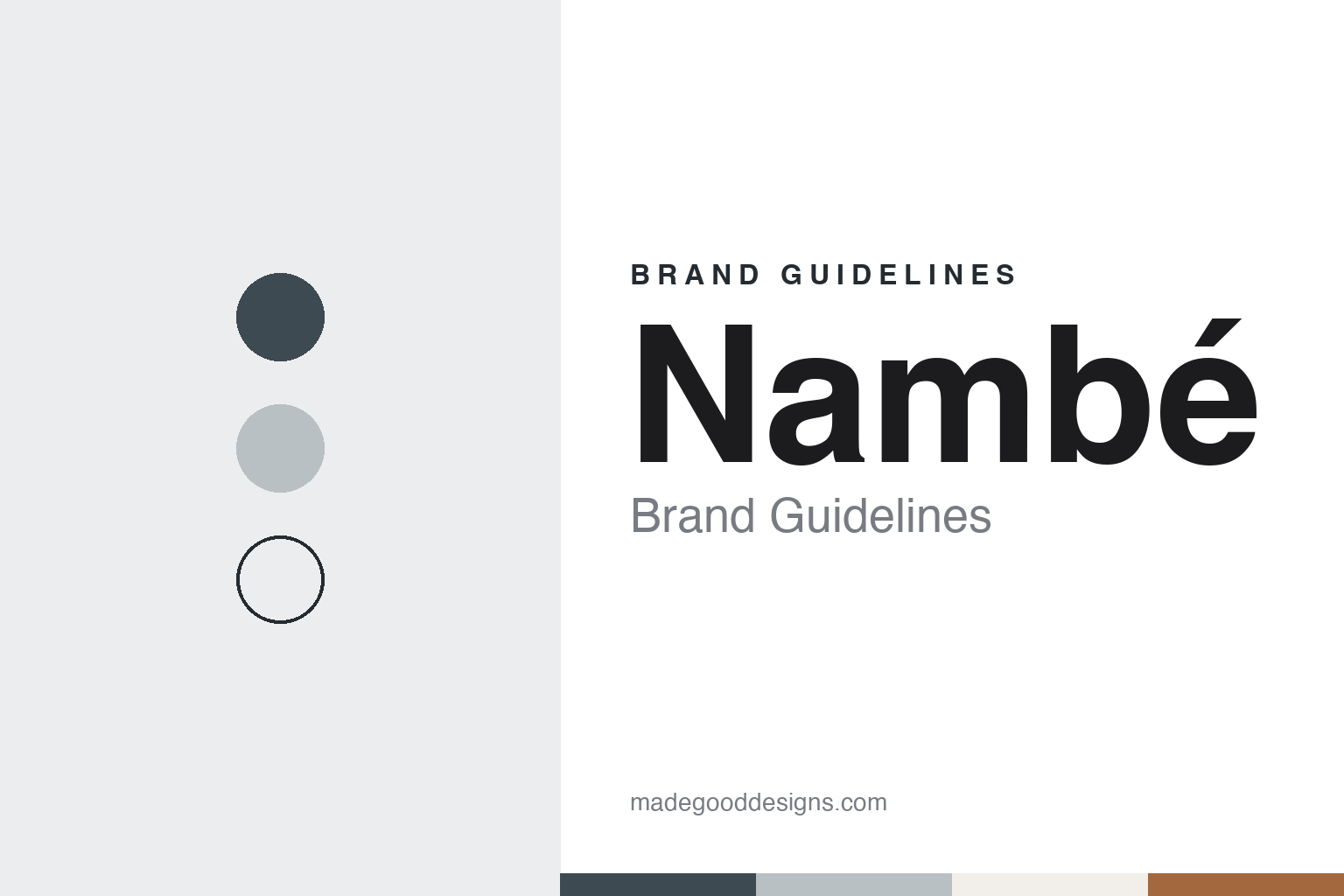
Nambé Brand Guidelines
A foundry near a pueblo, a silvery alloy and the curve of a cast bowl.
Aa
Two constants: a slate, alloy-silver and sand palette and a geometric mid-century sans register. Abstract homage — not a Nambé product or mark; no bowl, box or logo is reproduced.
A foundry north of Santa Fe
A copper foundry, a new owner and a name taken from the pueblo next door.
Nambé began in northern New Mexico in 1951. According to English Wikipedia, a foundry in Pojoaque, New Mexico, called Winkler Mills, which had made copper and gift items, was bought that year by Pauline Cable. She renamed it Nambé Mills after the neighbouring community of Nambé Pueblo, some ten miles north of Santa Fe. The Los Angeles Times, writing in February 2017, gave the same founding year and place, describing the company as founded in 1951 outside Santa Fe.
The name therefore comes from a place. Nambé Pueblo is a Tewa Pueblo community in Santa Fe County, and English Wikipedia says the word Nambé is the Spanish form of a similar-sounding Tewa word that can be read loosely as “rounded earth”.
The product that gave the brand its identity is a metal, not a pattern. English Wikipedia describes Nambé ware as tableware and cookware made from an eight-metal alloy whose main component is aluminium, with the lustre of silver and the solidity of iron, and says the metal keeps food hot or cold. It credits the alloy to Martin Eden, formerly a metallurgist at the nearby Los Alamos National Laboratory, and dates its development to 1953. The Los Angeles Times in 2017 called it a “top-secret” alloy that holds heat or cold for hours.
Pauline Cable was also the first designer. Wikipedia says she designed the original range of bowls and other pieces to be cast in the foundry, and that some of those shapes are still in the range. English Wikipedia places the range within mid-century modern design. The Los Angeles Times described the bowls as “sleek, sinuous” and the brand as a cult collectible, with a following that grew as interest in mid-century style returned.
The foundry moved more than once. Wikipedia says that after a fire, the foundry was moved to Santa Fe in 1976, stayed there until 1994, and was then moved to Española, before production later went abroad. For several decades, then, the pieces that carried the Nambé name were cast in northern New Mexico, within a short drive of the pueblo that gave them their name.
Colour
New designers, new materials, a family owner and a British buyer.
The range widened over time. English Wikipedia says the company’s portfolio grew from alloy pieces to take in cutlery, glassware, woodware, dinnerware, kitchenware, home décor and jewellery. The Los Angeles Times noted in 2017 that materials such as glass, acacia wood and concrete by then appeared across the brand alongside metal.
Nambé also worked with outside designers. Wikipedia says that in 1999 the company worked with Eva Zeisel on a line of alloy objects, including a platter, a bowl, a vase and salt and pepper shakers, based on her Tomorrow’s Classic forms of 1952. In 2001, it says, Zeisel worked with the industrial designer Steve Cozzolino on a further collection for Nambé.
Jewellery followed. The Los Angeles Times reported on 16 February 2017 that Nambé had launched a collection of sterling silver and gemstone jewellery with Macy’s the previous autumn, made in America and shaped to echo the curves of its bowls. The paper said the pieces were designed by Carolyn Pollack, whose company in Albuquerque had designed and made Southwest-influenced silver jewellery for decades. Nambé’s chief executive, Bill Robedee, told the paper that the sculptural, mid-century look was a natural fit for jewellery, and spoke to the paper from the company’s New York showroom.
Ownership changed in 2019. KRQE News, citing the Santa Fe New Mexican, reported that Nambé LLC had been sold to a British manufacturer and that the business had been owned by the Hillenbrand family for nearly forty years. The buyer was Portmeirion Group, the Stoke-on-Trent pottery group whose brands include Portmeirion, Spode and Royal Worcester. Portmeirion Group’s own history page says it completed the acquisition of Nambé LLC, “a US based premium homewares business”, in 2019, and that the purchase gave it more scale in its key US market and took it into new homeware categories. The new owner told the Santa Fe New Mexican, according to KRQE, that Nambé had a strong design ethic, calling it “contemporary and chic”. Portmeirion Group has owned Nambé since 2019, and English Wikipedia says the business now trades as Nambé International.
Where the pieces are made has also changed. English Wikipedia says production of the alloy metalwork is now in India, with woodware made in Thailand and stainless steel flatware in Vietnam. The design story still begins in New Mexico, while the making now takes place abroad.
Typography
Design and documentation.
The houses in this group make tableware and giftware: pottery, glass and metal pieces meant for the table, the sideboard and the gift box. Some began as a single maker’s studio, some as importers or shops, and some now belong to larger home-goods groups, so the name on the base of a plate does not always tell you who owns the business or where the piece was made.
A tableware house’s identity is usually carried less by a logo than by the pieces themselves: a repeated pattern, a recognisable edge or glaze, a stamp or signature on the underside, and the boxes, catalogues and showrooms that present them. Because a design can stay in production for many years while ownership and factories change, the plain questions are worth asking for each name: who started it, who owns it now, and where its pieces are actually made and decorated.
Each guide separates what independent sources record from what the company says about itself — its founding story, its owners over time, where its pieces are made and how its marks and patterns have changed — and marks plainly what rests only on the company’s own word.
Aa
A geometric sans with mid-century proportions, in the spirit of the brand’s clean wordmark. (Specimen set in Jost, a sans STAND-IN; NOT the Nambé logo.)
Nambé
A brand built on a material and a shape.
Nambé’s identity rests on two things that are easy to recognise without a logo: the soft, silvery surface of its alloy and the flowing outline of its cast pieces. English Wikipedia describes the metal as having the lustre of silver and the solidity of iron, and the Los Angeles Times described the bowls as sleek and sinuous. The 2017 jewellery collection, the Los Angeles Times reported, was shaped to echo the curves of the bowls.
The name does the rest of the work. It is taken from Nambé Pueblo, the community beside the original foundry, so the brand carries a place in northern New Mexico wherever it is sold.
The design history adds depth. Pauline Cable’s first shapes were designed for casting in the foundry she bought in 1951, and Wikipedia says some of them remain in the range. The 1999 work with Eva Zeisel and the 2001 collection with Zeisel and Steve Cozzolino connected the company with designers outside New Mexico, and the 2017 jewellery by Carolyn Pollack translated the tableware’s curves into something worn.
The ownership history is short and clear. The Hillenbrand family owned the business for close to four decades, according to KRQE’s 2019 report, and Portmeirion Group has owned it since 2019, placing an American metal serveware name beside British pottery names such as Spode and Royal Worcester.
The making has moved further than the brand. The foundry moved from Pojoaque to Santa Fe and then to Española, and Wikipedia now places alloy production in India.
For a design guide, Nambé shows how a single material, cast into a few curving shapes, can become a brand identity that survives new owners, new materials and new factories. Compare another metal serveware house built on hand-worked forms in our Michael Aram brand guidelines and a New England maker of handmade glass and pottery in our Simon Pearce brand guidelines. For this guide we use foundry slate, alloy silver and mesa sand with a geometric sans, an unofficial interpretation; no product or logo is reproduced.
Explore & save
Keep Nambé’s identity on hand — save it to a board in the Made Good inspiration library.
Nambé identity set
Pin the Nambé slate, alloy-silver and sand palette and the geometric mid-century sans register to your own board.