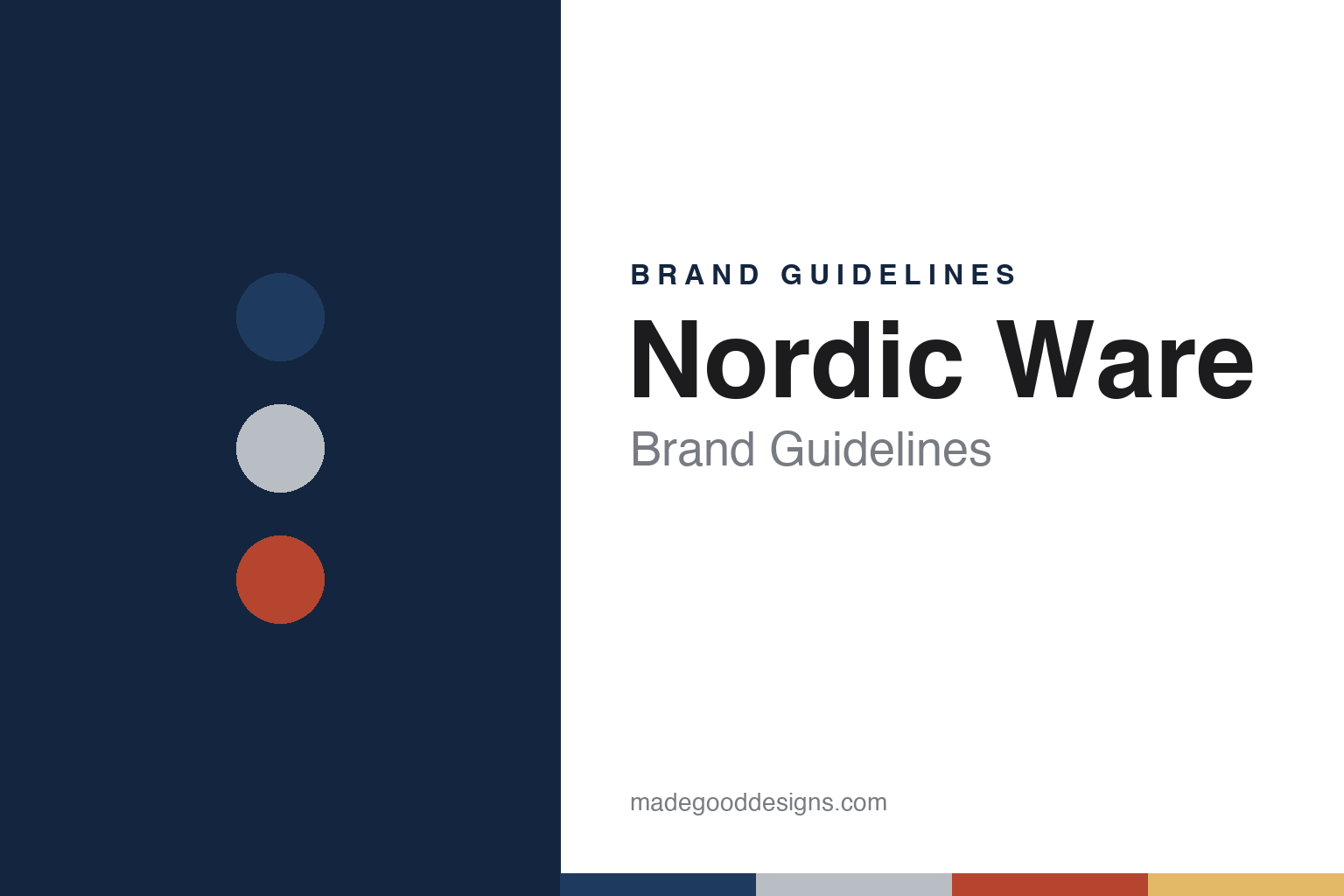
Nordic Ware Brand Guidelines
A Scandinavian-goods maker that gave a Gugelhupf a trademark.
Aa
Two constants: a fjord navy, cast aluminium, lingonberry and butter crumb palette and a geometric sans register. Abstract homage — not a Nordic Ware product or mark; no pan, package or logo is reproduced.
An old pan, recast
A Hadassah fundraiser and a foundry for Scandinavian goods.
Nordic Ware is a trading name. English Wikipedia gives the company’s legal name as Northland Aluminum Products, Inc., doing business as Nordic Ware, and places it in St. Louis Park, Minnesota. The encyclopedia says it was founded in 1946 by H. David Dalquist, his wife Dorothy, his brother Mark and their friend Donald Nygren. MNopedia, the online encyclopedia of the Minnesota Historical Society, in an entry by Alli Hearne dated 6 January 2017, says that Northland Aluminum Products made die-cast aluminium Scandinavian kitchen items.
The pan that made the company came from outside it. MNopedia says the ring-shaped mould was modelled on the Gugelhupf, a cast-iron pan brought to the United States by Jewish immigrants from Europe and used for heavy cakes, and that in the late 1940s women in Minneapolis could no longer find one. In 1950, it says, three members of the Hadassah Society of Minnesota, Rose Joshua, Fannie Shanfield and Mary Abrahamson, asked Dalquist to reproduce a pan the Abrahamson family had brought from Germany, so that they could bake cakes for a fundraiser. Dalquist made a cast-aluminium version and sold it to department stores; the women, MNopedia says, decided selling pans would raise more than selling cakes, and Dalquist gave them the factory seconds. English Wikipedia’s article on the Bundt cake credits Dalquist and the company engineer Don Nygren with the design and says Nordic Ware made a small production run in 1950.
The name took one added letter. MNopedia explains that the German word Bund refers to a gathering of people, and that Dalquist added the “t” so he could trademark the name and avoid any link with the German American Bund, a Nazi organisation. English Wikipedia’s company article dates the Bundt trademark to 1950, while its article on the cake gives 1951.
Colour
Pillsbury, the Bake-Off and a supermarket promotion.
The pan took years to find its market. English Wikipedia says early sales were poor enough that Nordic Ware considered dropping it, that it was mentioned in the New Good Housekeeping Cookbook in 1963, and that the turning point came in 1966. MNopedia says that year Ella Rita Helfrich of Houston took second place in the seventeenth Pillsbury Bake-Off with the Tunnel of Fudge, a cake baked in a Bundt pan that formed a soft fudge centre as it baked, and that Pillsbury was soon flooded with letters from people asking where to buy the pan.
The Dalquists turned the moment into a partnership. MNopedia says Dorothy “Dotty” Dalquist spent hours developing recipes for the pan, and that in October 1969 David pitched a line of boxed Bundt cake mixes to two Pillsbury executives on his boat on Lake Superior, with Dotty baking the cakes for the pitch. Pillsbury launched the mixes in 1971 and made them for fifteen years, it says, and in 1972 the two companies ran a promotion that sold a box of mix and a Bundt pan together in supermarkets. Nordic Ware had to buy more equipment to make enough pans; MNopedia quotes Dalquist as saying the promotion helped the business grow from a small family firm into a regional and, to some extent, national manufacturer. English Wikipedia’s cake article says Pillsbury licensed the Bundt name from Nordic Ware in the 1970s. The MNopedia bibliography lists a 1973 recipe book by Dorothy Dalquist, published by Northland Aluminum Products, for the “Bundt Brand Fluted Tube Pan”, and Pillsbury Bundt recipe books from 1974 and 1978; our Pillsbury guide covers the flour and baking company.
The company has stayed in the family. English Wikipedia says Nordic Ware remains family-owned and operated and names David Dalquist, son of the founders, as president. It says the company also worked in microwave cookware, with products such as the patented Micro-Go-Round food rotator, and that it runs an annual competition called Bundts Across America. MNopedia says Nordic Ware continues to produce Bundt pans in the United States, and English Wikipedia says the company’s headquarters and manufacturing plant are in St. Louis Park. A MNopedia photograph caption, used with the company’s permission, shows a sister company, Maid of Scandinavia, beside Northland Aluminum Products in St. Louis Park around 1960.
Typography
Design and documentation.
Bakeware and kitchen-tool brands sit at a busy point in the housewares trade. Some names belong to the families or companies that started them; others are licensed, so the name on the pack belongs to one company while another designs, makes or sells the goods, and a single name can be split between different licensees for pans, gadgets and storage. A cake tin or spatula may be sold in a department store, a craft chain, a restaurant-supply shop or a supermarket aisle, and the same brand can look different in each.
Much of the identity of these brands is carried by packaging rather than by the product itself: hang-tags and header cards, blister packs and peg-hung clamshells, printed sleeves around baking pans, and catalogues that once taught a craft as much as they sold the tools for it. Colour-coded handles, embossed names on metal and wordmarks set across a narrow card do the work a label does elsewhere.
Each guide separates what independent sources record from what the company says about itself — who started the brand, who owns or licenses it now and how its packs and marks have changed — and marks plainly what rests only on the company’s own word.
Aa
A geometric sans — the clean, Scandinavian-goods register of an aluminium pan. (Specimen set in Josefin Sans, a STAND-IN; NOT the Nordic Ware logo.)
A name on a landmark
A trademark, a sign and a day in November.
The company’s name appears on a listed structure. English Wikipedia says the Peavey–Haglin Experimental Concrete Grain Elevator, built in St. Louis Park in 1899 and 1900, has been maintained on the grounds of the Nordic Ware company since the late 1960s and is painted with the company’s name and logo. The elevator was listed on the National Register of Historic Places in 1978 and named a National Historic Landmark in 1981, the encyclopedia says. Its article on Nordic Ware adds that the elevator stands near the interchange of Minnesota State Highways 100 and 7, beside the company’s headquarters and plant, and that before Nordic Ware bought the land it carried a sign for Lumber Stores Inc.
The trademark shapes how the product is named. English Wikipedia’s article on the cake says that because “Bundt” is a trademark, similar pans from other makers are often sold as fluted tube pans, and that the trademark holder, Nordic Ware, produces Bundt pans only in aluminium. The phrase turns up on the company’s own early material too: MNopedia pictures a cardboard container for a Nordic Ware Bundt “jumbo fluted tube pan” of formed aluminium, dated between about 1950 and 1970. English Wikipedia says a number of the original Bundt pans are held in the Smithsonian collection, and that the company designated 15 November as National Bundt Day to mark the pan’s sixtieth anniversary.
MNopedia shows H. David Dalquist at the Chicago Housewares Show around 1955 in a photograph used with the company’s permission, and lists a family history, The Nordic Ware Saga: An Entrepreneur’s Legacy, published in Minneapolis in 2006. The 1973 Dorothy Dalquist volume and a 1978 Pillsbury publication listed there carry the words “Bundt Brand” in their titles.
For a design guide, Nordic Ware shows how one product shape and one coined word can carry a company, from a fundraiser’s factory seconds to a name painted across a historic landmark. Compare it with Wilton, the Illinois cake-decorating brand, and Pillsbury, whose 1966 Bake-Off featured the Tunnel of Fudge. For this guide we use fjord navy, cast aluminium, lingonberry and butter crumb with a geometric sans, an unofficial interpretation; no product or logo is reproduced.
Explore & save
Keep Nordic Ware’s identity on hand — save it to a board in the Made Good inspiration library.
Nordic Ware identity set
Pin the Nordic Ware fjord navy, cast aluminium, lingonberry and butter crumb palette and the geometric sans register to your own board.


