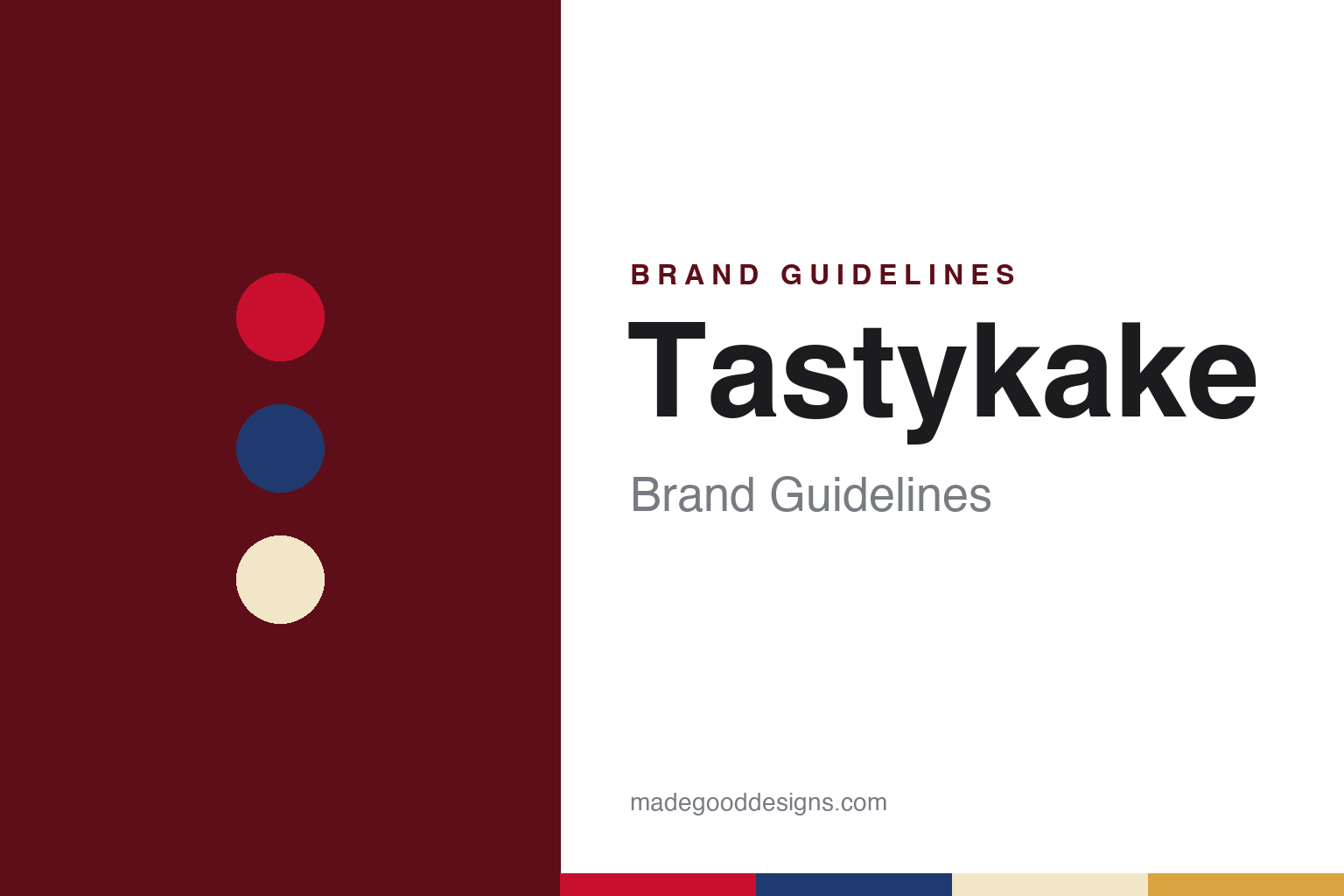
Tastykake Brand Guidelines
A Philadelphia cake with a name that came from a sales pitch.
Aa
Two constants: a red, navy, cream and butterscotch palette and a bold script register. Abstract homage — not a Tastykake product or mark; no pack, wrapper or logo is reproduced.
A Germantown bakery
Two bakers, a Philadelphia site and a name from a pitch.
Tastykake is the snack-cake line of the Tasty Baking Company of Philadelphia. The Encyclopedia of Greater Philadelphia, in an essay by the historian J. D. Bowers published in 2015, says the company was founded in 1914 by Philip J. Baur and Herbert T. Morris in the Germantown neighbourhood, along Sedgley Avenue. English Wikipedia, drawing on a company history published in 1990, says the two men had earlier run a bakery in the Pittsburgh area, sold it to the Ward Baking Company in 1913, and then looked to Philadelphia, settling on the Sedgley Avenue site in November 1913.
The name came from a sales pitch. The encyclopedia says Morris’s wife came up with it when she pitched the new bakery’s sample cakes as “tasty”. The first cakes, it says, were full-sized loaf cakes with icing, sold cheaply to the city’s industrial workers and their families as an added treat in lunchboxes and on weekend picnics in the region’s parks. Wikipedia, again citing the 1990 company history, says a student from Boston created the Tastykake girl and logo, and that the company adopted the slogan “The Cake That Made Mother Stop Baking.”
The bakery grew out of its first site within eight years, the encyclopedia says, and moved to Hunting Park Avenue. There it added the personal-sized cakes the brand is now known for, including the Chocolate and Coconut Juniors. The Butterscotch Krimpet followed in 1927, and soon after came a line of individually wrapped fruit and cream pies, bundled in wax paper, a practice the encyclopedia says lasted into the 1960s. A cake sold from 1931 as the Tandy-Kake became the Kandy Kake. Until 1941, the essay says, the company delivered almost entirely by horse-drawn wagon, which kept the cakes a city treat; during the Second World War it sent cakes and pies overseas to soldiers, and its market widened from there.
Colour
Television, ballparks, a boycott and a listed company.
After the war, the encyclopedia says, the company used television and professional sport to spread the name. Dick Clark, Shari Lewis with her puppet Lamb Chop, and Betty White all served as spokespeople; in a 1970s commercial White delivered the line “All the good things wrapped up in one.” The cakes were sold at Phillies baseball and Flyers hockey games, and the broadcaster Harry Kalas promoted them on the radio. The essay gives the brand’s tag line as “Nobody bakes a cake as tasty as a Tastykake”, and says that over a century the logo changed only in small ways.
The company’s history also includes a civil-rights campaign. Wikipedia, citing the historian Matthew Countryman’s 2006 book Up South, says that on 16 June 1959 a group of Philadelphia clergy known as the 400 Ministers, with the Rev. Leon Sullivan as spokesman, named Tastykake as the target of their first selective-patronage campaign, asking Black shoppers and grocers to stop buying the cakes until the company opened better jobs, such as driver-salesman routes, to Black workers. Wikipedia says the ministers announced the end of the boycott on 7 August 1959, after the company agreed to fixed routes for its Black drivers, hired Black women into positions previously held by white women, and desegregated its plant facilities.
Production changed in the late 1950s and early 1960s. The encyclopedia says new machinery shortened the baking cycle from twelve hours to forty-five minutes and ended the hand-wrapping that had been used since the start. The company went public on the New York Stock Exchange in 1961 and bought other food firms, including a cobbler maker in Arkansas, a potato-chip company in Pennsylvania and the Ohio-based Buckeye Biscuit Company, before refocusing on baking and selling those businesses. Marketing ties with the Baltimore Orioles, Pittsburgh Steelers and New York Yankees carried the cakes beyond the Philadelphia region, and distribution reached Florida. In 1996, the essay says, the company bought a bakery in Oxford, Chester County, to make doughnuts, breads and honey buns.
In 2010 the company moved its headquarters and main bakery from Hunting Park Avenue to the Philadelphia Naval Business Center, the former naval shipyard; Wikipedia says the move was completed in May 2010. The encyclopedia calls it the company’s last significant independent action. Flowers Foods of Thomasville, Georgia, has owned the Tasty Baking Company since 2011; Wikipedia says the company’s shares were removed from trading on 24 May 2011, when the acquisition was completed.
Typography
Design and documentation.
The guides in this group look at American snack cakes: small cakes, pies, rolls and buns baked in quantity, sealed in printed wrappers and sold from supermarket shelves, gas-station and convenience-store racks and lunchbox-sized multipacks. Their identity rarely sits in the cake itself, which often looks much the same from one bakery to the next. It sits in the packaging, the name and the characters that travel with them.
Most of the visible design work happens on a thin cellophane or film wrapper that has to carry a name, a flavour and a picture in very little space, and then on the carton that groups several wrapped cakes together. Mascots, cartoon figures and named characters appear often in this category, and a single brand can pass through several bakeries and owners while keeping the same name on the pack.
Each guide follows the same approach: who started the name, who has owned it since, and how its wrappers, logos and advertising have changed over time, using dated independent sources where they exist and marking plainly what rests only on a company’s own account.
Aa
A bold, looping script — the register of a cake named for a sales pitch. (Specimen set in Lobster, a script STAND-IN; NOT the Tastykake logo.)
All the good things wrapped up
A girl, a slogan and a century of small cakes.
The Tastykake identity can be traced through its words and its wrappers. The 1914 name came from Mrs Morris’s pitch of the sample cakes as “tasty”; the early slogan, in Wikipedia’s account, was “The Cake That Made Mother Stop Baking”; and the 1970s line delivered by Betty White was “All the good things wrapped up in one”. The tag line the encyclopedia quotes is “Nobody bakes a cake as tasty as a Tastykake”. Wikipedia credits a Boston student with the Tastykake girl and logo, and the encyclopedia says the logo has changed only a little since.
The product names include the Krimpet, the Kandy Kake and the Juniors. The encyclopedia traces the packaging from wax-paper bundles of individually wrapped pies, through decades of hand-wrapping, to the machinery of the late 1950s and early 1960s that ended hand-wrapping. The company marked its centenary in 2014 under Flowers Foods with a campaign the encyclopedia gives as “Celebrating 100 Years of Freshness!”, run online and on social media, by which time, it says, the cakes were sold along the East Coast, across the South and Southwest, and online.
For a design guide, Tastykake shows a regional bakery identity built from a coined name, a figure on the logo, a run of slogans and individually wrapped cakes sold at ballparks and in local stores. Compare it with Drake’s, another early Northeastern snack-cake bakery, and Hostess, whose Twinkies and cupcakes sold in the same aisle. For this guide we use red, navy, cream and butterscotch with a bold script, an unofficial interpretation; no product or logo is reproduced.
Explore & save
Keep Tastykake’s identity on hand — save it to a board in the Made Good inspiration library.
Tastykake identity set
Pin the Tastykake red, navy, cream and butterscotch palette and the bold script register to your own board.