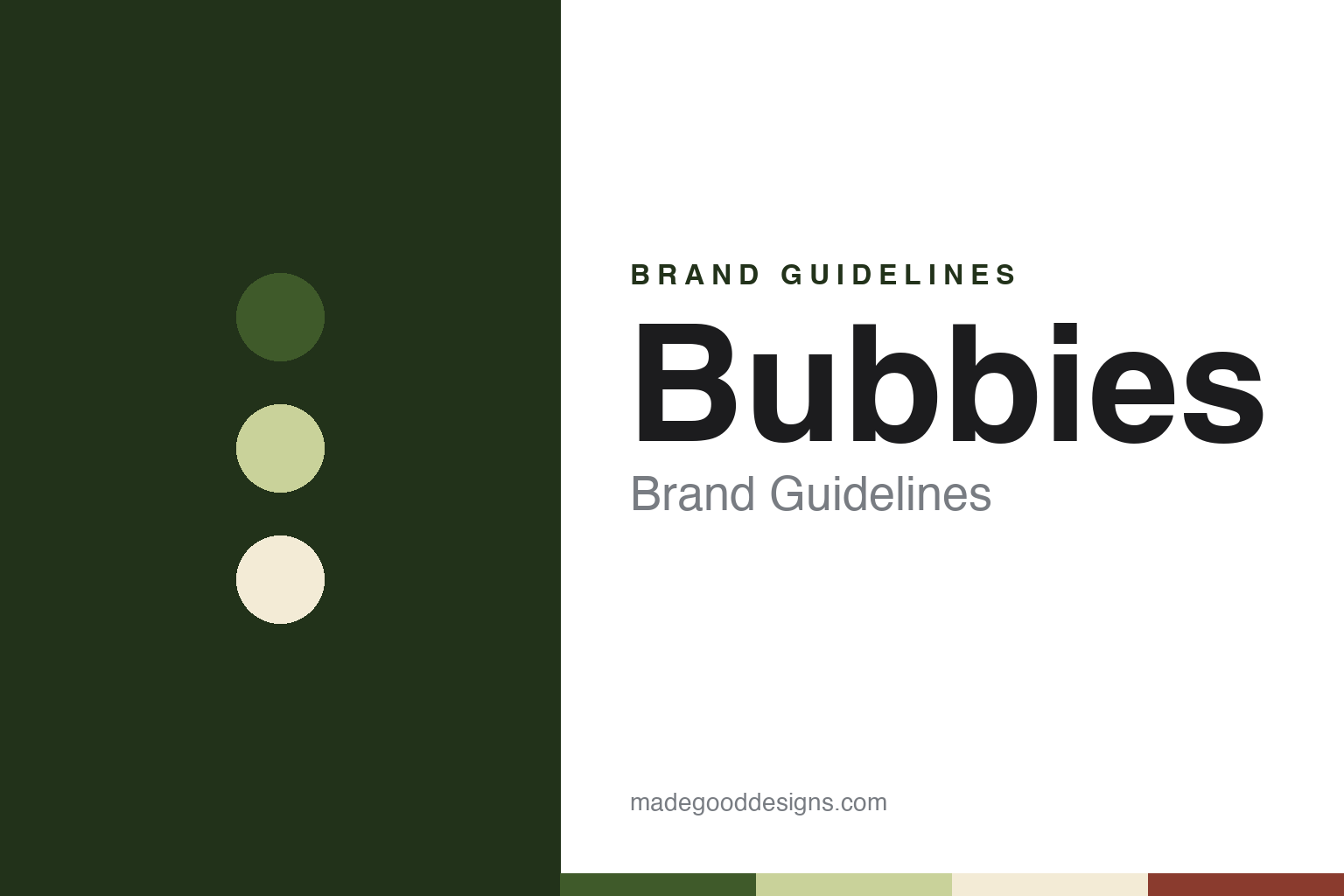
Bubbies Brand Guidelines
A San Francisco market pickle that went national without vinegar in the jar.
Aa
Two constants: a dill green, brine and deli cream palette and a soft serif register. Abstract homage — not a Bubbies product or mark; no jar, label or logo is reproduced.
From a San Francisco market stall
Kosher dills, local stores and a farmers market.
Bubbies is an American brand of naturally fermented pickles and related condiments, sold chilled. Its story, as the Canadian trade magazine Food In Canada told it in a feature by Nithya Caleb published on 7 August 2024, begins in San Francisco in 1982. That year, the magazine says, Leigh Truex began selling naturally fermented kosher dill pickles at local stores and farmers markets in the city.
The pickles were made the traditional way, and that method is the thread that runs through every later chapter of the brand. Food In Canada describes the process in plain terms: the pickles are salted, flavoured and left to ferment for four to five weeks, with no vinegar added to do the souring. The magazine notes that fully fermented pickles made without preservatives or vinegar are time-consuming and difficult to produce on a large scale, which it gives as one of the main reasons so few were sold nationally at the time.
In its early years the brand stayed close to home. Chris Glab, chief innovation officer of the brand’s current owner, told Food In Canada that Bubbies had established itself as a “nice little regional brand” in that first period. The traditionally made pickles, the magazine says, became very popular in the local community.
That regional phase ended in 1989, when the business changed hands and its new owners set out to sell it across the United States.
Colour
Two former bankers, a move to Quebec and a holding company.
The next owners came from outside the food business. According to Food In Canada, former bankers John and Kathy Gray acquired Bubbies in 1989. Glab told the magazine: “They took a broad-scale approach and expanded it from a small regional product to a national brand.” The Grays, the magazine says, believed Bubbies had a special place in the U.S. market because there were very few fully fermented pickles in the country, and virtually none sold nationally, at the time they bought it.
Under the Grays the range widened. Food In Canada lists the additions as bread and butter chips, relishes, horseradishes and sauerkrauts, all sitting alongside the original kosher dills. The family also changed where the products were made. The magazine says the Grays moved most of the manufacturing from California to Quebec, and that in 2024 the bulk of Bubbies’ products, including its Kosher Dill Pickles and Kosher Dill Pickle Chips, were co-packed in Quebec. Glab explained the choice: “What’s nice about Canada, and Quebec, in particular, is that it has a strong deli culture,” so the partner there understands how to package these products. He added that a manufacturing hub in Quebec helps with distribution in Canada, where the magazine names stores such as Loblaws, Metro, Whole Foods and Sobeys among its stockists.
Fermentation itself was scaled up rather than replaced. Food In Canada says Bubbies still uses the traditional method, but in large, controlled rooms where factors such as temperature and humidity are monitored throughout the weeks the pickles spend in brine.
The latest change of ownership came in December 2021. Food In Canada says that Fermented Food Holdings, which it described in 2024 as headquartered in Wisconsin and as owning a portfolio of fermented-food brands, acquired Bubbies that month. A company announcement carried by Gama Consumer described the buyer as a recently established specialist food company and quoted co-founder Oliver Joost: “We see a huge opportunity to bring together the operating disciplines of traditional CPG businesses with the passion and innovation of entrepreneurial teams and a fresh approach to connecting with our consumers.” The same announcement said Fermented Food Holdings had formed a partnership with the vegetable grower Taylor Farms. Fermented Food Holdings has owned Bubbies since 2021.
Typography
Design and documentation.
The brands in this group are all American pickle names. Pickle brands in general reach people through a glass jar more than through any other object: a cylinder of brine, cucumbers and spice that sits on a shelf or in a chilled case, with a paper or printed label and a metal lid. Some pickles are sold shelf-stable in the ordinary grocery aisle, while others are kept refrigerated from the plant to the store, and that choice shapes where a jar is placed, how it is shipped and how the label has to read from a distance.
Because brine and cucumbers look much the same from one jar to the next, much of a pickle brand’s identity is carried by the label, the lid, the colour of the type and sometimes a mascot or a slogan. Many pickle names began as regional brands sold close to the farms and plants that supplied them, and some have since passed to national food companies. The questions worth asking are plain ones: who started it, who owns it now, and where the pickles are packed.
Each guide separates what independent sources record from what a company says about itself, and marks plainly what rests only on the company’s own word.
Aa
A soft serif — the warm, delicatessen register of a jar of kosher dills. (Specimen set in Fraunces, a soft serif STAND-IN; NOT the Bubbies logo.)
A deli pickle in a cold case
Brine, beets and an Eastern European thread.
The brand’s signature product has stayed the same through three owners: the kosher dill pickle, fermented in salt brine rather than soured with vinegar. Its later products extend the same idea to other vegetables and condiments, from sauerkraut to horseradish, and the line is sold chilled.
The direction under Fermented Food Holdings leans further into that heritage. In the 2024 Food In Canada feature, Glab said the company was focusing on expanding distribution and on launching new products that would fit the Bubbies brand, which the magazine framed as products with an Eastern European heritage, such as pickled beets and mustard-based condiments.
Bubbies also sits within a small group of American pickle brands sold from the refrigerated aisle. Its owners have been a San Francisco founder, a pair of former bankers who took it national, and, since 2021, a holding company that owns fermented-food brands. Its place of manufacture has also moved across a border, from California to a co-packer in Quebec, while the brand itself remained an American one.
For a design guide, Bubbies shows how a brand built on one traditional method can carry that method through three owners, a wider product range and a move of production to another country, keeping the dill, the brine and the deli feel at its centre. Compare it with Claussen, another pickle sold from the refrigerated case, and McClure’s, a family pickle maker built on a great-grandmother’s recipe. For this guide we use dill green, deep brine, deli cream and beet red with a serif, an unofficial interpretation; no product or logo is reproduced.
Explore & save
Keep Bubbies’s identity on hand — save it to a board in the Made Good inspiration library.
Bubbies identity set
Pin the Bubbies dill green, brine and deli cream palette and the soft serif register to your own board.


