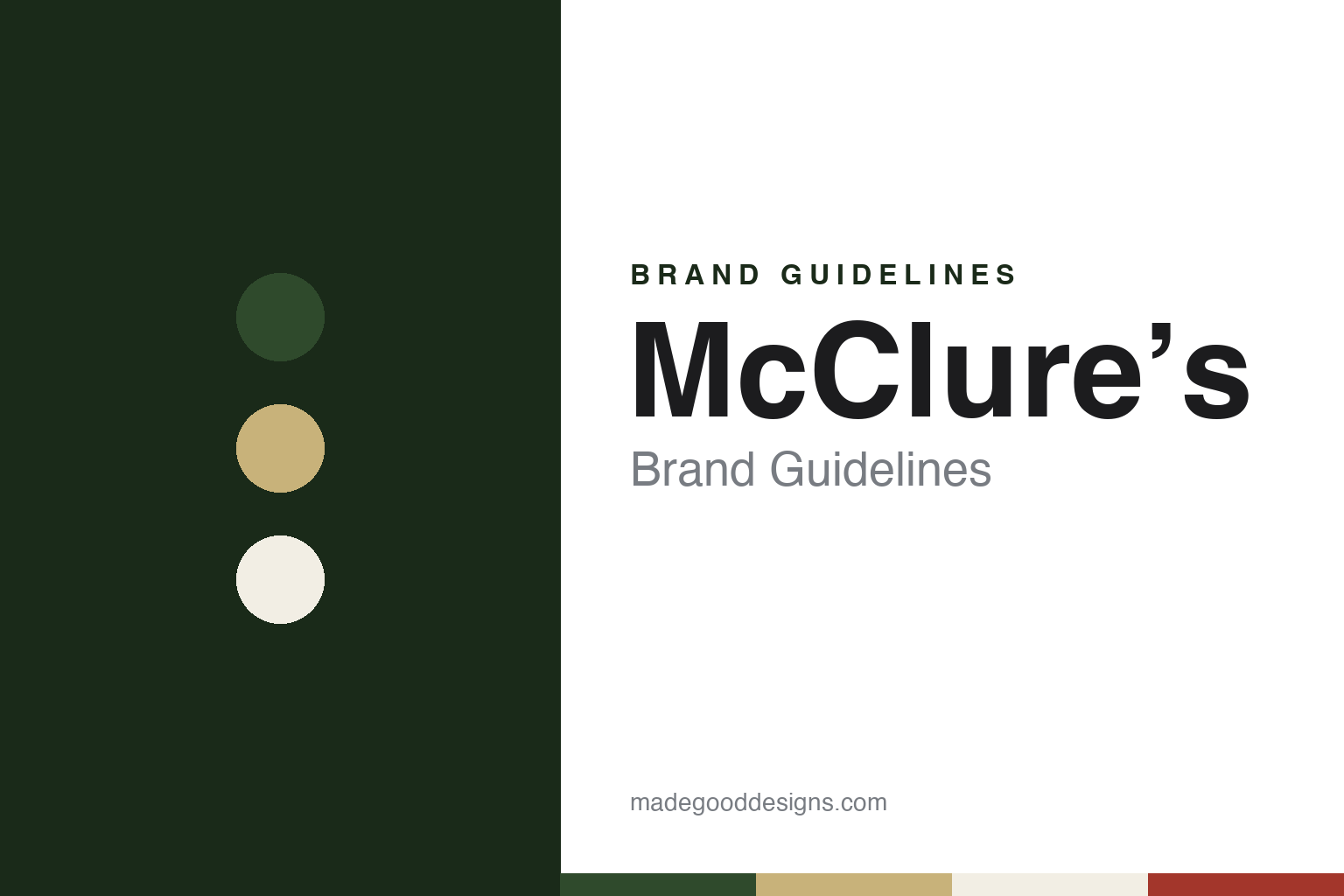
McClure’s Brand Guidelines
Two brothers, a great-grandmother’s recipe and a factory in Detroit.
Aa
Two constants: a pickle green, mustard seed and chili red palette and a slab serif register. Abstract homage — not a McClure’s product or mark; no jar, label or logo is reproduced.
A recipe handed down
Lala, a summer tradition and two brothers.
McClure’s is a pickle company from Detroit, Michigan, started by two brothers, Bob and Joe McClure. The business press has told its origin the same way for more than a decade. Smart Business, in a profile of Joe McClure published on 1 July 2012, said that in 2006, after years of making pickles in their tiny Michigan kitchen and using their great-grandmother Lala’s recipe, Joseph McClure and his brother Bob started McClure’s Pickles. Vegetable Growers News repeated the account on 14 August 2014.
The recipe is the centre of the company’s own telling. Its online timeline says Great Grand Momma Lala took an interest in cooking early, was introduced to pickling by a friend, and made a spicy pickle every summer at the request of her heat-loving husband. The company says the recipe passed to Jennifer Pearce, who grew up in the suburbs of Detroit and made a more kid-friendly garlic dill with Lala. Jennifer, the timeline says, married Mike McClure in 1973, and the couple made the pickles every summer for friends and family, who kept asking for more.
Joe McClure described that tradition to New Zealand’s Supermarket News in a piece dated 6 April 2018. “My dad would wake us up at 3 in the morning and take us down to the local farmers market,” he said. “It was our tradition every summer. I’d have to call up my friends and tell them that I couldn’t play baseball because that day was pickle day.” The magazine noted that the McClure name is Scottish and that the recipe came from the mother’s side of the family. In 2014 Bob McClure told Vegetable Growers News: “We learned how to make the pickles from our grandfather and parents, and now we continue the tradition with a bit more room.”
Colour
Brooklyn, a doctorate and a Detroit factory.
The brothers came to the business from other careers. Vegetable Growers News said in 2014 that before entering the pickle business full time, Bob McClure had been an actor and comedy writer living in Brooklyn, and that Joe had completed a doctoral degree in physiology at Wayne State University and was also a classical musician. Joe told Supermarket News that the brothers launched the company in the same month he started his postgraduate studies: “I would be up at 2 AM to make the pickles, then have class from 10 then study until 4:30.” The company’s timeline says that the brothers had no business background, no manufacturing experience and knew nothing about food production, and adds: “But they were hungry.”
The company’s timeline also gives the business two homes from the start, with Joe in Detroit and Bob taking the product to Brooklyn, where they approached specialty food stores. Its timeline says that in 2009 the brothers received a favourable review in The New York Times, which led to an appearance on the Food Network programme The Best Thing I Ever Ate. Smart Business said in 2012 that Joe McClure could still be found greeting customers at the Detroit farmer’s market where the brothers began selling the pickles.
Production settled in Detroit. Bob McClure told Vegetable Growers News in 2014: “We make the pickles, relish, Bloody Mary mix and other McClure’s products in Detroit, Michigan. In Brooklyn, New York, we have a small marketing, sales and order management office.” He said every jar is hand-packed by a member of the team, and that the company uses as much local produce as possible when it is in season. The same report said Bob had moved back to the Detroit area to work at the plant, overseeing business administration, key accounts and brand development, while Joe oversaw production, Midwest distribution and the factory. The brothers’ parents, Jennifer and Mike McClure, were also part of the operation. The company says it moved into a larger factory in Detroit in 2012, and Supermarket News described the site in 2018 as a converted former American Axle factory.
Typography
Design and documentation.
The brands in this group are all American pickle names. Pickle brands in general reach people through a glass jar more than through any other object: a cylinder of brine, cucumbers and spice that sits on a shelf or in a chilled case, with a paper or printed label and a metal lid. Some pickles are sold shelf-stable in the ordinary grocery aisle, while others are kept refrigerated from the plant to the store, and that choice shapes where a jar is placed, how it is shipped and how the label has to read from a distance.
Because brine and cucumbers look much the same from one jar to the next, much of a pickle brand’s identity is carried by the label, the lid, the colour of the type and sometimes a mascot or a slogan. Many pickle names began as regional brands sold close to the farms and plants that supplied them, and some have since passed to national food companies. The questions worth asking are plain ones: who started it, who owns it now, and where the pickles are packed.
Each guide separates what independent sources record from what a company says about itself, and marks plainly what rests only on the company’s own word.
Aa
A slab serif — the sturdy, workshop register of a hand-packed Detroit jar. (Specimen set in Roboto Slab, a slab serif STAND-IN; NOT the McClure’s logo.)
A pickle with a city attached
Chips, Bloody Mary mix and Detroit.
The range grew out from the two family recipes. The company’s timeline names the original pair as Lala’s spicy pickle and the garlic dill made with Jennifer, and by 2012 Smart Business said the company also produced relish, Bloody Mary mix and other products. The company’s timeline says production widened in 2012 to include relishes, kettle-cooked chips and Bloody Mary mix.
The chips came from a customer. Smart Business reported that in 2011 a customer’s online suggestion led to a collaboration with Detroit’s Better Made Potato Chips to create a McClure’s Pickles chip line. Vegetable Growers News said in 2014 that the chip was a classic crinkle cut, available in Garlic Dill or Spicy Pickle flavours, matching the names of the two pickles.
The city is part of how the brand presents itself. Joe McClure told Supermarket News in 2018 that he considered the regeneration of Detroit an important part of the McClure’s brand: “There’s this perception that Detroit is a shell of a city, but really there are some fantastic food companies leading the regeneration.” Speaking in 2014, Bob McClure pointed to the long history of pickle-making in Michigan, naming Vlasic and H.J. Heinz. The brand has also travelled: Vegetable Growers News said in 2014 that its products were sold in specialty shops in Australia, the United Kingdom, Ireland and South Korea, and Supermarket News said McClure’s arrived in New Zealand in 2015 through Cook & Nelson.
For a design guide, McClure’s shows how a small family company can build its identity on a handed-down recipe, two named flavours and the city where its jars are packed, carrying the same pair of names from pickles into chips. Compare it with Vlasic, the pickle brand Bob McClure named as part of Michigan’s pickle history, and Bubbies, another pickle brand that began with traditional kosher dills sold at a farmers market. For this guide we use pickle green, deep dill, mustard seed and chili red with a slab serif, an unofficial interpretation; no product or logo is reproduced.
Explore & save
Keep McClure’s’s identity on hand — save it to a board in the Made Good inspiration library.
McClure’s identity set
Pin the McClure’s pickle green, mustard seed and chili red palette and the slab serif register to your own board.


