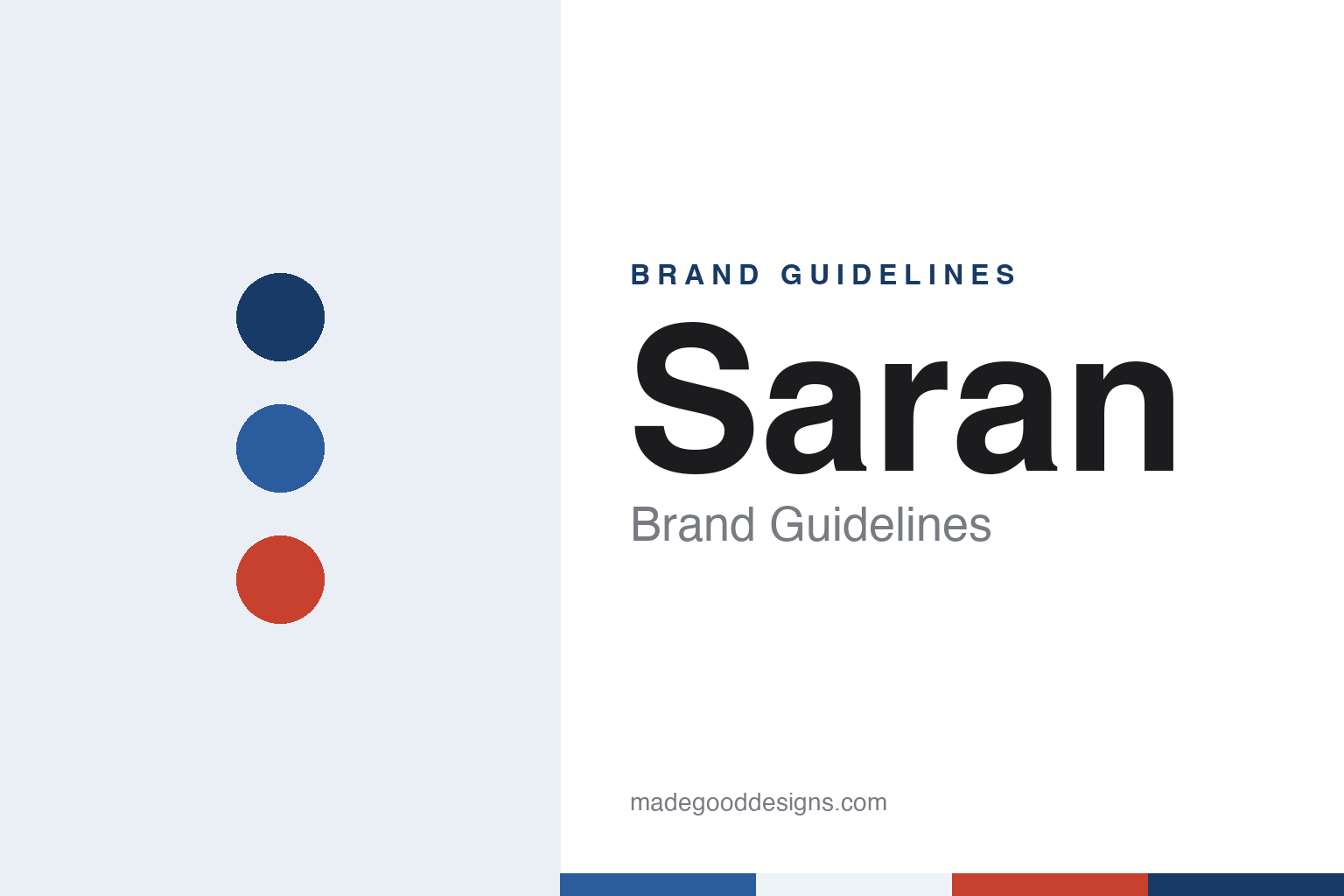
Saran Brand Guidelines
The Dow Chemical food wrap that moved to SC Johnson.
Aa
Two constants: a carton blue, cutter-edge red and film clear palette and a mid-century grotesque register. Abstract homage — not a Saran product or mark; no roll, carton or logo is reproduced.
A Dow laboratory accident
A plastic named Saran, then a roll for the kitchen.
Saran was a material before it was a kitchen product. The Dow Chemical Company says that polyvinylidene chloride, the plastic “which Dow dubbed Saran,” was discovered by accident in 1933 by Ralph M. Wiley, and that the discovery led to uses in seating materials, in plastics for wartime and industrial purposes, and eventually in Saran Wrap. SC Johnson’s chairman and chief executive, Fisk Johnson, gave the same outline in an article for the Harvard Business Review in April 2015: as Racine’s Journal Times summarised it on 25 April 2015, Johnson wrote that Saran had been accidentally discovered in 1933 by a Dow lab worker, that the US military used the compound during the Second World War, and that it debuted as Saran Wrap in 1953.
That 1953 launch is well documented in Dow’s own material. The company’s history pages present a 1953 print advertisement headed “The Most Amazing Food Wrap Ever Developed!”, which ran in the nationally syndicated This Week magazine and which Dow describes as one part of a large advertising campaign. Dow says Saran Wrap debuted on The Today Show, and that the company sponsored a whole television programme, Medic, to showcase the product. Dow places the wrap within its consumer push of the 1940s and 1950s.
The Science History Institute in Philadelphia holds another piece of that campaign in its digital collections: a 1953 Dow Chemical Company promotional booklet titled That Soft, Velvety Feel Tells You It’s Saran Wrap. The Institute catalogues it as advertising ephemera and describes its contents as a history of Dow, an account of the manufacturing process for Saran Wrap, and the wrap’s household and commercial uses. Among related items the Institute lists a 1955 photograph of the Saran Wrap plant at Dow.
In its first years, then, Saran was both the name of a chemical made by an industrial company and the name of a consumer product built on it, sold through magazines and network television.
Colour
Asahi-Dow in Japan, SC Johnson and a 2004 change of formula.
Dow took the wrap abroad through partners. The Japanese chemicals group Asahi Kasei says in its corporate history that Asahi-Dow, its venture with Dow, began producing polystyrene in 1957 and that in 1960 it launched a fabricated plastic products business by introducing Saran Wrap cling film to the Japanese market. Asahi Kasei records that Asahi-Dow was merged into Asahi Chemical, as the group was then called, in 1982. In Japan, the Saran Wrap name has since been part of Asahi Kasei’s own history.
In the United States the brand changed hands with the rest of Dow’s consumer goods. The Harvard Business Review article and the Journal Times both state that S. C. Johnson & Son, the family-owned household products company of Racine, Wisconsin, acquired Saran Wrap from Dow in 1998. SC Johnson has owned the US brand since then.
Six years later the company changed what the wrap was made of. In the Harvard Business Review, Fisk Johnson explained the decision through the company’s ingredient-review process, which it calls Greenlist, and wrote that SC Johnson pledged to stop selling wraps containing chlorine of any kind, including PVDC, by 2004. A dedicated research, development and engineering team was given a year to re-create Saran Wrap without the material. The Journal Times reported that the reformulated wrap appeared in shops in 2004, and quoted Johnson saying the team had created “a new formulation for a high-quality wrap,” but one that “would not retain the original’s competitive advantage.” He told the paper that, as expected, sales dropped, and that the company had also reduced marketing support for the wrap because it could no longer make certain product claims.
Johnson tied the choice to a line from his great-grandfather in 1927, which he quoted to the paper: “The goodwill of the people is the only enduring thing in any business. The rest is shadow.”
The range that followed was compact. An archived version of the brand’s website from February 2020 lists two wraps, Saran Premium Wrap and Saran Cling Plus wrap, says both are made with polyethylene, and describes Premium as easy to handle and Cling Plus as offering cling at value pricing. The same site said festive coloured versions of the wrap appeared periodically through the year, with the colourless wrap sold year-round.
Typography
Design and documentation.
Paper towels, tissues, paper cups and food wraps share a design question. The product itself is usually plain paper, plastic or foil, so much of a brand’s identity is carried by the package around it: a printed wrapper around a roll, a carton or cube of tissues, a sleeve of cups, a box with a cutting edge. That package sits on a shelf beside its rivals and has to tell one name from another at a glance.
The identities in this category therefore tend to rest on things printed on the pack and seen in advertising: a drawn character, a slogan, a run of colours or patterns, a box shape. Many of these names have also passed between owners over the decades, through acquisitions and mergers of the paper and packaging companies behind them, so a character or a slogan can stay in use long after the company that introduced it has gone.
Each guide sets out who started the brand, who owns it now and how its packaging and advertising have changed over time, and marks plainly what rests only on the company’s own word.
Aa
A mid-century grotesque — the register of a 1950s magazine advertisement for a new kitchen product. (Specimen set in Libre Franklin, a sans-serif STAND-IN; NOT the Saran logo.)
Saran
A chemical name, a velvety feel and a television launch.
Saran’s identity starts with a name that belonged to a material. Dow used “Saran” for polyvinylidene chloride itself, and then put the same word on a kitchen roll, so that the brand on the carton and the substance in the lab shared one name. Dow still presents the material and the wrap side by side in its history pages, under the heading of chance discoveries.
The launch language of 1953 was built on touch and wonder. Dow’s print advertisement promised “The Most Amazing Food Wrap Ever Developed!”, and its promotional booklet, now held by the Science History Institute, led with the feel of the film: That Soft, Velvety Feel Tells You It’s Saran Wrap. The booklet paired that sensory promise with a company history and a description of how the film was made, presenting the wrap as both a household convenience and a piece of chemical engineering. Dow’s decision to introduce the product on The Today Show and to sponsor Medic put the wrap on network television from the start.
The brand also carries the marks of its later owners. On the archived SC Johnson site of 2020, the name is written Saran™ throughout, while the Cling Plus line carries a registered mark, and the two products are described by handling and cling rather than by the chemistry that once defined them. In Japan the same Saran Wrap name has its own history with Asahi Kasei, which counts the wrap’s 1960 introduction as the start of its fabricated plastic products business.
The 2004 reformulation is part of the story the owner tells about itself. Fisk Johnson wrote about Saran in the Harvard Business Review as an example of a decision that cost sales, setting it beside his father’s earlier decisions on product ingredients, as the Journal Times reported.
For a design guide, Saran shows how a brand can begin as an industrial material name and be turned into a consumer product through advertising that sells a feeling — clarity, cling, a soft and velvety touch — and how that name can survive a change in the material underneath. Compare it with Ziploc, another Dow kitchen brand that moved to SC Johnson, and Glad, the Union Carbide wrap and bag brand now with Clorox. For this guide we use carton blue, cutter-edge red and film clear with a sans, an unofficial interpretation; no product or logo is reproduced.
Explore & save
Keep Saran’s identity on hand — save it to a board in the Made Good inspiration library.
Saran identity set
Pin the Saran carton blue, cutter-edge red and film clear palette and the mid-century grotesque register to your own board.


