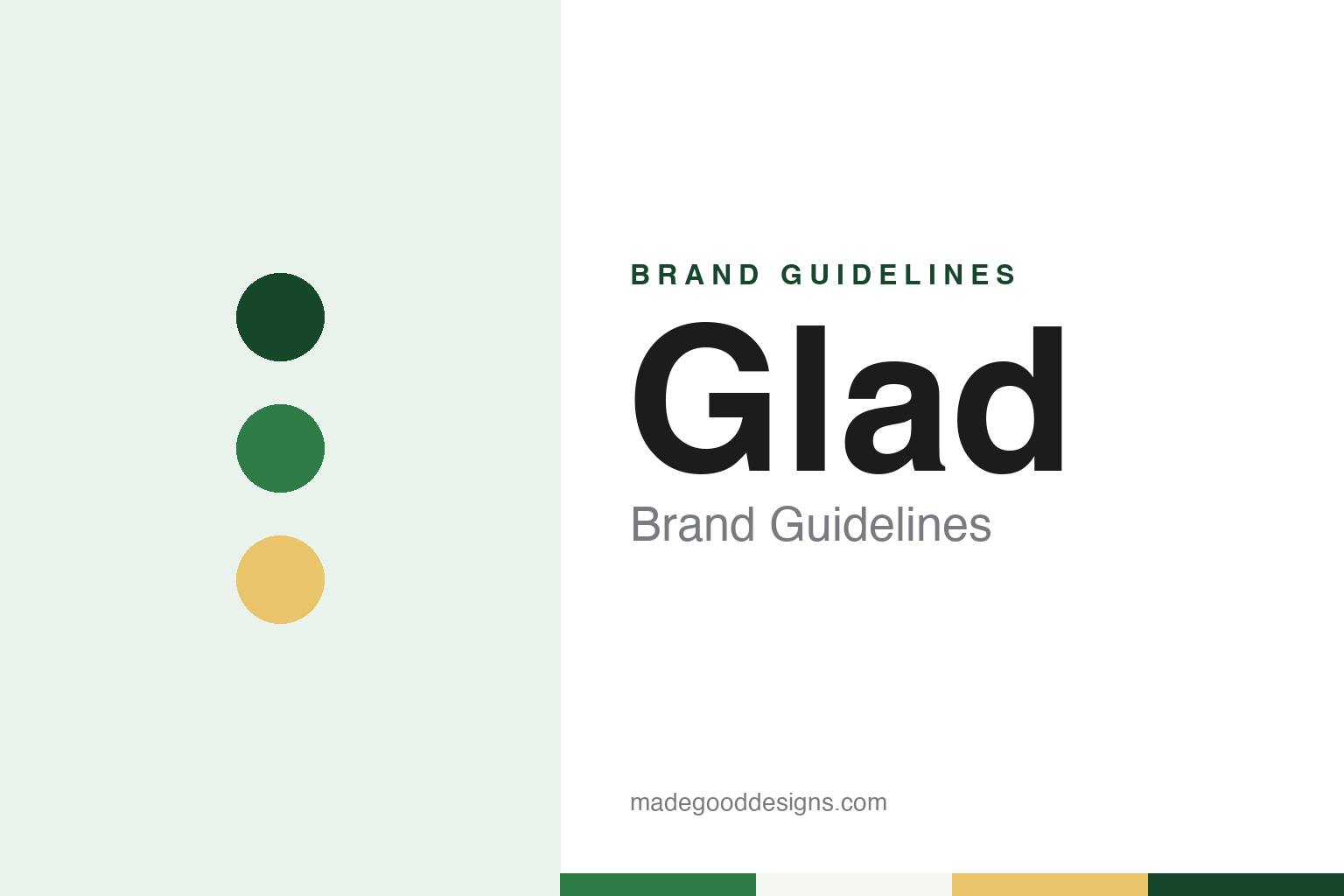
Glad Brand Guidelines
The Union Carbide bags and wraps that became a Clorox brand.
Aa
Two constants: a bag green, seal yellow and wrap clear palette and a sturdy grotesque register. Abstract homage — not a Glad product or mark; no bag, box or logo is reproduced.
From Union Carbide
A chemical company’s bags, wrap and a television pitchman.
Glad began as a consumer brand of the Union Carbide Corporation, the American chemicals, plastics and industrial-gases group. In a profile of the company’s new leadership published on 2 January 1977, The New York Times listed Glad bags and Glad wrap among Carbide’s consumer goods, alongside Eveready batteries and Prestone antifreeze, in a business that otherwise ran from chemicals and metals to carbon products. The same article recalled that Carbide had, several years earlier, hired a fair-haired television pitchman dubbed “the Man from Glad” to sell its line of plastic bags. In the paper’s description he was a sworn enemy of stale sandwiches, shown teaching households how to keep food fresh in Glad bags.
The brand also travelled beyond the United States under Carbide. In Australia, where the business is now run by Clorox Australia, the company says Glad has been creating ways to protect, preserve and cook food since 1966, and describes it as having been in Australian kitchens for more than half a century.
Carbide’s ownership ended in the middle of the 1980s. A profile of First Brands in Gale’s International Directory of Company Histories says Union Carbide had two consumer products divisions at the time: Eveready batteries, which went to Ralston Purina, and Home and Automotive Products, which was bought by Alfred E. Dudley and 23 other managers from Carbide’s consumer products side in a leveraged buyout. The managers organised the business as the First Brands Corporation, and the deal, concluded in mid-1986, gave them Carbide’s STP motor products, its Glad and Glad-Lock lines of plastic bags, Prestone antifreeze and Simoniz waxes, together with product lines and factories in Asia, Canada and Europe.
The new company set up its headquarters near the airport in Danbury, Connecticut, according to the same profile, which says First Brands spent its early years working on the value of the brands it had inherited. It credits the business with more than thirty product variations in that period, among them Glad bags with handles, and names one launch as the most successful of them: the Glad-Lock zipper bag.
Colour
First Brands, Clorox and a venture with Procter & Gamble.
Glad-Lock gave the brand a closure with its own visual idea. The Gale profile describes the bag’s interlocking seal by its slogan, “Yellow and Blue Make Green”: two coloured halves of the zipper that show green when pressed together. It also records that First Brands planned in early 1992 to expand Glad bag manufacturing and to move some production from a Connecticut plant to Virginia, while keeping Glad plants in Georgia and Arkansas.
The next owner was The Clorox Company of Oakland, California, which says it has been headquartered there since 1913. Chemical Online reported on 22 October 1998 that Clorox had signed a definitive agreement to acquire First Brands, a maker of plastic wraps and bags, auto care products, cat litter and fireplace products, with operations in Canada, Australia, New Zealand and South Africa. Clorox’s chairman and chief executive, G. Craig Sullivan, called the purchase “an excellent strategic fit.” Writing in March 2024, Clorox marked the deal’s twenty-fifth anniversary, saying it had brought in Glad bags and food protection along with Scoop Away and Jonny Cat litter and STP. The company says the purchase also brought Glad plants in Rogers, Arkansas, Amherst, Virginia, and Orangeville, Ontario, which remain in its network, and a research facility in Willowbrook, Illinois.
Clorox then shared the business with a rival. A joint press release from Clorox and Procter & Gamble dated 16 December 2004 says the Glad products joint venture was formed in January 2003, with access to P&G patents, trademarks and other technologies for food and trash bags, wraps and containers sold under the Glad and GladWare names. In that release P&G raised its interest from 10 to 20 percent, the most the venture agreement allowed, with Clorox owning the rest. Glad’s vice-president and general manager, Beth Springer, credited two products launched since the venture began: Press’n Seal wrap and ForceFlex trash bags.
The arrangement had a fixed end. On 3 February 2025 Clorox announced that it and P&G had jointly decided to wind down the Glad bags and wraps venture as of 31 January 2026, and that it intended to acquire P&G’s 20 percent interest when the venture ended. Clorox said Glad would keep exclusive core licences to the intellectual property P&G had contributed, royalty-free, for certain licensed products, and that it planned to continue licensing the Febreze and Gain trademarks from P&G. Its results release of 30 April 2026 referred to the termination payment under the Glad joint-venture agreement.
Typography
Design and documentation.
Paper towels, tissues, paper cups and food wraps share a design question. The product itself is usually plain paper, plastic or foil, so much of a brand’s identity is carried by the package around it: a printed wrapper around a roll, a carton or cube of tissues, a sleeve of cups, a box with a cutting edge. That package sits on a shelf beside its rivals and has to tell one name from another at a glance.
The identities in this category therefore tend to rest on things printed on the pack and seen in advertising: a drawn character, a slogan, a run of colours or patterns, a box shape. Many of these names have also passed between owners over the decades, through acquisitions and mergers of the paper and packaging companies behind them, so a character or a slogan can stay in use long after the company that introduced it has gone.
Each guide sets out who started the brand, who owns it now and how its packaging and advertising have changed over time, and marks plainly what rests only on the company’s own word.
Aa
A sturdy grotesque — the register of a printed carton on a grocery shelf. (Specimen set in Archivo, a sans-serif STAND-IN; NOT the Glad logo.)
Glad
A man in white, a seal that turns green and a scent.
Much of Glad’s identity was carried by a character. Writing in the Chicago Tribune on 11 August 1989, the advertising critic Barbara Lippert described the 1960s Man from Glad as wearing a silver wig and a white raincoat and descending by helicopter, then by rubber dinghy, into a kitchen where a woman had just been scolding her husband over badly wrapped leftovers; the Man swept in and dealt with the problem. Lippert set him among the strangest jobs held by any advertising endorser of the decade, Mr. Whipple included. She also recalled a later campaign starring Tom Bosley, the father from Happy Days, as a neighbour advising a friend on storing strawberries.
The 1989 campaign she reviewed went another way. Built around Glad-Lock zipper bags, it staged mock television demonstrations: an announcer at a demonstration table confronted people who were loyal to other zipper bags. One spot, “Angry Bees,” offered a woman the choice of being locked in a phone booth with her own bag full of bees or with a Glad-Lock bag full of bees; another, “Pigsty,” featured a comic-book collector; a third was called “Chef.” Lippert wrote that the bees spot made a vivid case for Glad-Lock’s green colour-change seal, which shows the shopper that the bag is shut.
Colour and scent have since become part of the pack. In its March 2024 anniversary piece, Clorox described the OdorShield technology introduced under the venture, using P&G scents from Febreze and Gain alongside Clorox and Pine-Sol scents, and said it had moved beyond black, white and grey bags to coloured, scented ones, among them pink bags in a Cherry Blossom scent, blue in Beachside Breeze and green in Sweet Citron Lime. Glad’s own website today leads with ForceFlex kitchen bags, food wraps and storage bags, and seasonal scented bags.
The brand’s name, meanwhile, has carried through three corporate owners and a joint venture without changing: from Union Carbide to the managers of First Brands, to Clorox, and through two decades of shared ownership with Procter & Gamble. The products have changed around it, from the wrap and sandwich bags of the Man from Glad to drawstring kitchen bags, zipper bags and Press’n Seal.
For a design guide, Glad shows how a commodity brand can be held together by a few repeatable devices — a costumed spokesman, a seal that changes colour when it works and, later, coloured and scented bags — while its owners change behind it. Compare it with Clorox, its owner since the First Brands deal, and Saran, the Dow food wrap. For this guide we use bag green, seal yellow and wrap clear with a sans, an unofficial interpretation; no product or logo is reproduced.
Explore & save
Keep Glad’s identity on hand — save it to a board in the Made Good inspiration library.
Glad identity set
Pin the Glad bag green, seal yellow and wrap clear palette and the sturdy grotesque register to your own board.


