Red Baron Brand Guidelines
A Minnesota frozen pizza named after a First World War pilot and sold with real biplanes.
Aa
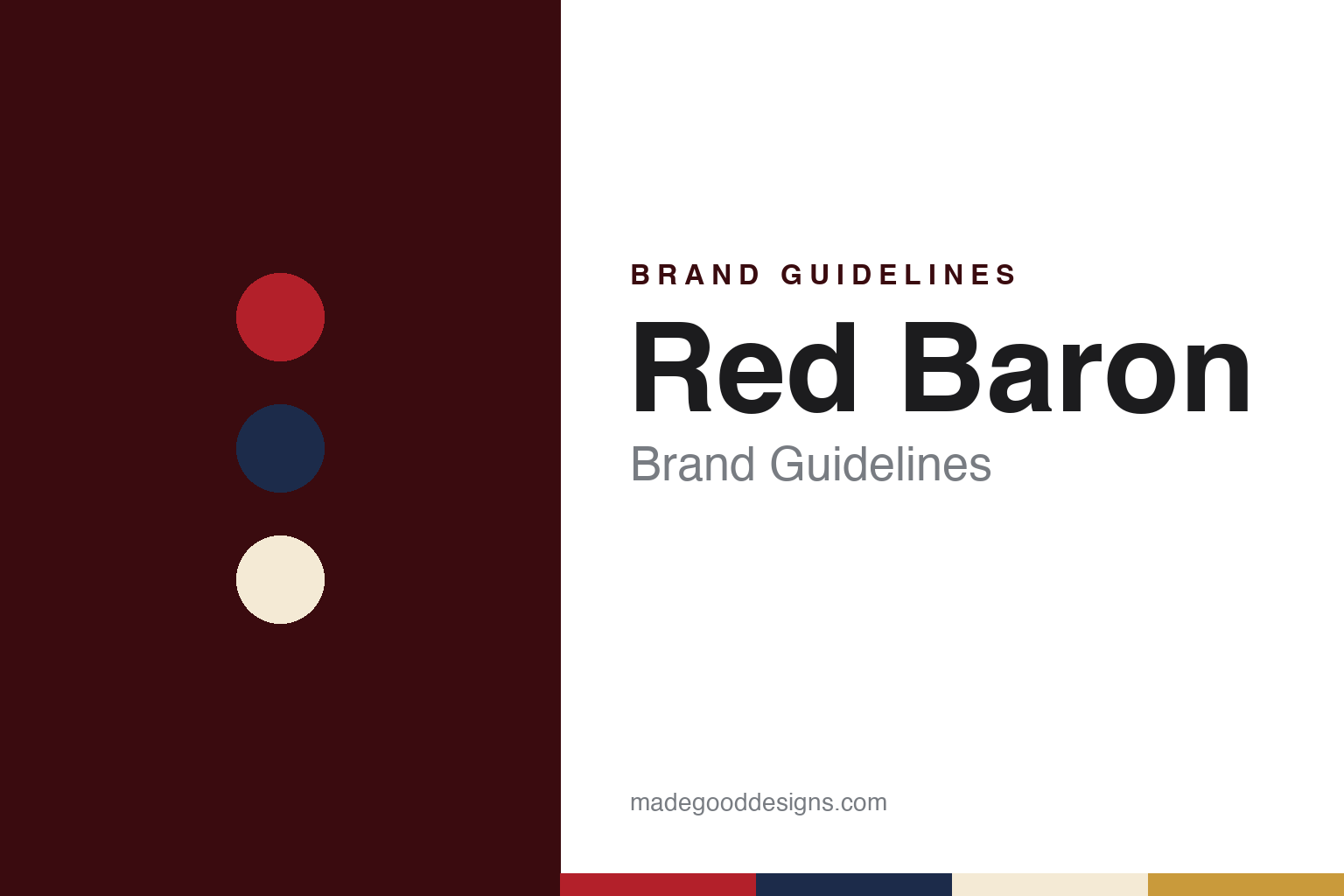
Two constants: a baron red, cockpit navy and biplane cream palette and a heavy slab serif register. Abstract homage — not a Red Baron product or mark; no package, aircraft or logo is reproduced.
A pizza without an Italian name
An ice-cream round, a Kansas pizzeria and a name thought up on a plane.
Red Baron is an American frozen pizza made by Schwan’s Company of Marshall, Minnesota. The company did not begin with pizza. English Wikipedia, citing a 2015 biography of the founder published by the German Historical Institute, says Marvin Schwan started in 1952 by delivering his family’s homemade ice cream to farms in rural western Minnesota. The company’s own history dates the first round to a Tuesday in March 1952 and says he made it in a second-hand 1946 Dodge panel van. Home delivery stayed at the heart of the business for decades, and Wikipedia says the company later added juice concentrates in 1957 and frozen fish in 1962.
Pizza arrived through the delivery trucks and then through a factory. A history published on the company’s blog in June 2017 says that by the late 1960s Schwan’s depended on contract packers for its pizzas and could not keep up with demand. Marvin’s brother Alfred Schwan told him, in the blog’s account, “We should control our destiny and make our own pizza.” After scouting empty buildings in Iowa, Illinois and South Dakota, the company placed a plain advertisement in the Wall Street Journal that read “Wanted: Frozen Pizza Manufacturer.” The reply came from the owner of a pizzeria in Salina, Kansas. That business had started in the 1960s as Tony’s Little Italy, and Schwan’s bought it in 1970, the company says, keeping the Tony’s name for a national frozen pizza.
Red Baron came six years later, and the company is candid about why. Its marketers at the time, the 2017 history says, believed that a frozen pizza did not need an Italian name to sell: any name that caught the shopper’s eye would do. The name came to Tom Caron, who had started at Schwan’s as a part-time truck loader and had risen to its leadership team, while he was on a plane ride home. A trademark search showed that no one owned “Red Baron” for pizza, and Caron registered it.
The phrase was already in wide use. “The Red Baron” is the English nickname of Manfred von Richthofen, the German fighter pilot of the First World War, as English Wikipedia notes in the first lines of its article on him. The company says the name was chosen because it had “a sense of nobility and enjoyment.”
The brand’s first customers were not supermarket shoppers. Red Baron officially launched in 1976, the company says, and was first sold to local taverns, with a beer stein on its label. Only later did it move into grocery-store freezers, and with that move, the 2017 history says, “more elegant artwork” arrived, including the figure the company calls the Pizza Baron and his airplane. The company’s timeline credits its Consumer Brands division with the launch.
Colour
A family firm in Marshall, then a Korean food group.
For more than four decades Red Baron belonged to a family business. Leadership of Schwan’s passed in 1993 from Marvin Schwan to his older brother Alfred, who had run manufacturing since joining in 1964, according to the company and English Wikipedia. The company took the name The Schwan Food Company in 2003, replacing Schwan’s Sales Enterprises, and in 2017, for its 65th anniversary, it changed its name again to Schwan’s Company and rolled out new corporate branding, its history page says.
The ownership changed in 2019. Verdict Foodservice reported on 26 February 2019 that Schwan’s had sold an 80% stake to the South Korean food company CJ CheilJedang, in a transaction announced the previous November, and would operate as its subsidiary. The report named Red Baron, Freschetta, Tony’s Pizza, Edwards and Mrs Smith’s among the brands, and said the deal also covered Schwan’s manufacturing and logistics operations. Chief executive Dimitrios Smyrnios was quoted saying the combination would create “a much stronger business.” CJ CheilJedang has controlled Red Baron’s owner since that deal. The home-delivery round where it all started was not part of the sale: English Wikipedia says it stayed with the Schwan family, was renamed Yelloh in 2022 and closed in November 2024. Schwan’s says CJ Foods USA and Schwan’s Company were combined into one team in 2023, and the company now describes itself as a U.S.-based affiliate of CJ Foods, still based in Minnesota.
Red Baron’s advertising has passed through several agencies. MediaPost reported on 15 February 2016 that Schwan’s Consumer Brands had named space150 its agency of record for seven brands, Red Baron among them, which had previously used BoomAgers for television creative. Their first project was a 40-week promotion for the brand’s 40th birthday called “Timeless”, with a 30-second spot following a girl through four decades of pizza nights. The agency said it had dropped the usual “cheese pull” and “bite and smile” shots, and the digital content commemorated the brand’s logo changes and packaging shifts over the years, with a website where visitors spun a virtual oven dial to travel through its history.
A character followed. In May 2017, the company’s blog announced the Baroness, a new voice for the brand aimed at mothers, introduced in a digital spot called “War Stories” with the comedian Kristin Hensley. Her signature look, the company said, was a bomber jacket covered in patches earned as a parent, with titles such as Clean Plate Club.
Later work came from TBWA\Chiat\Day LA. The Drum reported on 23 August 2023 that the agency had made “The Showdown: Fully Loaded”, a western in which a saloon brawl breaks out over a pizza, directed by Robert Llauro with the production company Landia, after earlier digital campaigns including “Hometown Throwdown” and “Pizza Sharing.” DesignRush reported on 24 September 2025 that the brand had launched “Sharing Leads to More Sharing” with the same agency in July 2024, extending its longer-running “Share Something Awesome” platform with comic spots about librarians, hipsters and a book club.
Typography
Design and documentation.
The brands in this group live in the chilled and frozen aisles: frozen pizzas, coffee creamers and plant-based milks. Their packaging is usually seen through a freezer door or on a crowded refrigerated shelf, so the identity has to work on a pizza box, a creamer bottle or a milk carton as much as on a logo sheet, and it is often carried by colour, a flavour picture and the name of each variety.
Many brands like these began with a single founder, a family business or a small regional company and now sit inside much larger food groups, so the name on the box may have outlived several owners, moved between factories or been licensed to another company in a different market. That makes the plain questions behind each name worth asking: who started it, who owns it now, and where its pizzas, creamers or milks are actually made.
Each guide separates what independent sources record from what the company says about itself — its founding story, its owners over time, where its products are made and how its packaging has changed — and marks plainly what rests only on the company’s own word.
Aa
A heavy, bracketed slab serif — the stencilled, aviation-poster register of a pizza named after a pilot. (Specimen set in Alfa Slab One, a slab-serif STAND-IN; NOT the Red Baron logo.)
A squadron over the Midwest
Real biplanes, a pilot mascot, and a decision to land them.
To help sell Red Baron across the United States, the company says, it formed the Red Baron Squadron in 1979, a team of Second World War-era biplanes that flew for the brand for 28 years. MPR News described it in December 2007 as an airshow team flying Stearman biplanes from coast to coast, based in Marshall, the company’s home town.
The squadron ended in a changed grocery trade. MPR News reported on 4 December 2007 that the Schwan food company had announced it was grounding the team. “The retail grocery industry has experienced considerable change over the past few years,” the company’s Bill McCormack said, “and, as a result, we have decided to refocus our Red Baron marketing program and to discontinue the Red Baron Squadron.” The team’s crew chief had once called it “the New York Yankees of the air show industry,” the report said.
The product itself was simplified in the years that followed. In an interview with FoodNavigator published on 1 July 2013, Bob Waldron, then president of Schwan’s Consumer Brands, said consumer research had shown that using seven different types of pepperoni across Red Baron products added cost and complexity without a meaningful benefit to shoppers. “Some products had been over-engineered,” he said, and the company had concentrated instead on “the product right, the pack right, the merchandizing right.”
The company’s 2017 history describes the move from a tavern label with a beer stein to grocery packaging with the Pizza Baron and his airplane, and the 40th-birthday campaign of 2016 looked back over the logo and packaging changes in between, according to MediaPost.
The owner has kept the brand close to its sister lines. Red Baron sits in the Schwan’s portfolio beside Freschetta, the rising-crust pizza the company launched in 1996, and Tony’s, the Salina pizza that brought Schwan’s into pizza-making in 1970. It is sold in the same freezer aisle as rivals with very different stories, among them DiGiorno, the rising-crust pizza Kraft was test-marketing in the winter of 1997, according to The New York Times Magazine.
For a design guide, Red Baron shows how a brand with no founder’s name and no Italian kitchen to point to can build an identity from a single borrowed figure, a pilot, and then carry him from a label to a real squadron of aircraft and on to a jacket of patches. Compare it with CJ CheilJedang, the Korean food group that has controlled its owner since 2019, and DiGiorno, its rising-crust rival in the freezer aisle. For this guide we use baron red, cockpit navy, biplane cream and brass gold with a heavy slab serif, an unofficial interpretation; no product or logo is reproduced.
Explore & save
Keep Red Baron’s identity on hand — save it to a board in the Made Good inspiration library.
Red Baron identity set
Pin the Red Baron baron red, cockpit navy and biplane cream palette and the heavy slab serif register to your own board.