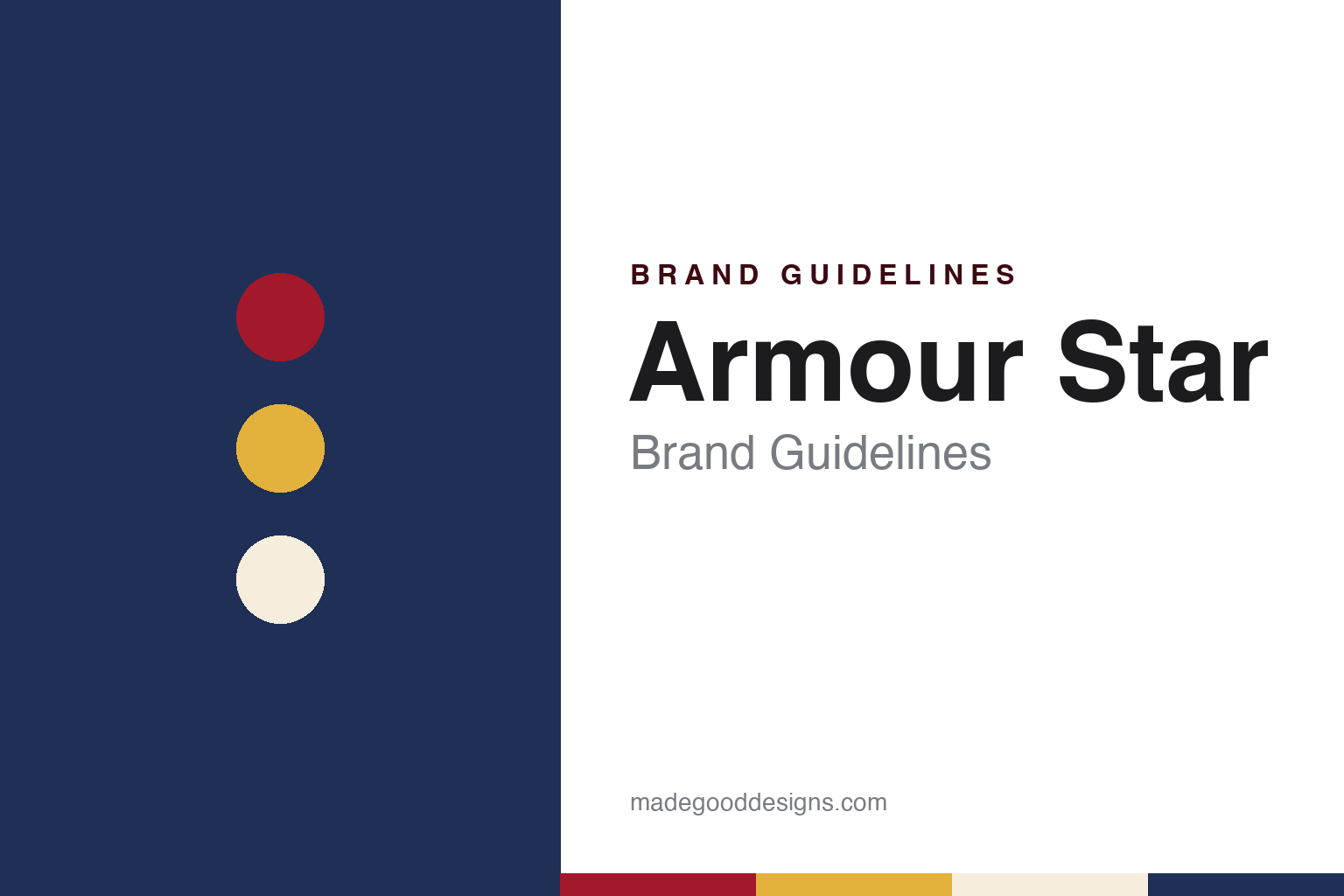
Armour Star Brand Guidelines
A Chicago packing-house name, split in two, with the canned half now at Conagra.
Aa
Two constants: a packing-house red, star gold and paper cream palette and a heavy slab serif register. Abstract homage — not an Armour Star product or mark; no can, label or logo is reproduced.
A packing house in Chicago
Philip Danforth Armour, a Milwaukee partnership and the Union Stock Yards.
Armour Star is an American brand of shelf-stable canned meats — Vienna sausages, potted meat, chili, stew, hash, luncheon meat, sliced dried beef and corned beef — sold today by Conagra Brands. The name it carries belongs to one of the old Chicago meatpacking houses, Armour and Company, and the brand’s own website tells its story through that company rather than through a separate launch of its own.
That account, on the Armour Star site as archived in 2023, says Armour and Company was founded in Chicago, Illinois, in 1867 by Philip Danforth Armour. It says that by 1880 the company had become a major Chicago business and had helped make the city and its Union Stock Yards the centre of the American meatpacking trade. The English-language Wikipedia article on Armour and Company gives the firm a slightly earlier root: it says Philip D. Armour joined John Plankinton in Milwaukee in 1863 to establish Plankinton, Armour and Company, which expanded the Milwaukee packing operation and opened branches in Chicago and Kansas City and an exporting house in New York, and that the two men dissolved the partnership in 1884.
The company’s later history, as the brand itself tells it, passes through the family and then out of it. The Armour Star site says that in the early 1920s the firm ran into financial trouble and the Armour family sold its majority interest to the financier Frederick H. Prince, and that the business came through the Great Depression and the Second World War as a major American company.
The same page connects the canned meats to a better-known household name. It says that in 1948 Armour, which had long made soap as a by-product of meatpacking, introduced the deodorant soap Dial, and that the company eventually renamed itself around both businesses. Wikipedia dates the incorporation of the consumer-products arm as Armour-Dial, Inc. to 1967. That link between soap and canned meat would decide where the Armour Star name ended up for the next four decades. MGD’s Dial guide covers the soap side of the story.
Colour
Greyhound, Conagra, Dial, Pinnacle and Conagra again.
The split that produced two Armour brands began with a bus company. Wikipedia says the Chicago-based Greyhound Corporation acquired Armour and Company in 1970 and moved its headquarters to Phoenix, Arizona, in 1971. The New York Times reported on 30 June 1983 that Greyhound had agreed to sell its Armour Food Company to Conagra, then a diversified grain and fertiliser company based in Omaha; the paper said the sale was part of a corporate clean-up begun by Greyhound’s chairman, John W. Teets.
Greyhound did not sell everything. Wikipedia says it kept the Armour Star canned-meat business, and that Armour-Dial went on making the canned products under the Armour Star trademark under licence from ConAgra. In 1985, the article says, Greyhound bought the household-products business of Purex Industries and combined it with Armour-Dial to form The Dial Corporation, which later became an independent company based in Scottsdale, Arizona. Wikipedia says the German group Henkel acquired Dial in March 2004.
The canned meats then left the soap company. Food Ingredients First reported on 2 March 2006 that Pinnacle Foods Group had acquired certain assets of The Dial Corporation’s Armour food products business. The trade title described that business as being in the dry canned-meat category, sold mostly under the Armour name, and listed its lines as Vienna sausage, potted meat, sliced beef, meat spreads, chili, luncheon meat, corned and roast beef hash, beef stew and lunch buckets. Pinnacle’s chairman and chief executive, C. Dean Metropoulos, was quoted as saying the business would give Pinnacle’s brands further growth opportunities and scale.
The other half of the name went a different way the same year. Wikipedia says ConAgra sold its refrigerated meats businesses, including the Armour brand, to Smithfield Foods in July 2006, and the Armour Meats website, as archived in 2024, says Armour is now owned by Smithfield Foods and sold in refrigerated and frozen meat categories. On the shelf the two are distinct: Armour Star is the canned, shelf-stable range; Armour without the star is Smithfield’s refrigerated line.
Pinnacle itself changed hands twice more. Wikipedia says the private-equity firm Blackstone Group acquired Pinnacle Foods in 2007. Reuters reported on 27 June 2018 that Conagra Brands had said it would buy Pinnacle Foods, a deal Reuters described as aimed at frozen and snack foods. Conagra Brands has owned Armour Star since that deal closed in 2018, and the Armour Star website carries a Conagra Brands copyright line. The brand now sits in the same portfolio as Banquet.
Typography
Design and documentation.
This group brings together two kinds of grocery shelf staple: meat sold in a sealed tin and pepper sauce sold in a small glass bottle. Both are everyday cupboard goods rather than occasion purchases, and both are packed so they can travel a long way and keep for a long time before anyone opens them. Brands in these two categories sit at many different points in the food trade, from family firms that still carry a founder’s name to labels that now belong to much larger food groups.
A tin or a sauce bottle has very little room to work with. The identity is carried by a printed label or a lithographed can, a name, a colour, sometimes a small illustration and a line of wording about what is inside or where it comes from. Because the company behind a name may have changed hands or moved production over the years, the questions behind each label are worth asking plainly: who started it, who owns it now, and where the product is actually made.
Each guide separates what independent sources record from what the company says about itself — its founding story, its owners over time, where its tins or bottles are filled and how its labels have changed — and marks plainly what rests only on the company’s own word.
Aa
A heavy slab serif — the stamped, packing-house register of a canned-meat label. (Specimen set in Alfa Slab One, a slab-serif STAND-IN; NOT the Armour Star logo.)
A star on a small can
A company name, a star, a slogan and a pantry shelf.
The name is the brand’s main asset, and the company uses it with a slogan. The Armour Star website, as archived in 2023, closes its brand story with the line “any time is Armour Star time”, and its home page uses a shortened version of the same line. Wikipedia’s infobox for the brand gives the tagline as “Any Time is Armour Time”.
The range is built around small, portable cans. The Armour Star site lists its product families as snack kits, Vienna sausages, potted meat, chili and stew, hash, luncheon meat, sliced dried beef and corned beef. The company says its Vienna sausages are “a take-along classic”, and its about page suggests corned beef hash for breakfast, a sandwich made with Treet luncheon meat at lunch and a bowl of homestyle beef stew for dinner. Treet is sold under the Armour Star umbrella on the same site.
The brand also leans on the pantry. The Armour Star site says the brand believes every family should create and practise a Family Disaster Plan and keep a Disaster Supply Kit, and it offers a downloadable disaster-preparedness guide. That framing — shelf-stable food as something to keep in reserve — sits naturally with canned meat that needs no refrigeration until it is opened.
For a design guide, Armour Star shows how a nineteenth-century company name can outlive the company itself and travel, as a licensed and then a sold trademark, through a bus operator, a soap maker, a private-equity-backed food group and a packaged-food company. Compare it with the canned-meat guide for SPAM, or with the Louisiana sauce in Louisiana Hot Sauce. For this guide we use packing-house red, star gold and paper cream with a heavy slab serif, an unofficial interpretation; no product or logo is reproduced.
Explore & save
Keep Armour Star’s identity on hand — save it to a board in the Made Good inspiration library.
Save Armour Star to a moodboard
Keep the palette, the slab-serif register and the ownership timeline together while you work.

