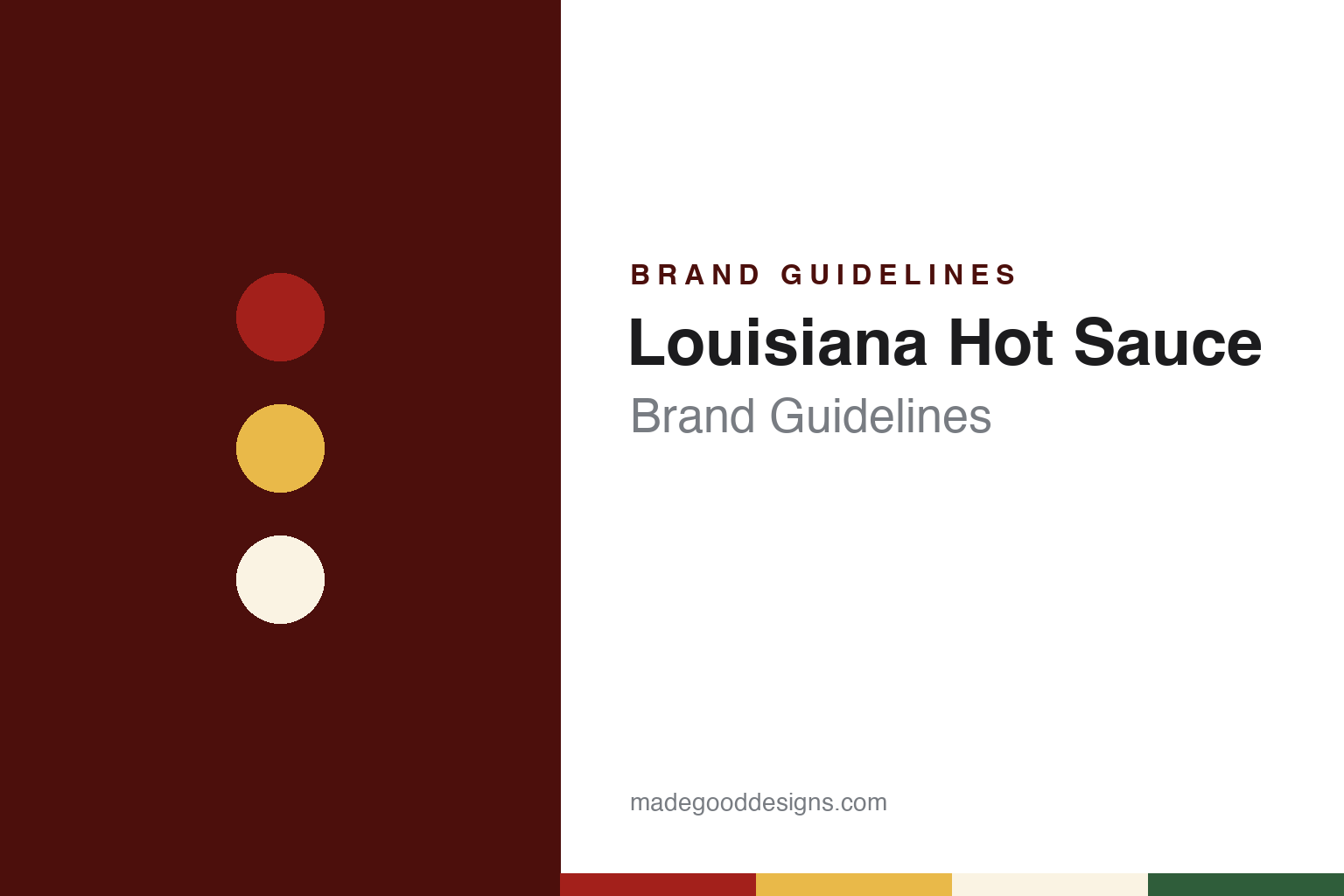
Louisiana Hot Sauce Brand Guidelines
A Cajun-country pepper sauce, a family firm in New Iberia and a label built on the state’s name.
Aa
Two constants: a cayenne red, bayou gold and vinegar cream palette and a slab-serif display register. Abstract homage — not a Louisiana Hot Sauce product or mark; no bottle, label or logo is reproduced.
A pepper sauce from New Iberia
A Bruce family business, a home kitchen and a sauce sold under the state’s name.
Louisiana Hot Sauce is an American pepper sauce sold under the label “The Original” Louisiana Brand Hot Sauce. It comes from New Iberia, a town in the south of Louisiana, and from 1928 until 2015 it belonged to a family food company in the same town, Bruce Foods Corporation. English Wikipedia says Bruce Foods first marketed the sauce in 1928, citing the 2005 book Stir the Pot: The History of Cajun Cuisine and an Associated Press report carried by The Southeast Missourian on 28 March 2001. The same article says the business started as a family company, with the sauce prepared in the kitchen of a home and sold to neighbours.
English Wikipedia’s article on the parent company names Ignatius and Jonathan Bruce as the founders of Bruce Foods and gives New Iberia and 1928 as its place and year of founding. The company grew well beyond pepper sauce. The Advocate, the Baton Rouge newspaper, reported on 6 April 2015 that Bruce Foods also made Casa Fiesta Mexican foods, Cajun Injector marinades and seasonings, Mexene chili powder and Cajun King seasonings at a plant in El Paso, Texas, and that late in 2013 it had sold its canned-vegetable line, which included Bruce’s Yams, to McCall Farms of South Carolina.
The sauce itself is of the kind usually called Louisiana style: peppers, vinegar and salt. English Wikipedia says it is made with aged long cayenne peppers, which are aged for at least a year, and that it belongs to the Louisiana-style group of sauces in which cooked and ground peppers are combined with vinegar and salt and left to ferment while they age. In April 2015, a Southeastern Mills executive told The Advocate that the sauce consisted of three simple ingredients. English Wikipedia gives the brand’s slogan as “not too hot, not too mild”, citing a 2011 hot-sauce book by A. Garbes.
By the late 1990s the sauce was being marketed through sport. The New York Times, in an article by Marian Burros published on 18 March 1998, described Louisiana Hot Sauce as owned by Bruce Foods of New Iberia, “just down the road” from the McIlhenny family of Tabasco, and reported that it had begun sponsoring bull-riding events and the U.S. 500 motor race in Brooklyn, Michigan. The paper quoted Si Brown, the president of Bruce Foods, as saying that the consumers who kept hot sauce factories running were from the inner city, blue-collar workers and young people who had grown up with it.
Colour
Bruce Foods, Southeastern Mills and a plant that stayed put.
The brand left the Bruce family in 2015. The Advocate reported on 6 April 2015, in an article by Ted Griggs, that Bruce Foods Corp. had sold its Original Louisiana Brand Hot Sauce and related assets to Southeastern Mills Inc., a company based in Rome, Georgia. The purchase included all of the brands and intellectual property related to Bruce’s hot sauce business, as well as its manufacturing and warehouse facilities in New Iberia. Terms were not disclosed.
The same report listed the other brands that went with it: Louisiana Wing Sauce, Red Rooster hot sauce, Louisiana Gold Pepper Sauce and two lines of tabasco peppers in vinegar, one under the Louisiana Brand name and one under Bruce’s. The Advocate said the newly acquired brands would operate under the company name “The Original Louisiana Hot Sauce Co.” J.S. “Si” Brown III, the president and chief executive of Bruce Foods, told the paper that Southeastern Mills, a family business, would be good stewards of the hot sauce business Bruce Foods had built, and that his own company’s strategy now centred on Mexican foods, marinades and seasonings and outdoor cooking appliances.
The plant did not move. The Advocate reported that under the terms of the acquisition Southeastern Mills would keep the workers at the hot sauce plant and warehouse, according to both companies, and that the New Iberia plant would continue to operate as before. The paper described Southeastern Mills as a family food company based in Rome, Georgia, working in industrial, foodservice and branded consumer food, with brands including Better than Bouillon, Shore Lunch and Better than Gravy. A Southeastern Mills executive, George Manak, said the acquisition would let the company add hot sauce flavours to some of its other products.
English Wikipedia now says the sauce is manufactured in New Iberia by Summit Hill Foods, which it describes as the company formerly known as Southeastern Mills, headquartered in Rome, Georgia. The company has owned the brand since the 2015 purchase. The brand’s own website, as archived in 2024, said its family of hot sauces continued to use the techniques of Louisiana-style cooking and simple ingredients, including peppers it described as hand-picked and sun-ripened.
Typography
Design and documentation.
This group brings together two kinds of grocery shelf staple: meat sold in a sealed tin and pepper sauce sold in a small glass bottle. Both are everyday cupboard goods rather than occasion purchases, and both are packed so they can travel a long way and keep for a long time before anyone opens them. Brands in these two categories sit at many different points in the food trade, from family firms that still carry a founder’s name to labels that now belong to much larger food groups.
A tin or a sauce bottle has very little room to work with. The identity is carried by a printed label or a lithographed can, a name, a colour, sometimes a small illustration and a line of wording about what is inside or where it comes from. Because the company behind a name may have changed hands or moved production over the years, the questions behind each label are worth asking plainly: who started it, who owns it now, and where the product is actually made.
Each guide separates what independent sources record from what the company says about itself — its founding story, its owners over time, where its tins or bottles are filled and how its labels have changed — and marks plainly what rests only on the company’s own word.
Aa
A heavy slab serif — the poster-and-label register of a Gulf Coast grocery sauce. (Specimen set in Alfa Slab One, a slab-serif display STAND-IN; NOT the Louisiana Hot Sauce logo.)
A state’s name on a small bottle
“The Original”, a family of Louisiana Brand labels and a refreshed logo.
The label carries two elements at once: a place and a quoted word. Its full wording, “The Original” Louisiana Brand Hot Sauce, puts the state’s name at the centre of the mark and sets the word original inside quotation marks.
The name also works as a family of labels. When The Advocate listed the brands that changed hands in April 2015, several shared the same formula of state name plus “Brand”: Louisiana Wing Sauce, Louisiana Gold Pepper Sauce and Louisiana Brand tabasco peppers in vinegar. The brand’s website in 2024 grouped them in the same way, with the Original sauce shown beside Louisiana Brand Gold Pepper Sauce, Louisiana Brand Wing Sauce, Louisiana Brand Peppers and Louisiana Brand Red Rooster hot sauce, and offered flavours including Smoked Chipotle, Garlic Lovers and Sweet Heat with Honey.
A change to the label is dated 2023. English Wikipedia says that in that year the brand updated its logo and released new flavours, among them Garlic Lovers, Tangy Taco, Cajun Heat, Southwest Jalapeño and Smoked Chipotle, alongside the Original, Sweet Heat with Honey and a hotter habanero version.
Sport has been a recurring stage for the name. The New York Times reported the bull-riding and Michigan motor-race sponsorships in March 1998, and the brand’s website in 2024 promoted professional sports sponsorships and events. In 2015 Stan Harris of the Louisiana Restaurant Association told The Advocate that the large broad-line distributors such as Sysco and Reinhart Foodservice would continue to carry the sauces after the sale.
For a design guide, Louisiana Hot Sauce shows how a place name, a quoted word and a short family of “Louisiana Brand” labels can carry an identity through a change of owner without the factory or the name moving. Compare it with Crystal Hot Sauce, another Louisiana-style pepper sauce, and Tabasco, made by the McIlhenny family near New Iberia. For this guide we use cayenne red, bayou gold, vinegar cream and cane-field green with a slab serif, an unofficial interpretation; no product or logo is reproduced.
Explore & save
Keep Louisiana Hot Sauce’s identity on hand — save it to a board in the Made Good inspiration library.
Louisiana Hot Sauce identity set
Pin the Louisiana Hot Sauce cayenne red, bayou gold and vinegar cream palette and the slab-serif display register to your own board.