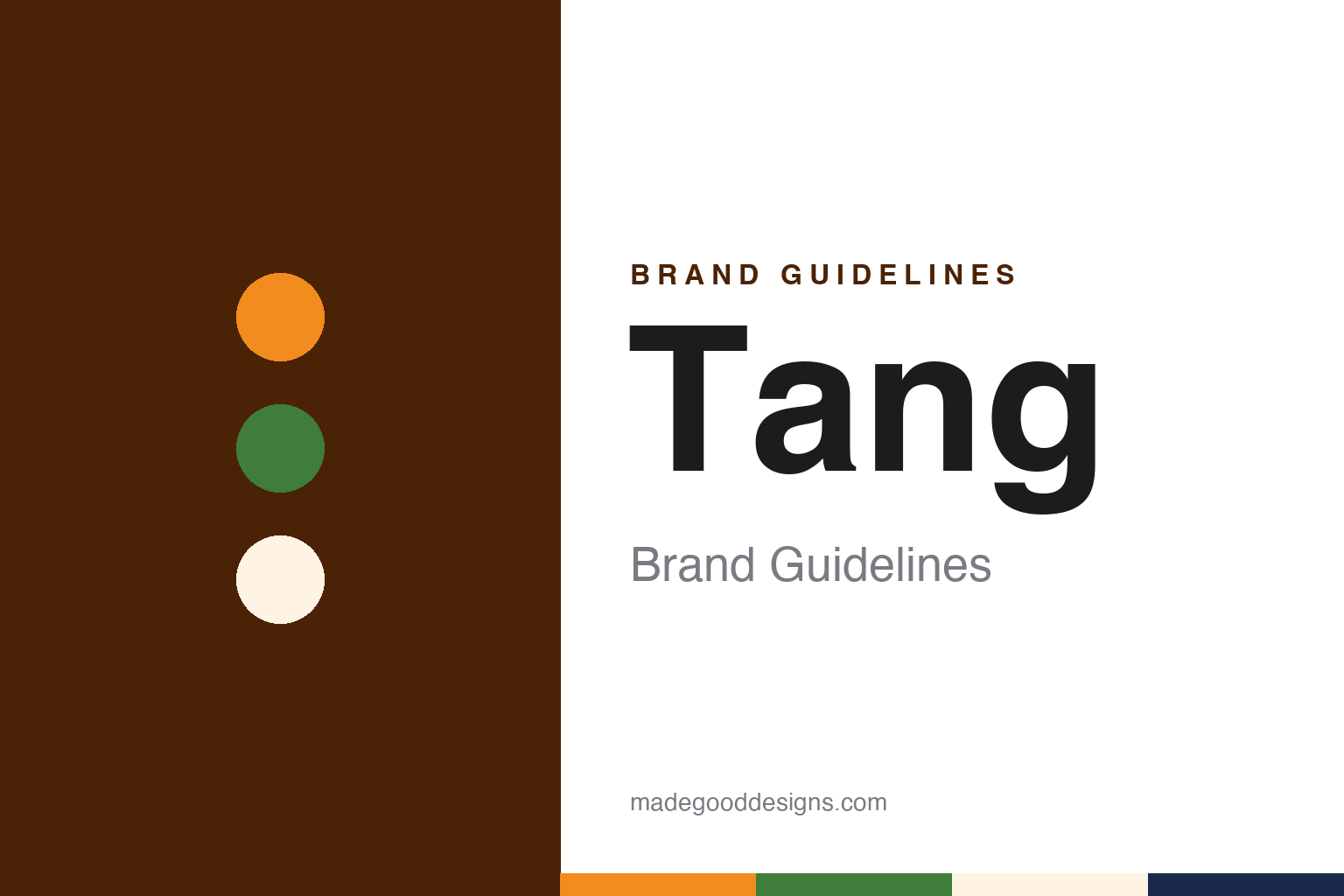
Tang Brand Guidelines
An orange powder from a food laboratory, a metallic jar label and a ride into orbit.
Aa
Two constants: a powder orange, label green and cream palette and a geometric space-age sans register. Abstract homage — not a Tang product or mark; no jar, label or logo is reproduced.
A powder from the General Foods laboratory
Two General Foods scientists, a 1957 formula and a public launch in 1959.
Tang is an orange-flavoured drink mix, sold as a powder that is stirred into water. It began inside an American food company, not a space agency. English Wikipedia says the drink was formulated in 1957 by William A. Mitchell, a food scientist at the General Foods Corporation, and the chemist William Bruce James, and that General Foods trademarked orange Tang that year. The same article says Tang entered test markets in 1958 and was available to the public from 1959.
Contemporary reporting matches that outline. The Deseret News wrote in November 2008 that the orange breakfast drink “was developed in 1957 by General Foods”, and that it was not used in space until 1962. In a January 2011 article, the site Today I Found Out described Mitchell as a chemist and occasional playwright working for General Foods, and said the company introduced Tang to the public in powder form in 1959. Mondelēz International, the brand’s owner across much of the world, says on its own brand page that the product spent two years in research and development before launch, and that it first went on sale in the United States in 7-ounce and 14-ounce glass jars.
The early sales story is a modest one. Today I Found Out wrote that the powder “wasn’t popular initially” after its 1959 introduction. The change came from an unexpected direction. The article says NASA decided to use Tang in 1962 on John Glenn’s Mercury flight and again from 1965 in the Gemini programme, in both cases to improve the taste of water from the spacecraft’s life-support system. The site argues that the Gemini flights in particular turned the drink into a hit, and that because so many people first met Tang through the space programme, many assumed it had been made for it.
The jar on the shelf was a designed object from the beginning. English Wikipedia describes the original orange Tang as packed in a glass jar with a metallic green label and an orange metal lid, and says General Foods promoted it as an “instant breakfast” drink rather than as a soft-drink mix. That positioning, next to juice on the breakfast table, gave the brand a domestic, morning register that its later space-age advertising would sit on top of.
Colour
General Foods, Kraft, and a 2012 split between Mondelēz and Kraft Heinz.
Tang’s ownership follows the corporate history of its parent. General Foods, which created the drink, later became part of Kraft; English Wikipedia says that in 2007 Kraft introduced a new version of orange Tang in which part of the sugar was replaced with sweeteners, sold in a smaller, more concentrated container. The decisive change came in 2012, when Kraft Foods divided into two companies. English Wikipedia says the Tang brand is owned in most countries by Mondelēz International, the company spun off from Kraft Foods in 2012, and that Kraft Heinz owns Tang in North America.
The two owners present the brand differently. Mondelēz says Tang is enjoyed across Asia, Latin America and the Middle East, and that its flavours vary with local preferences. English Wikipedia lists grape, lemon, mango and pineapple among the flavours sold in different countries, alongside the original orange. In the United States the brand sits in the Kraft Heinz drink-mix range, the same corporate family as Kool-Aid and Jell-O, two other names that came through General Foods.
The scientist behind the formula worked across that portfolio. English Wikipedia says William A. Mitchell also developed Pop Rocks, Cool Whip and an instant-set form of Jell-O, and that William Bruce James developed several Jell-O flavours. That connection matters for the visual story: Tang grew up in a company whose grocery brands were sold through bright packaging, mass advertising and recurring characters, and it borrowed all three.
The brand’s timeline on the Mondelēz site also records milestones in the brand’s own words. The company says Gemini 4 astronauts took Tang on their mission, and that Tang sponsored television coverage of Apollo 8, the American crewed flight around the Moon in December 1968. Those are company statements, and they show how closely the brand chose to tie its public image to the space programme in the years after Glenn’s flight.
Typography
Design and documentation.
The brands in this group sit on the drinks and dessert shelves of an ordinary grocery store: powdered mixes stirred into a jug of water, fruit drinks sold in bottles and small boxes, and whipped toppings kept in the freezer. Each one turns a simple product into something a shopper can recognise at a glance, and most of that work is done by the container rather than the contents.
A drink-mix brand lives on a canister, a tub or a flat pouch, where the flavour name, a fruit illustration and the number of quarts it makes all compete for space. A juice drink has to read from a refrigerated case or a lunchbox, on a tall bottle or a box with a straw. A frozen topping has a round lid and a tub that is often kept and reused long after it is empty, so its colours stay in a kitchen for years.
Each guide sets out what dated, independent sources record about the brand — who started it, who has owned it since, and how its labels, logos and advertising have changed — and marks plainly what rests only on the company’s own account.
Aa
A geometric, rounded display sans — the clean, slightly futuristic register of a 1960s breakfast powder. (Specimen set in Righteous, a geometric display STAND-IN; NOT the Tang logo.)
Jars, labels and the orbit story
Metallic labels in green, yellow, blue and purple, an orangutan and a long space connection.
Tang’s packaging used colour to separate flavours long before the range grew large. English Wikipedia says that in 1961 General Foods introduced a grapefruit Tang, advertised in Time Life magazine, sold in a glass jar with a yellow label and a green metal lid; in 1971 that packaging was updated with an orange metallic label. The same article says a grape flavour arrived in 1971, advertised in The New York Times magazine that July, and first appeared with a metallic blue label and blue lid, later replaced by a metallic purple label and purple lid. The metallic finish on each label tied the range together while the colours told shoppers which jar was which.
The space connection became central to the brand’s public story, and its origins are on the record. The Deseret News quoted Michelle Perchonok, then NASA’s project manager for advanced food technology, saying in 2008 that Tang “wasn’t developed for the space program”, and that General Foods had already developed it when NASA “took a look at it”. The paper cited NASA’s own website, which said that in 1962, when John Glenn performed eating experiments in orbit, Tang was selected for the menu, raising the drink’s public profile. The Deseret News added that the drink flew on Gemini and Apollo missions, that General Foods ran heavy advertising around the link, and that Glenn asked for Tang again in 1998, when he returned to space as a senator from Ohio.
Not every astronaut was a fan. English Wikipedia records that in 2013 Buzz Aldrin dismissed the drink in blunt terms, and quotes his 1973 autobiography Return to Earth, in which he wrote that the Apollo 11 crew had sampled the orange drink and chosen a grapefruit-orange mixture instead. Today I Found Out recounted a story from Apollo 16, in which John Young added Tang to the water bag in his suit and the sticky powder jammed the drinking valve open. In print and on television, English Wikipedia says, Tang was sold as the “space age” drink of the astronauts. Later campaigns took a lighter tone: Mondelēz says Tang introduced an orangutan spokescharacter, and English Wikipedia places that mascot in advertising of the 1990s and early 2000s.
For a design guide, Tang shows how a grocery powder can carry two identities at once — a sunny breakfast-table orange and a borrowed space-age glamour — held together by jar, lid and label colour. Compare Kool-Aid for a sibling drink mix built on a character, and Jell-O for another General Foods name. For this guide we use powder orange, label green and cream with a geometric sans, an unofficial interpretation; no product or logo is reproduced.
Explore & save
Keep Tang’s identity on hand — save it to a board in the Made Good inspiration library.
Tang identity set
Pin the Tang powder orange, label green and cream palette and the geometric space-age sans register to your own board.