Hawaiian Punch Brand Guidelines
A Fullerton syrup, a forty-six-ounce can and a cartoon in a striped shirt.
Aa
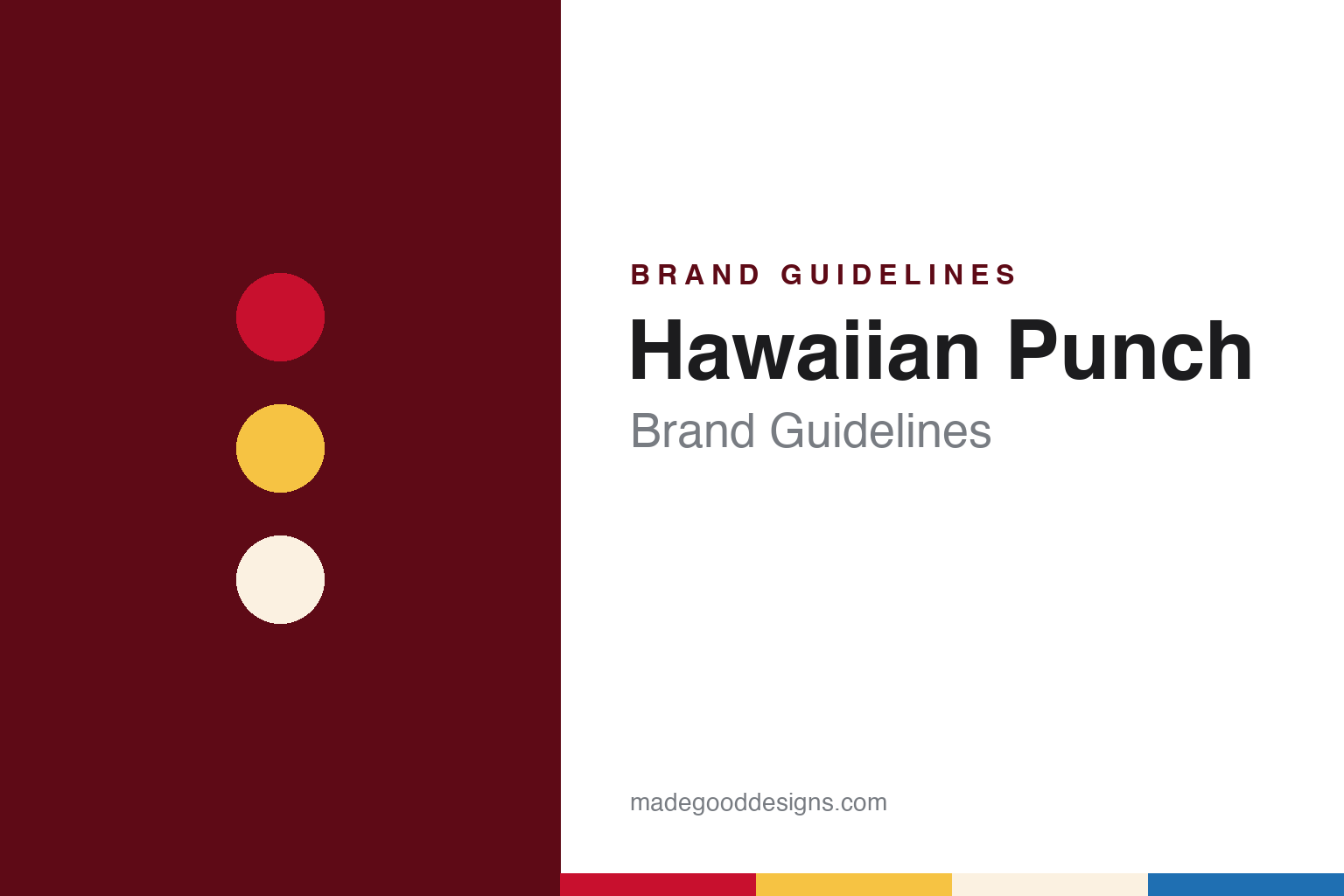
Two constants: a punch red, sunshine yellow and sand cream palette and a bouncy cartoon display register. Abstract homage — not a Hawaiian Punch product or mark; no can, character or logo is reproduced.
A syrup made in a Fullerton garage
A.W. Leo, Pacific Citrus Products and a base for ice cream and drink stands.
Hawaiian Punch is an American fruit punch, sold today in cans, bottles and juice boxes and owned by Keurig Dr Pepper. It did not start as a drink on a supermarket shelf. English Wikipedia says the original product, Leo’s Hawaiian Punch, was created in 1934 as an ice-cream topping syrup by A.W. Leo, Tom Yeats and Ralph Harrison, in a converted garage in Fullerton, California, and that the company was called Pacific Citrus Products. The article says the first formula combined five fruit juices: orange, pineapple, passion fruit, guava and papaya.
The local-history site Fullerton History, in a July 2023 article, describes the product as created in the early to mid-1930s by Leo as a drink base for juice stands and as an ice-cream flavouring, in a converted garage at a downtown Fullerton address. The article notes a 2007 Orange County Register story about a Fullerton resident who placed a plaque on his own garage stating the formula was created there in 1934; it says records in the Fullerton History Room of the Fullerton Public Library show that Leo moved to that house only in 1936. The site quotes a 1968 oral-history interview with Reuben Paul Hughes, a later president of the company, who said the original plant was “located at 120 W. Amerige in a former garage”, and concludes that the garage was most likely a converted auto garage on that site.
The early business was a wholesale one. English Wikipedia says that although customers found the syrup made an appealing drink when mixed with water, Hawaiian Punch was at first sold only wholesale, in gallon glass jugs, to ice-cream parlours and soda fountains. Fullerton History says Leo’s laboratory worked up formulas for sherbet bases, flavouring extracts and hot-weather drinks, and that by 1940 the company sold throughout the United States, making bar mixers, fruit concentrates, fountain syrups and specialty flavours alongside the punch. Hughes told the oral-history interviewer that the company bought its pineapples from Hawaii and other fruit from packers in California.
Colour
Reuben Hughes, R.J. Reynolds, Del Monte, Procter & Gamble, Cadbury and Keurig Dr Pepper.
The shift from syrup to grocery drink came under Hughes. Fullerton History says he worked his way up from the warehouse to become president and co-owner in 1946; English Wikipedia says he bought the company that year, renamed it Pacific Hawaiian Products Company and began selling Hawaiian Punch Base to consumers in quart glass containers. In the 1968 interview Hughes recalled the decision to mix the base into a ready-to-drink product “in the big 46 ounce juice can”, dating it to 1949 and calling it a smart move. English Wikipedia dates the ready-to-serve can to 1950 and frozen concentrate to 1955. Fullerton History says a fire in 1950, reported by the Fullerton News Tribune, destroyed the Amerige plant, after which the company built a larger concrete-and-steel plant beside the railway.
From the 1960s the brand moved through a series of large companies. English Wikipedia says R. J. Reynolds Tobacco Company bought Pacific Hawaiian in 1962 and in 1981 transferred it to its Del Monte subsidiary, and that under RJR the marketing turned from cocktail mixer toward households and children. The same article credits RJR with 8-ounce single cans in 1973 and a powdered form in 1976.
The New York Times reported on 27 January 1990 that Procter & Gamble had agreed to acquire Del Monte’s Hawaiian Punch business, and that it would sit alongside P&G’s juice lines, which then included Sunny Delight. On 16 April 1999, the paper reported that Cadbury Schweppes had agreed to buy Hawaiian Punch from P&G, and that the brand would be distributed to soft-drink outlets through Cadbury’s Dr Pepper/Seven Up unit and to juice outlets through its Mott’s unit. English Wikipedia says Cadbury spun off its American drinks business as Dr Pepper Snapple in 2008, and that Dr Pepper Snapple merged with Keurig Green Mountain in 2018 to form Keurig Dr Pepper — the company that also owns Canada Dry and Snapple.
Typography
Design and documentation.
The brands in this group sit on the drinks and dessert shelves of an ordinary grocery store: powdered mixes stirred into a jug of water, fruit drinks sold in bottles and small boxes, and whipped toppings kept in the freezer. Each one turns a simple product into something a shopper can recognise at a glance, and most of that work is done by the container rather than the contents.
A drink-mix brand lives on a canister, a tub or a flat pouch, where the flavour name, a fruit illustration and the number of quarts it makes all compete for space. A juice drink has to read from a refrigerated case or a lunchbox, on a tall bottle or a box with a straw. A frozen topping has a round lid and a tub that is often kept and reused long after it is empty, so its colours stay in a kitchen for years.
Each guide sets out what dated, independent sources record about the brand — who started it, who has owned it since, and how its labels, logos and advertising have changed — and marks plainly what rests only on the company’s own account.
Aa
A bouncy, hand-drawn display face — the cartoon, Saturday-morning register of a fruit punch fronted by a character. (Specimen set in Chewy, a cartoon display STAND-IN; NOT the Hawaiian Punch logo.)
Rosy red, sunshine yellow and Punchy
Two coloured flavours, a 1961 cartoon and a 2003 update in three dimensions.
Colour was part of the product before it was part of the advertising. English Wikipedia says that around 1954 the brand added a second flavour, Sunshine Yellow, and the original red punch became Rosy; the yellow version left out orange juice and swapped the red food colouring for yellow. Those two names, a red and a yellow, set the pattern for a range that the article traces through grape, orange, cherry and tropical blends in later decades, each sold on its colour as much as its fruit. The original red, renamed Fruit Juicy Red, remained the anchor of the line.
The brand’s character came in 1961. English Wikipedia says the Atherton-Privett advertising agency commissioned a 20-second television commercial, produced by John Urie and Associates in Hollywood, with the characters Punchy and Oaf designed by Bob Guidi and John Urie, animation by Rod Scribner, and Punchy voiced by Ross Martin. The joke was simple: Punchy asks, “Hey! How ’bout a nice Hawaiian Punch?”, Oaf says yes, and receives a punch instead of a drink, after which Punchy leans on a can and asks viewers whether that was a refreshing commercial. The mascot site PopIcon credits the artist Martin Mandelblatt with helping create Punchy, describes his blue-and-white striped shirt and red straw hat, and dates his television debut to February 1962.
Under R.J. Reynolds the character spread well beyond television. English Wikipedia quotes the company’s employee magazine listing commercials, magazines, Sunday comics, school book covers, toys, clothing, tumblers and wristwatches carrying Punchy, and praising him as a salesman for the drink. The article says Punchy and Oaf appeared in commercials into the 1980s and again in the early 1990s. PopIcon says that in 2003 the studio Radium/Reel FX, with concept artist Ronnie Bates, redrew Punchy as a three-dimensional figure, keeping the hat and striped shirt and adding cut-off jeans and a surfboard.
For a design guide, Hawaiian Punch shows how a regional syrup became a national grocery brand through two tools: a flavour range coded by colour, and a cartoon character who stayed consistent across six decades of owners. Compare Canada Dry and Snapple, two Keurig Dr Pepper stablemates with very different identities. For this guide we use punch red, sunshine yellow and sand cream with a rounded cartoon sans, an unofficial interpretation; no product or logo is reproduced.
Explore & save
Keep Hawaiian Punch’s identity on hand — save it to a board in the Made Good inspiration library.
Hawaiian Punch identity set
Pin the Hawaiian Punch punch red, sunshine yellow and sand cream palette and the bouncy cartoon display register to your own board.