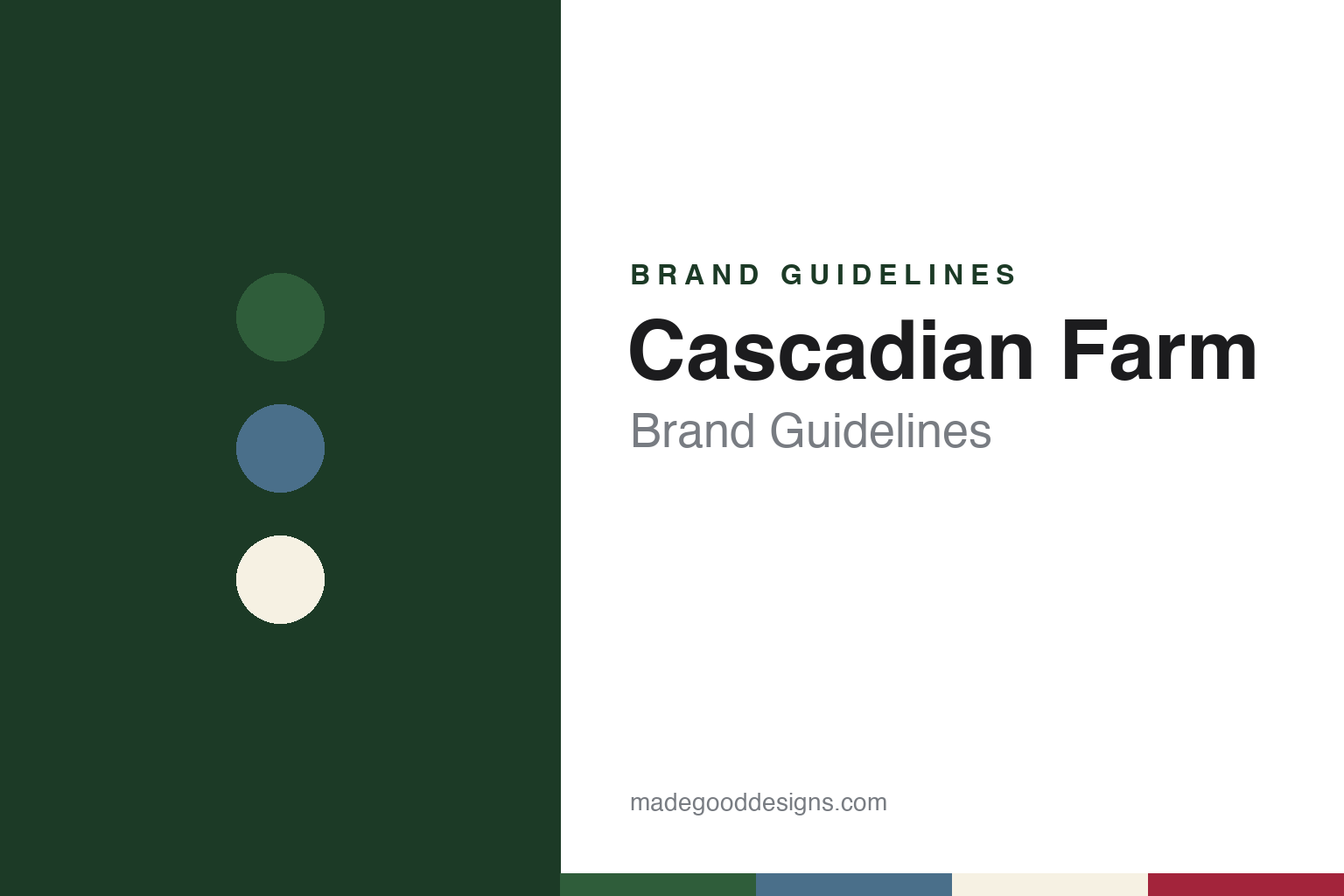
Cascadian Farm Brand Guidelines
A farm on a shelf of land between a river and the mountains, and the brand that took its name.
Aa
Two constants: a valley green, Cascade blue and field cream palette and a bookish farm serif register. Abstract homage — not a Cascadian Farm product or mark; no package, photograph or logo is reproduced.
A reclamation project on the Skagit
A graduate student from Chicago, two books and an abandoned property in the North Cascades.
Cascadian Farm is an American brand of frozen fruit and vegetables, cereals, granola and other packaged foods, owned today by General Mills. Unlike many grocery names, it refers to a real place. In a long article for The New York Times Magazine published on 13 May 2001, the writer Michael Pollan described Cascadian Farm as occupying “a narrow, breathtaking shelf of land” between the Skagit River and the North Cascades, in the town of Rockport, Washington. In the same piece he called it one of the older organic brands.
The farm was the work of one man. Pollan wrote that it was started by Gene Kahn, a graduate-school dropout from the South Side of Chicago, with the idea of growing food for a collective of environmentally minded friends in nearby Bellingham. Kahn had read Rachel Carson’s Silent Spring and Frances Moore Lappé’s Diet for a Small Planet and decided, in Pollan’s phrase, to go back to the land. He was also a reader of J. I. Rodale’s magazine Organic Gardening and Farming. The original name was a mouthful: the New Cascadian Survival and Reclamation Project.
The dates in print are close but not identical. Pollan gave 1971 as the year the farm was started. Supermarket News, reporting on 3 January 2000, described Kahn as the founder of Cascadian Farm in 1972, and General Mills, in a history of the brand published on 21 April 2025, says Kahn began farming near the Skagit River in 1972. In that article General Mills quotes Kahn recalling an abandoned property of about fifty acres that had been used as a dump for cars, appliances and rubbish, with no electricity and a house without plumbing, heating or windows. The company says he first sold produce out of the back of a Volkswagen truck to a small local community.
Farming came slowly. Pollan wrote that Kahn, like many early organic growers, had no idea what he was doing at first and lost crops along the way. To sell strawberries before they rotted in the field, Kahn recruited a partner, Roger Weschler, and an offshoot called Community Produce began distributing the food the farm grew. General Mills, for its part, says the conventional farmers of the Skagit Valley at first tried to talk Kahn out of farming without agrochemicals, then became his mentors. In the 2025 article the company quotes Kahn saying their education and continuing support had a lifesaving impact on the farm.
The decisive change was from growing to processing. By the late 1970s, Pollan wrote, Kahn had discovered the value of turning his produce into something else, freezing blueberries and strawberries and making jams. Once Cascadian Farm was processing food, Kahn found it paid better to buy produce from other farmers than to grow it all himself. During the 1980s, in Pollan’s account, the business became an increasingly “virtual” sort of farm, processing and marketing packaged foods well beyond the Seattle area, while the land at Rockport stayed at the centre of the story. Kahn himself lived in the clapboard farmhouse there until 1993, Pollan reported.
Colour
Welch’s, Muir Glen, Small Planet Foods and a sale to General Mills.
Growth brought outside owners. Pollan reported that in 1990, after the scare over the apple chemical Alar, demand for organic food rose sharply and then fell back. Kahn had borrowed heavily to expand and contracted with farmers to grow a large amount of produce; when the demand subsided, he was forced to sell a majority stake in the company to Welch’s. Kahn described that period to Pollan as the time he lost the company, and also said that Welch’s had been his business school.
The business then grew by acquisition. Pollan wrote that Cascadian Farm became a small conglomerate of its own by buying Muir Glen, the California organic tomato processor, after which the combined company changed its name to Small Planet Foods, echoing the title of one of the books Kahn had read. Its headquarters were in Sedro-Woolley, Washington, in a block of nineteenth-century brick storefronts in what Pollan called a faded logging town.
The next owner was far larger. Natural Products Insider reported on 20 December 1999 that General Mills had announced in mid-December an agreement to buy Small Planet Foods with its Cascadian Farm and Muir Glen brands. The article said a third company in the group, Fantastic Foods, was not part of the deal and would stay with Trefoil Capital Investors, an investment partnership managed by senior executives of Shamrock Holdings, which had assembled Small Planet through a series of acquisitions. According to Kahn, the magazine said, General Mills and Trefoil had been in discussion for more than a year.
Supermarket News covered the same agreement on 3 January 2000. It listed the Cascadian Farm range at the time as organic frozen fruits, vegetables, juices and entrées, and Muir Glen’s as canned tomatoes, pasta sauces, salsa and condiments. The paper noted that General Mills had introduced Sunrise, a cereal made with certified organic ingredients, earlier that year, and quoted the chairman and chief executive Steve Sanger describing the purchase as a strategic growth opportunity that complemented it. Both reports said Small Planet would run as a subsidiary, led by Kahn, who would become a vice president of General Mills. General Mills has owned Cascadian Farm since that deal.
Pollan visited the company soon afterwards. In his 2001 article he described the farm at Rockport as a General Mills showcase, a phrase he attributed to Kahn himself, and wrote about the company’s new line of frozen organic dinners, developed by food scientists at the Sedro-Woolley offices. The home farm has since changed hands. General Mills says that in 2022 it donated the original Home Farm in the Skagit Valley to the Rodale Institute, a regenerative organic agriculture organisation. The brand itself stayed with General Mills, which says the Cascadian Farm name continues on every product it sells under it.
Typography
Design and documentation.
The brands in this group sit in three corners of the freezer and the baby-food shelf: bagged frozen vegetables, pints and tubs of ice cream and gelato, and food for babies sold in jars and squeeze pouches. Each of those formats asks a lot of a small surface. A frozen bag is read through frost and at a glance from an open case; an ice-cream pint is turned in the hand, its lid seen from above; a jar or pouch is bought by a parent who wants to know quickly what is inside.
Names in these categories have often started with a family, a farm or a single shop and later passed to larger food companies, sometimes more than once. A label can therefore outlast several owners, and the place on the front of a pack is not always the place where the food is now grown, churned or packed.
Each guide separates what independent, dated sources record from what the company says about itself — who started the brand, who owns it now, where its food is made and how its packs and logos have changed — and marks plainly what rests on the company’s own word.
Aa
A warm, bookish text serif — the register of a farm journal rather than a cereal aisle. (Specimen set in Lora, a serif STAND-IN; NOT the Cascadian Farm logo.)
A farm on the front of the box
Two slogans, a landscape across the carton and a stamp inviting a visit.
From early on the brand sold a place as much as a product. Pollan quoted the Cascadian Farm slogan of the time, “Better Food for a Better Planet”, and wrote that the farm pictured on his frozen dinner was a real farm growing real food, though not quite the food inside the carton. He also described the development of a newer line, “Taste You Can Believe In”, created under a vice president for marketing at Small Planet Foods and aimed at shoppers who wanted familiar flavours rather than a counter-cuisine.
The pictured landscape became the core of the packaging. Food Dive reported on 23 February 2016 that Cascadian Farm, by then a General Mills brand, had undergone a packaging overhaul designed to put its farm roots and simple ingredient lists forward. The new design, the trade publication said, enlarged the picture of the farm so that it stretched across the box, where it had earlier been a smaller graphic, and added a “Visit Our Home Farm” stamp to the label. Food Dive described the change as a way of telling shoppers more of the backstory behind the product and where its ingredients came from.
General Mills says the property in the Skagit Valley remained the brand’s Home Farm until 2022, when the company donated it to the Rodale Institute, and in its 2025 history it quotes Kahn saying that the growth measure he cared about was not cases or sales but acres farmed organically. The company also says that, although Cascadian Farm has moved well beyond its original roots, its products are made with ingredients bought from organic farmers.
The place names in the record all belong to one corner of Washington State. Pollan located the farm at Rockport, on the Skagit River below the North Cascades, and the offices of Small Planet Foods in Sedro-Woolley, downriver; Supermarket News gave Sedro-Woolley as the company’s home when General Mills, writing from Minneapolis, agreed to buy it. General Mills’ own 2025 history still opens with Kahn’s arrival in the Skagit Valley and the abandoned property he set out to reclaim, and quotes him describing local farmers who taught him to grow in a temperate rainforest.
For a design guide, Cascadian Farm shows how a packaged-food brand can keep a single landscape at the centre of its identity through changes of owner, product and scale, and use the image of one farm as a promise about all of its products. Compare it with Welch’s, which bought a majority stake in the company in 1990, and Nature Valley, a fellow General Mills brand that also sells an outdoor landscape. For this guide we use valley green, Cascade blue, field cream and berry red with a bookish serif, an unofficial interpretation; no product or logo is reproduced.
Explore & save
Keep Cascadian Farm’s identity on hand — save it to a board in the Made Good inspiration library.
Cascadian Farm identity set
Pin the Cascadian Farm valley green, Cascade blue and field cream palette and the bookish farm serif register to your own board.


