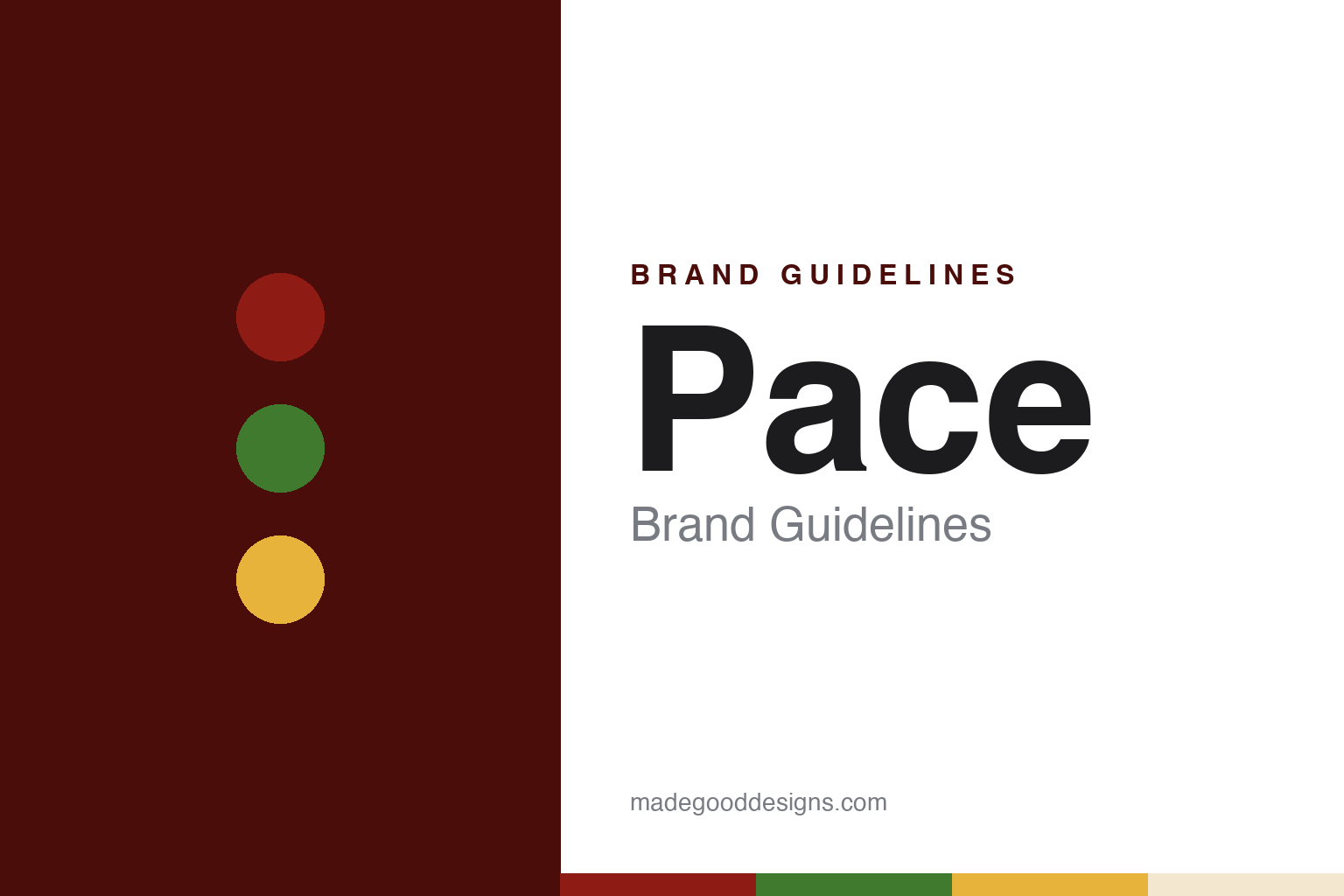
Pace Brand Guidelines
A liquor-store back room, a jalapeño recipe and a bottle with a waist.
Aa
Two constants: a picante red, jalapeño green and prairie gold palette and a Western display serif register. Abstract homage — not a Pace product or mark; no bottle, label or logo is reproduced.
The syrup of the Southwest
A Louisiana syrup family, a San Antonio back room and a jalapeño sauce.
Pace is an American salsa and picante sauce brand, and The Campbell’s Company has owned it since 1995, the year Campbell’s gives for its purchase of Pace Foods. Campbell’s own history describes the business as founded by David Pace in San Antonio, Texas, in 1947.
The Handbook of Texas, published by the Texas State Historical Association, says David Pace and his wife, Margaret, established Pace Foods in 1947 with startup money from Margaret’s mother. The same entry describes David as a former United States Army Air Forces pilot who came from a Louisiana syrup-making family. The Austin Chronicle, in a profile by Mick Vann dated 22 August 2008, says the Pace family had made cane molasses in Alexandria, Louisiana, before the Second World War, where David learned the basics of food manufacturing and bottling, and that he went through Army air training at a base in San Antonio and decided to settle in the city after the war.
The business began small. The Chronicle describes a little liquor store in San Antonio in 1947 where David and Margaret made syrups, jams, jellies, dressings, pickles and chile salsa in the back room, selling to grocery stores door to door. English Wikipedia says Pace came to see Mexican picante sauce as the real “syrup of the Southwest”.
The recipe was refined at the dinner table and on the golf course. The Christian Science Monitor reported on 25 November 1986 that David Pace perfected his picante sauce just after the war by testing batch after batch on his golf partners, and that the company was still making it to the same recipe forty years later. Wikipedia names the base of that recipe as jalapeños, onions and tomatoes, and the Handbook of Texas says the Paces’ children helped taste-test hundreds of salsas as their father worked towards what became Pace Picante Sauce.
Over time the sauce took over the company. The Austin Chronicle says David Pace wanted to be known as “the Heinz of salsa”, that the bottled chile sauce he called Pace Picante was paying more and more of the bills, and that he eventually dropped the other products to concentrate on picante sauce alone. The Spanish word on the label is part of the brand’s vocabulary: Wikipedia glosses picante as “piquant”, meaning flavourful or spicy.
Colour
Margaret Pace, the Goldsburys, Campbell’s and Paris, Texas.
For nearly half a century Pace stayed in the founding family. The Handbook of Texas says David and Margaret Pace divorced in 1976 but remained business partners until 1977, when Margaret bought her husband’s share and named her son-in-law, Christopher “Kit” Goldsbury, company president. Goldsbury had married the couple’s daughter, Linda Pace, in 1967, and the same entry says he worked for Pace Foods in the early years of the marriage.
In September 1982, according to the Handbook of Texas, Linda and Kit bought the company from Linda’s mother. The entry says Linda contributed ideas for marketing campaigns, took part in hands-on demonstrations on sales trips and invested in a new plant in San Antonio. When the couple divorced in 1991, it says, Linda sold her share of Pace Foods to Kit. The Austin Chronicle credits Goldsbury with expanding the product lines, modernising manufacturing and advertising creatively.
The sauce itself was put on a technical footing. The Chronicle says that in 1982 Pace hired the food scientist Lou Rasplicka as vice-president of technology, later nicknamed “Dr. Pepper”, who measured the capsaicin in each incoming batch of jalapeños. The Christian Science Monitor described in 1986 how Rasplicka and colleagues had driven south looking for growers and built supply relationships with Mexican farmers as far as the Yucatán Peninsula, with a refrigerated warehouse under construction in the state of Veracruz. The Chronicle adds that Rasplicka led the selective breeding of a no-heat jalapeño at a test farm near Hondo, Texas, which let the company blend each batch to a steady heat level.
The range widened from one sauce to several. Wikipedia says Mild and Hot were added in 1981 alongside the original Medium, that Thick & Chunky arrived in 1989 and was later renamed Chunky Salsa, and that a line of specialty salsas followed in 2008. The Chronicle recalls Rasplicka describing how Goldsbury, Rod Sands and he sat in the laboratory in the early 1980s and set the mild, medium and hot recipes by taste.
Then came the sale. The Handbook of Texas and the Austin Chronicle both place Goldsbury’s sale of Pace to the Campbell Soup Company in 1994; Campbell’s dates its acquisition to 1995. The Chronicle says that Campbell’s later shut down operations in San Antonio and moved production to its plant in Paris, Texas, and Wikipedia today locates Pace Foods in Paris, Texas. A Pace spokesman told The New York Times in September 2004 that, although the company was headquartered in New Jersey, the product was made in Texas.
Typography
Design and documentation.
The names in this group sit on supermarket shelves as salsa jars, tortilla packs, bean cans and frozen-burrito boxes. Packaging of this kind has to work at a glance: a shopper scanning a long aisle of similar jars or a freezer door of similar boxes reads colour, a name and a picture of the food before reading any small print, so a label’s job is to make one product easy to find again on the next visit.
Each format has its own constraints. A jar label wraps around glass and leaves room for the colour of the salsa to show through; a tortilla pack is soft and folds, so the name has to survive creases; a can label is printed flat and read on a curve; and a frozen box has to stay legible behind frosted glass. Heat levels, flavours and sizes are usually signalled with colour bands or small badges rather than new designs.
Each guide separates what independent, dated sources record about a brand — who started it, who owns it now and where its food is made — from what the company says about itself, and marks plainly what rests only on the company’s own word.
Aa
A Western display serif — the chuckwagon register of a Texas picante sauce. (Specimen set in Rye, a Western display serif STAND-IN; NOT the Pace logo.)
Get a rope
An hourglass bottle, a chuckwagon cook and salsa from New York City.
Pace’s identity rests on two things that are easy to remember: a bottle shape and a joke about geography. Start with the bottle. The Christian Science Monitor reported in November 1986 that company officials believed Pace’s hourglass bottle had a lot to do with how regular customers identified the product. Rod Sands, then Pace’s vice-president for sales and marketing, told the paper that customers had become used to reaching for the 16-ounce hourglass bottle. The same article said Pace had filed suit in October 1986 against Pet Inc., then owner of Old El Paso, alleging that Old El Paso’s new picante sauce bottle and label copied Pace’s; Pet said in its response that consumers would not confuse the two.
The Monitor also described what Old El Paso had moved away from: a cylindrical 12-ounce bottle with a yellow, red and brown label. The contrast shows how much a silhouette on a shelf can carry for a sauce brand, before a shopper has read a word.
The joke came from television. The Handbook of Texas says the company’s profits surged in the mid-1980s with a television campaign that set its made-in-San Antonio authenticity against brands from New York City. The New York Times described the commercials on 21 September 2004: cowboys angered when their chuckwagon cook replaced their favourite Texas-made sauce with one made in New York City. “Get a rope,” one cowhand says at the end, as an announcer tells viewers, “Pick up the original. Pick up the Pace.” The Austin Chronicle notes that many people remember the “get a rope” line.
The campaign returned two decades later. USA Today reported on 7 November 2004 that Pace had brought back its long-running 1980s theme, in which Southwestern cowboys made fun of people who bought salsa from New York City, after ads that had run for a decade. James Caporimo, executive creative director at the agency Young & Rubicam, told the paper that people in focus groups kept repeating the line, and said: “It became part of the DNA of the Pace brand.” The Times said the new spots, made by Young & Rubicam in New York, swapped the menace for comedy: in one a city visitor brands a cow with spray paint, in the other he locks his horse with a car alarm, and each time the cowboys say he gets his salsa from New York City. Both spots, the Times said, ended with the theme “Grab the Southwest by the bottle.”
For a design guide, Pace shows how a sauce can turn a place of origin into a punchline and a bottle into a signature: Texas against New York, a chuckwagon against a city, and a glass shape regular buyers looked for on the shelf. Compare it with Old El Paso, its rival in the 1986 bottle dispute, and Tostitos, the chip brand that also sells salsa. For this guide we use picante red, jalapeño green, prairie gold and adobe cream with a Western display serif, an unofficial interpretation; no product or logo is reproduced.
Explore & save
Keep Pace’s identity on hand — save it to a board in the Made Good inspiration library.
Pace identity set
Pin the Pace picante red, jalapeño green and prairie gold palette and the Western display serif register to your own board.