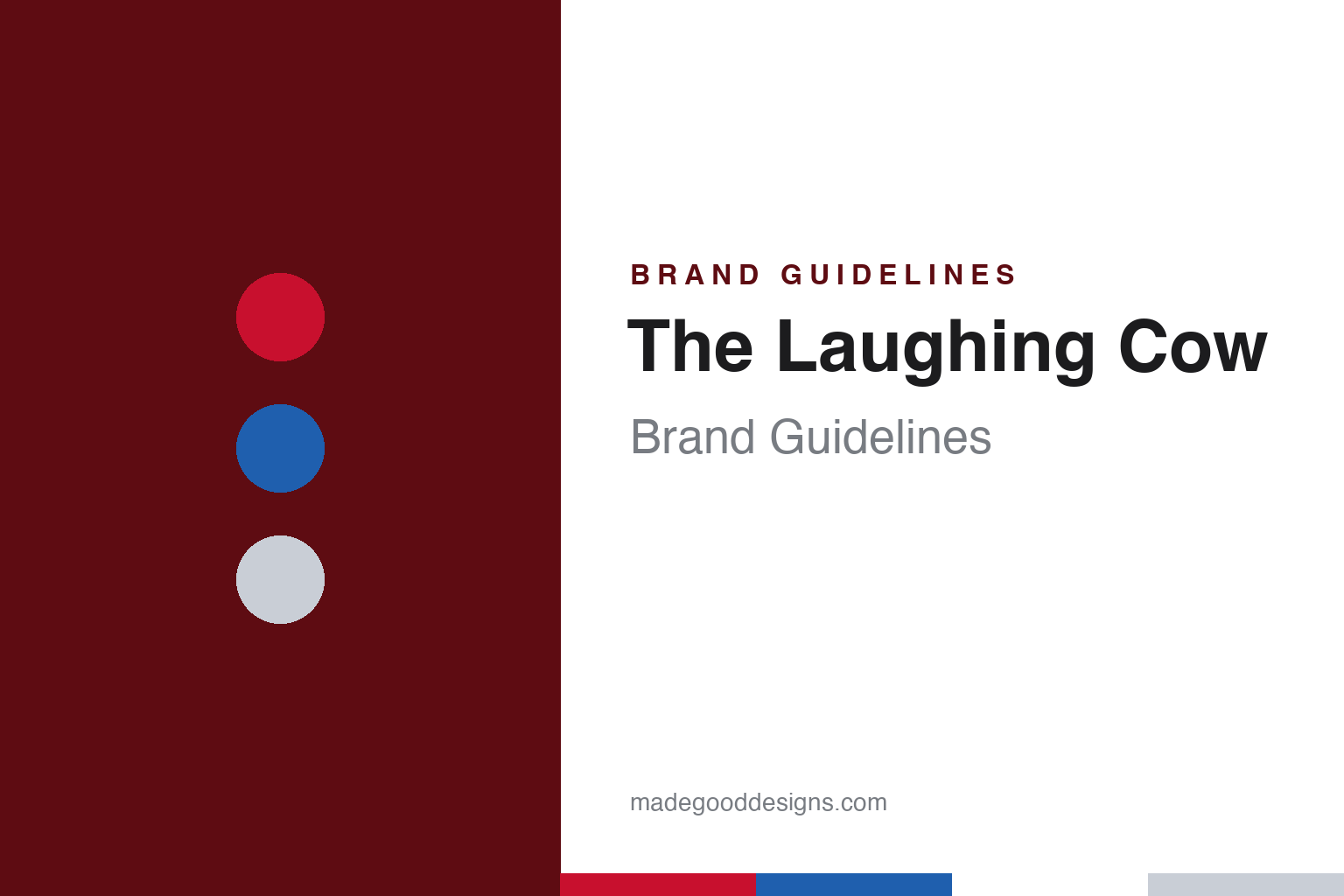
The Laughing Cow Brand Guidelines
A laughing cow from a wartime lorry, a pair of cheese-box earrings and a foil wedge in a round box.
Aa
Two constants: a cow red, box blue and foil silver palette and a rounded sans register. Abstract homage — not a Laughing Cow product or mark; no box, wedge or logo is reproduced.
From the Jura
A cheese-ripening family and a Swiss process.
The Laughing Cow is the English name of La vache qui rit, a brand of processed cheese sold in small foil-wrapped portions. It belongs to the French group Bel, which Le Figaro, in September 2026, described as named after its founder, Jules Bel, and created in 1865 in the Jura, in eastern France.
The family business was a cheese trade before it was a brand. Le Figaro, in an August 2012 series on advertising characters by Elsa Bembaron, wrote that Jules Bel settled his family in the Jura in 1865 and made Comté there. Bel’s own timeline places that start at Orgelet and says that, after three decades, his sons Henri and Léon moved the business to Lons-le-Saunier.
The product came out of the 1914–18 war. Le Figaro reported that, after Léon Bel was demobilised, he took over the family business and learnt from Swiss cheesemakers how to make a processed cheese that keeps for a long time at room temperature. BFM Business, in a centenary report by Jérémy Bruno on 9 May 2021, wrote that cheese was piling up unsold in his father’s trading business at the end of the war, and that Léon Bel turned to processed cheese, drawing on a process developed in Switzerland. The idea, the broadcaster wrote, was a cheap, popular product that was easy to carry and to keep.
France’s industrial-property office, INPI, in a feature published in January 2016, describes Léon Bel as a cheese ripener who took up a Swiss processed-cheese recipe and offered it in individual portions, and dates the brand’s birth at Lons-le-Saunier to 1919. The trademarks themselves were filed on 16 April 1921, INPI records. BFM Business wrote that the portion packs followed three years after the trademark, and that industrial production began in 1926 at Léon Bel’s new factory in Lons-le-Saunier.
Colour
The Wachkyrie and the earrings.
The brand’s face came from a wartime lorry. Le Figaro wrote in 2012 that Léon Bel served in a unit supplying meat to the troops, and that these units held a competition for mascots. His chose a laughing cow drawn by Benjamin Rabier, the illustrator known for the duck character Gédéon. The cow, brownish in colour, was nicknamed the “Wachkyrie,” a jab at the Valkyries of German legend. BFM Business also wrote that Rabier drew the head during the war to decorate meat-supply lorries.
When Léon Bel needed a name for his cheese, he returned to that drawing. Le Figaro reported that he called on Rabier again to redraw La vache qui rit, and that the cow now wore a red coat. BFM Business described the same change: the cow went from brown to red, was made more feminine, was redrawn with a broader smile and was given its earrings. The earrings have a family story attached. Le Figaro quoted Delphine Peyrel, then Bel’s marketing head for western Europe, as saying that “the story goes” that Léon Bel’s wife had the idea of adding them; INPI also reports that it is said to have been her idea, and Bel’s own timeline says the earrings, shaped like cheese boxes, were added at “Mrs Bel’s insistence.”
The dates for the drawing vary by source. INPI says the trademarks were filed in 1921 and that Rabier’s effigy was registered in 1924; Bel’s own timeline says the brand adopted the red cow drawn by Rabier in 1924; Le Figaro gives 1921 for the filing of the mark.
The drawing has changed little since. Le Figaro wrote that the cow has had few facelifts: its horns became shorter and less pointed, and the drawing less realistic, as the character was made more human. In the same article Julie Régis, then in charge of the brand at the agency Young & Rubicam, described the cow as at once “red like a little devil,” a woman with earrings and a nurturing mother. BFM Business quoted Véronique Pauwels, a professor at IÉSEG in Lille, as saying that the brand had changed very little, which reassures the consumer.
Typography
Design and documentation.
Butter spreads and packaged cheese share a shelf and a set of design problems. A spread is usually sold in a plastic tub with a printed lid, or as wrapped sticks in a small carton; cheese is sold in vacuum-sealed blocks, in slices, in wedges wrapped in foil, or in a round box that holds several portions. In each case the pack is small, handled every day and stored in a refrigerator, so the brand has to read clearly from the front of a lid, the end of a carton or the face of a block.
That is why so much of the identity in this category sits in a few repeated elements: a name in a set type style, a colour that runs across the whole range, and sometimes a drawn character or symbol that customers can find among many similar packs. Behind those elements, the companies themselves may have changed owners, merged or moved production more than once.
Each guide sets out who started the brand, who owns it now, where its products are made and how its packs and advertising have changed, and marks plainly what rests only on the company’s own word.
Aa
A soft, rounded sans — the friendly register of a cartoon cow. (Specimen set in Baloo 2, a rounded-sans STAND-IN; NOT The Laughing Cow logo.)
The cow on the box
A round box, a foil wedge and a cow that travels.
The pack is part of the identity. BFM Business described the product in 2021 as a triangle of processed cheese wrapped in aluminium foil and stacked in a white and blue cardboard box. Le Figaro wrote in 2012 that the portions were triangular from the beginning, sold initially in metal tins that were soon replaced by cardboard.
Léon Bel put the cow on objects well beyond the box. Le Figaro reported that from the 1920s the cow appeared on blotters, exercise-book covers and pencil cases for schoolchildren, and that it rode in the Tour de France publicity caravan from 1933 to 2009. It appeared in cinema advertising in the 1950s and on television from 1968; in 2010, the paper wrote, the cow, which had been shown only as a head, was given a body so that it could star in animated films. INPI adds a partnership with the comic-strip character Gaston Lagaffe in 1985.
The cow travels under local names. BFM Business wrote that Bel opened factories outside France in Belgium and the United Kingdom from 1929 and crossed the Atlantic in the 1970s, and that the name is translated in each country: The Laughing Cow in English-speaking countries, La Vaca que ríe in Spanish, Con bò cười in Vietnam and Gülen İnek in Turkey. The broadcaster also reported that the recipe and the size of the portions vary from country to country.
In September 2026 the American packs briefly changed the face itself. The Independent reported on 23 September 2026 that select packs of The Laughing Cow Creamy Original wedges in the United States showed the cow with a serious expression and the words “We need to talk,” with a QR code pointing to a campaign site; Bel Brands USA described the change as temporary. Le Figaro reported on 30 September 2026 that the campaign, called “The Not Laughing Cow,” played on the English phrase “wedge issues” to ask Americans to stop quarrelling, and that Bel said the timing had no link with the midterm elections.
For a design guide, The Laughing Cow shows how a single drawn character, kept close to its original form and reproduced on every pack, can carry a brand across languages for more than a century. Compare Babybel, Bel’s red-wax cheese, and Kraft Singles, another processed-cheese brand built on a portion pack. For this guide we use cow red, box blue, foil silver and white with a rounded sans, an unofficial interpretation; no product or logo is reproduced.
Explore & save
Keep The Laughing Cow’s identity on hand — save it to a board in the Made Good inspiration library.
The Laughing Cow identity set
Pin The Laughing Cow cow red, box blue and foil silver palette and the rounded sans register to your own board.