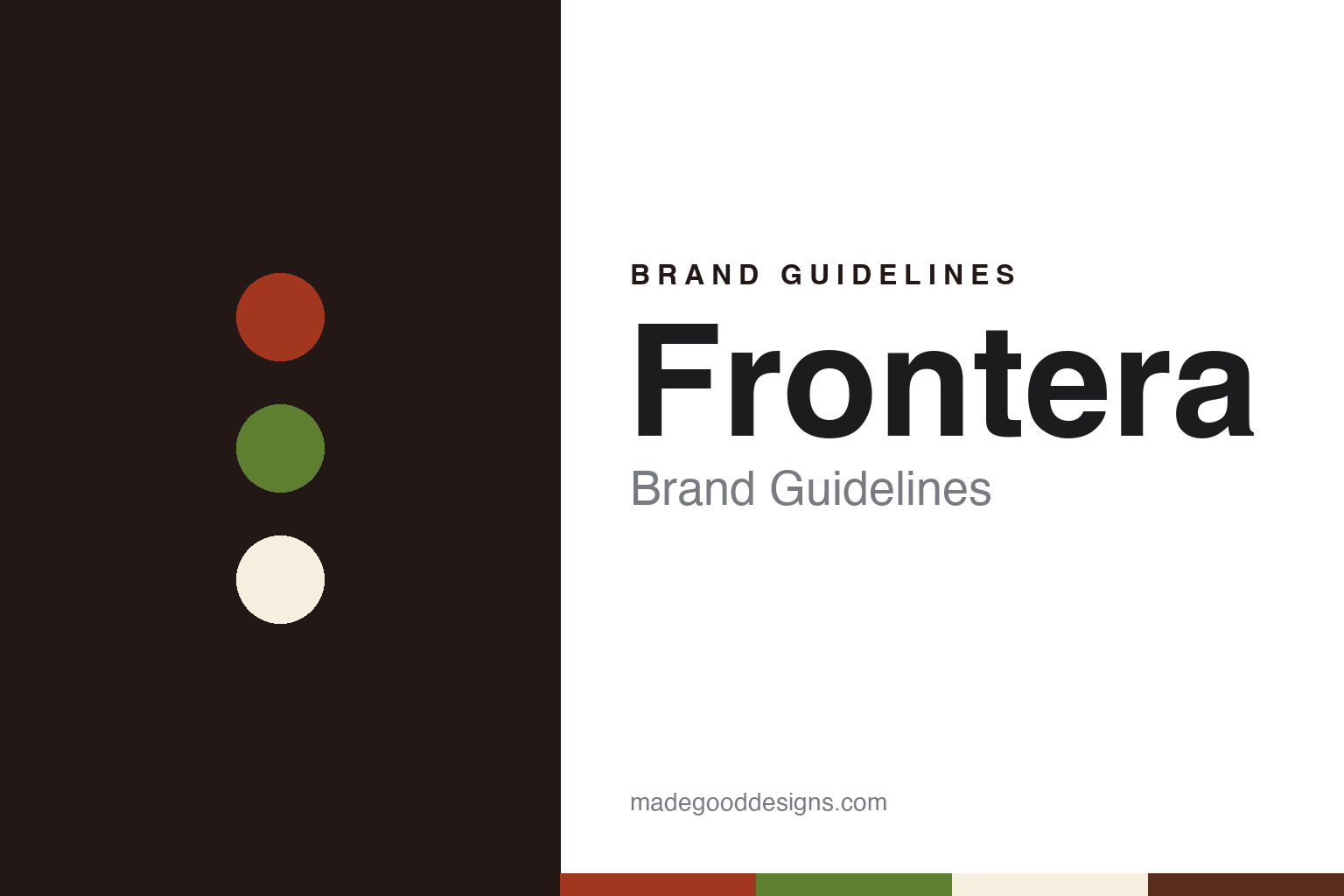
Frontera Brand Guidelines
A Chicago chef’s restaurant name, carried onto jars, pouches and freezer bowls.
Aa
Two constants: a chipotle red, tomatillo green and adobe cream palette and a soft old-style serif register. Abstract homage — not a Frontera product or mark; no jar, package or logo is reproduced.
A restaurant before the jars
A PBS series, a cookbook, a Chicago grill and a packaged-food spin-off.
Frontera is a line of salsas, cooking sauces, tortilla chips and frozen meals sold in American grocery stores. It shares its name with Frontera Grill, the Chicago restaurant of the chef Rick Bayless, but the grocery brand and the restaurants are separate businesses. Conagra has owned the Frontera grocery brand since 2016; the restaurants were not part of that sale.
The restaurant came before the jars. English Wikipedia says Bayless hosted a PBS television series, Cooking Mexican, in 1978–1979, and that years of culinary research in Mexico led to his book Authentic Mexican: Regional Cooking from the Heart of Mexico, published in 1987. In the same year, it says, Bayless and his wife, Deann, opened Frontera Grill in Chicago, specialising in contemporary regional Mexican cooking with an emphasis on the cuisines of Oaxaca, followed in 1989 by a second restaurant, Topolobampo. Food Business News also dated the opening of Frontera Grill to 1987 in an article of July 2018.
The packaged-food company followed. The Chicago Tribune, in a report reprinted by The Herald of Everett, Washington, on 26 September 2016, said Frontera Foods was launched in 1996 by Bayless and Manny Valdes, a former Kraft Foods executive, to produce regional Mexican food products using all-natural ingredients. A ConAgra press release of the same month, reprinted by El Restaurante, said Bayless established Frontera Foods in 1996 with Valdes as partner and chief executive. Food Business News reported in July 2018 that Bayless and JeanMarie Brownson co-founded the business with partners Manny Valdes and Greg Keller in 1996. English Wikipedia gives 1995 as the year Bayless and his partners started the Frontera Foods line.
Brownson brought a newspaper test kitchen with her. Food Business News said that before joining Bayless she had been test kitchen director and assistant food editor at the Chicago Tribune, cooking alongside chefs and cookbook authors across the country.
The business stayed in Chicago. The Tribune described Frontera Foods in 2016 as a Chicago-based gourmet Mexican food company and listed its products as salsa, tortilla chips and seasoning mixes. It also reported where they were made at the time: the sauces in Houston, and the chips by El Milagro in Chicago. Manny Valdes told the paper that demand had run ahead of supply before Cinco de Mayo in 2015, and that the founders had concluded they needed to make significant investments in manufacturing.
Rather than build that capacity themselves, the Tribune said, Valdes and Bayless decided to partner with a company that already had it. That led to a meeting in January 2016 with Sean Connolly, chief executive of ConAgra Foods, and to months of discussions before ConAgra agreed to buy the business.
Colour
Pouches, a sale to ConAgra and frozen bowls.
Before the sale, the company changed the shape of its packs. The ConAgra press release of September 2016 said Frontera had launched fresh-packed seasoning sauces in pouches in 2010, for skillet tacos, fajitas and enchiladas, followed by a mole sauce and slow-cook sauces for barbacoa and carnitas in the same pouch format. The release described the wider range as salsas, taco skillet sauces, slow-cook sauces and enchilada sauces, alongside stone-ground corn tortilla chips, and said Frontera products were sold nationally through gourmet, specialty and natural food stores.
The acquisition closed on 26 September 2016, according to the Tribune. Food Business News reported the same day that ConAgra Foods had acquired the packaged-food businesses of Frontera Foods, Inc. and Red Fork, L.L.C., including the Frontera, Red Fork and Salpica brands; it described Red Fork as a line of American cooking sauces and Salpica as a Tex-Mex salsa line. Terms were not disclosed, and the deal did not include any restaurant assets, including the Frontera-branded restaurants.
Both sides explained the deal in the Tribune. Connolly said ConAgra’s strategy was to reshape its portfolio to be “more premium and more contemporary”, and called Frontera “a terrific fit”. Bayless said the founders had built the line “from a dream” and that there was “a little bit of trepidation and sadness in the whole thing”, but that they needed to take the next step. The paper said Albert Valdes, Frontera’s chief operating officer, would lead the business within ConAgra; that Bayless and Manny Valdes would stay on as advisers, developing new products from the Frontera test kitchen; and that the business would remain headquartered in Chicago, with the Houston and Chicago plants staying online. Connolly told the paper ConAgra was not planning changes to how the products were made at that point.
The timing suited the buyer’s geography. The Tribune noted that ConAgra had moved its own headquarters from Omaha to Chicago in June 2016, and Valdes said that move had helped the deal, because it let the founders stay close by as advisers.
The brand soon moved into the freezer. Food Dive reported on 27 March 2017, citing the Chicago Tribune, that Conagra Brands would introduce Frontera-branded single-serving bowls and skillet meals approved by Bayless, in chicken fajita, barbacoa taco and veggie taco varieties. In July 2018 Food Business News described Brownson as culinary director of Conagra Brands, a role she had taken on when the company acquired Frontera Foods, heading culinary development across its growth programmes. She and Bayless had just returned from a week-long trip to Mexico looking for ingredients and flavours for new packaged sauces, meals and snacks, the article said, and the brand’s stand at the Summer Fancy Food Show in New York, held 30 June to 2 July 2018, was sampling a frozen chicken and chorizo taco bowl.
Typography
Design and documentation.
The names in this group sit on supermarket shelves as salsa jars, tortilla packs, bean cans and frozen-burrito boxes. Packaging of this kind has to work at a glance: a shopper scanning a long aisle of similar jars or a freezer door of similar boxes reads colour, a name and a picture of the food before reading any small print, so a label’s job is to make one product easy to find again on the next visit.
Each format has its own constraints. A jar label wraps around glass and leaves room for the colour of the salsa to show through; a tortilla pack is soft and folds, so the name has to survive creases; a can label is printed flat and read on a curve; and a frozen box has to stay legible behind frosted glass. Heat levels, flavours and sizes are usually signalled with colour bands or small badges rather than new designs.
Each guide separates what independent, dated sources record about a brand — who started it, who owns it now and where its food is made — from what the company says about itself, and marks plainly what rests only on the company’s own word.
Aa
A soft, old-style serif with generous curves — the warm, cookbook register of a chef-led grocery line. (Specimen set in Fraunces, a serif STAND-IN; NOT the Frontera logo.)
A chef’s name on the shelf
A restaurant name, a pouch format and a promise not to water things down.
The brand’s name is its restaurant’s name: Frontera Grill opened in 1987, and the grocery company launched under the same word in the following decade. The 2016 ConAgra release called him Frontera’s “founding chef”, and the Tribune described the company as having been started by him.
Bayless has explained how he thinks a supermarket product differs from a restaurant plate. In the July 2018 interview with Food Business News, he said a restaurant guest gives a chef undivided attention for a long stretch, with a server who can explain the background of a dish, whereas in a grocery store a great many products are competing for attention at the same time and a shopper gives any one of them just a moment. The team’s answer, he said, is to work out what in the traditional Mexican kitchen will resonate with shoppers and build around that. “We don’t Americanize our food,” he told the magazine, and he described the aim as giving people what he called the time-honored flavour.
Brownson framed the products the same way. She told Food Business News that there was much more that could be done with authentic Mexican food than the company was doing, and Bayless described the products as never watered down. At the 2018 show, he pointed to the frozen taco bowl being heated in a microwave at the booth exactly as the package directions said, and joked about visitors asking whether it really came out of a microwave.
Packaging format has been part of the story. The 2016 release presented the pouch, introduced in 2010, as the format for the skillet and slow-cook sauces, alongside the jarred salsas and bagged tortilla chips. After the sale, Conagra took the brand into frozen single-serving bowls and skillet meals, carrying the Frontera name and Bayless’s approval into the freezer aisle, according to the 2017 Food Dive report.
The founders stayed involved after the sale. The Tribune said in 2016 that Bayless and Manny Valdes would remain as advisers working from the Frontera test kitchen, and Food Business News reported two years later that Brownson led culinary development at Conagra Brands and that she and Bayless were still travelling in Mexico to look for new ingredients.
For a design guide, Frontera shows how a chef’s restaurant name can travel onto jars, pouches and frozen bowls, and keep its link to the kitchen after a national food company takes over the packaged-food business. Compare it with Herdez, another salsa name on American shelves, and Marie Callender’s, a fellow Conagra brand built on a restaurant name. For this guide we use mole brown, chipotle red, tomatillo green and adobe cream with a serif, an unofficial interpretation; no product or logo is reproduced.
Explore & save
Keep Frontera’s identity on hand — save it to a board in the Made Good inspiration library.
Frontera identity set
Pin the Frontera chipotle red, tomatillo green and adobe cream palette and the soft old-style serif register to your own board.