Franklin Sports Brand Guidelines
The Brockton family firm whose name rides on the back of the hand.
Aa
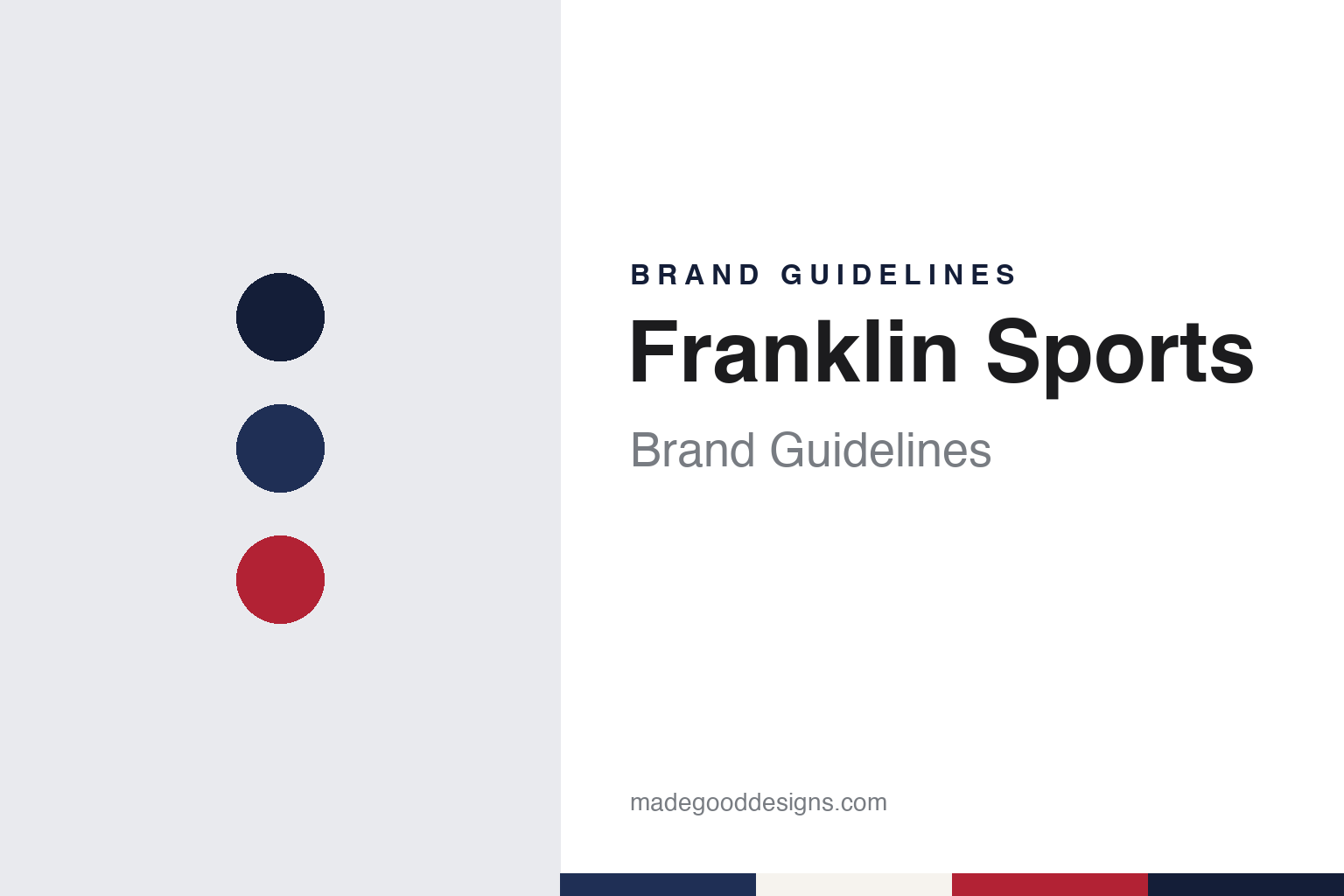
Two constants: a glove navy, knuckle red and leather tan palette and a bold athletic sans register. Abstract homage — not a Franklin Sports product or mark; no glove, ball or logo is reproduced.
Brockton
Leather, a Sears order and a turn to sporting goods.
Franklin Sports traces its start to 1946 and to Brockton, Massachusetts. A profile in The Boston Globe on 3 August 2021 says the founder Irving Franklin came from the leather industry and began the business there after the Second World War, selling a wide mix of goods that ran from football shoulder pads to women’s underwear. The paper says he held a government contract to make military gear during the Korean War, and that in the early 1950s he concentrated on sporting goods.
A department-store buyer pushed the company towards baseball. The Globe says Sears, one of Irving Franklin’s customers, wanted to buy baseball gloves, and his grandson Adam Franklin told the paper that the founder agreed to the order before he knew how he would make them. He worked it out, and the gloves became part of a range that, in the decades since, has spread across many sports, from shin guards to basketballs. The company left Brockton for nearby Stoughton: the Globe says it has occupied its Stoughton warehouse since 1970, and that it renovated the building during the pandemic, adding workspace and planning a pickleball court behind it.
Endorsements were part of the plan early on. The Globe says Irving Franklin approached the New York Jets quarterback Joe Namath after Namath’s Super Bowl win, reasoning that everyone knew Namath’s name while few knew Franklin’s. The resulting line of Namath-branded football gear, the paper says, took Franklin products into retail stores across the United States. The same idea, putting a well-known player beside a lesser-known company name, would shape the product the brand is now associated with in baseball.
The family has kept the business. The Globe describes Franklin Sports as privately held and family-run, led in 2021 by Adam Franklin as third-generation chief executive, with his father Larry Franklin, Irving’s son, still involved. It says the company’s staff work mostly at the Stoughton headquarters and at a distribution centre in Memphis, Tennessee.
Colour
Mike Schmidt, the back of the hand and Major League Baseball.
The batting glove came out of a visit to spring training. The Globe says that in the 1980s Irving Franklin noticed baseball players wearing golf gloves at the plate to protect their hands and improve their grip, and travelled to Clearwater, Florida, to ask the Philadelphia Phillies third baseman Mike Schmidt to help him design a batting glove. Franklin also wanted his company’s name to be recognised on the field in the way Nike’s mark was becoming recognised on shoes, and the paper reports Schmidt’s suggestion: put the logo on the back of the hand. The Globe says the logo has stayed there ever since.
The paper describes how the programme with professional players grew from there. Schmidt handed out Franklin gloves to other players until the task became too much during spring training, and then asked Larry Franklin to send someone down. The company sent a warehouse employee, John Ballas, who the Globe says went on to manage Franklin’s entire MLB player programme. By 2021 the paper could write that when television cameras closed in on batters in Major League Baseball, the Franklin name was striped across the knuckles of the league’s official batting glove.
That relationship has been renewed in public. On 12 March 2024 MLB.com reported that Franklin Sports and Major League Baseball had extended their long-term partnership, with Franklin continuing as MLB’s Official On-Field Batting Gloves and adding the category of Official Sliding Glove, launched as part of Franklin’s PRT-Series of protective products under the MLB Authentic Collection designation. The same report said Franklin remained the exclusive equipment partner of PLAY BALL, MLB’s youth participation initiative, and that it makes licensed youth baseball and softball products such as bat-and-ball sets, training products and youth pitching machines.
The company has applied the same approach to a newer sport. The Globe reported in August 2021 that Franklin’s pickleball had been named the official ball of USA Pickleball, the sport’s governing body in the United States, two weeks earlier, and that the company already had contracts with professional pickleball players. Adam Franklin told the paper he was treating pickleball the way his grandfather had treated batting gloves.
Typography
Design and documentation.
A ball or a bat carries its maker’s identity in a way few other products do. The mark has to survive being struck, thrown, kicked, scuffed and photographed from a distance, so the design work happens on curved panels, turned wood and moulded rubber rather than on a flat label or a box.
On a ball, the logo usually sits between seams or on a single panel, printed or stamped so it can still be read as the ball spins, while the colours of the panels themselves often do as much work as the wordmark. On a bat, the name is burned, stamped or printed along the barrel, where a player and a camera can see it, and the same few letters may be repeated on the knob or grip. Balls supplied for a particular league or competition often carry that body’s marks beside the maker’s, so a single panel can hold two identities at once.
Each guide separates what independent sources record from what the company says about itself — its founding story, its owners over time, where its balls or bats are made and how its marks have changed — and marks plainly what rests only on the company’s own word.
Aa
A bold athletic sans — the register of a glove strap and a ball box. (Specimen set in Oswald, a sans-serif STAND-IN; NOT the Franklin Sports logo.)
Franklin Sports
A family name placed where cameras look.
Franklin’s signature piece of identity is a placement decision rather than a drawing. According to the Globe, the founder wanted the kind of recognition on the field that a shoe brand was getting from its mark, and Mike Schmidt’s answer was to move the Franklin logo to the back of the batting glove. The Globe describes the Franklin name striped across the knuckles of the batting glove worn in Major League Baseball, where it appears whenever television cameras close in on a batter.
The rest of the brand works on a different scale. The Globe lists Franklin products in mass retailers alongside its professional gear, and MLB.com’s 2024 report describes youth bat-and-ball sets, training aids and pitching machines made under licence.
Endorsements run through the history as well, from the Namath line in football to the Schmidt collaboration in baseball and the professional pickleball contracts the Globe reported in 2021. The Globe quoted Adam Franklin as saying that, for much of its history, the brand had flown under the radar despite its reach.
For a design guide, Franklin Sports shows how a family surname, placed consistently on the part of a product that faces the camera, can serve as the brand’s mark across three generations of one family. Compare it with Rawlings, another glove and ball name in the major leagues, and Spalding, another ball and equipment brand. For this guide we use glove navy, knuckle red and leather tan with a sans, an unofficial interpretation; no product or logo is reproduced.
Explore & save
Keep Franklin Sports’s identity on hand — save it to a board in the Made Good inspiration library.
Franklin Sports identity set
Pin the Franklin Sports glove navy, knuckle red and leather tan palette and the bold athletic sans register to your own board.