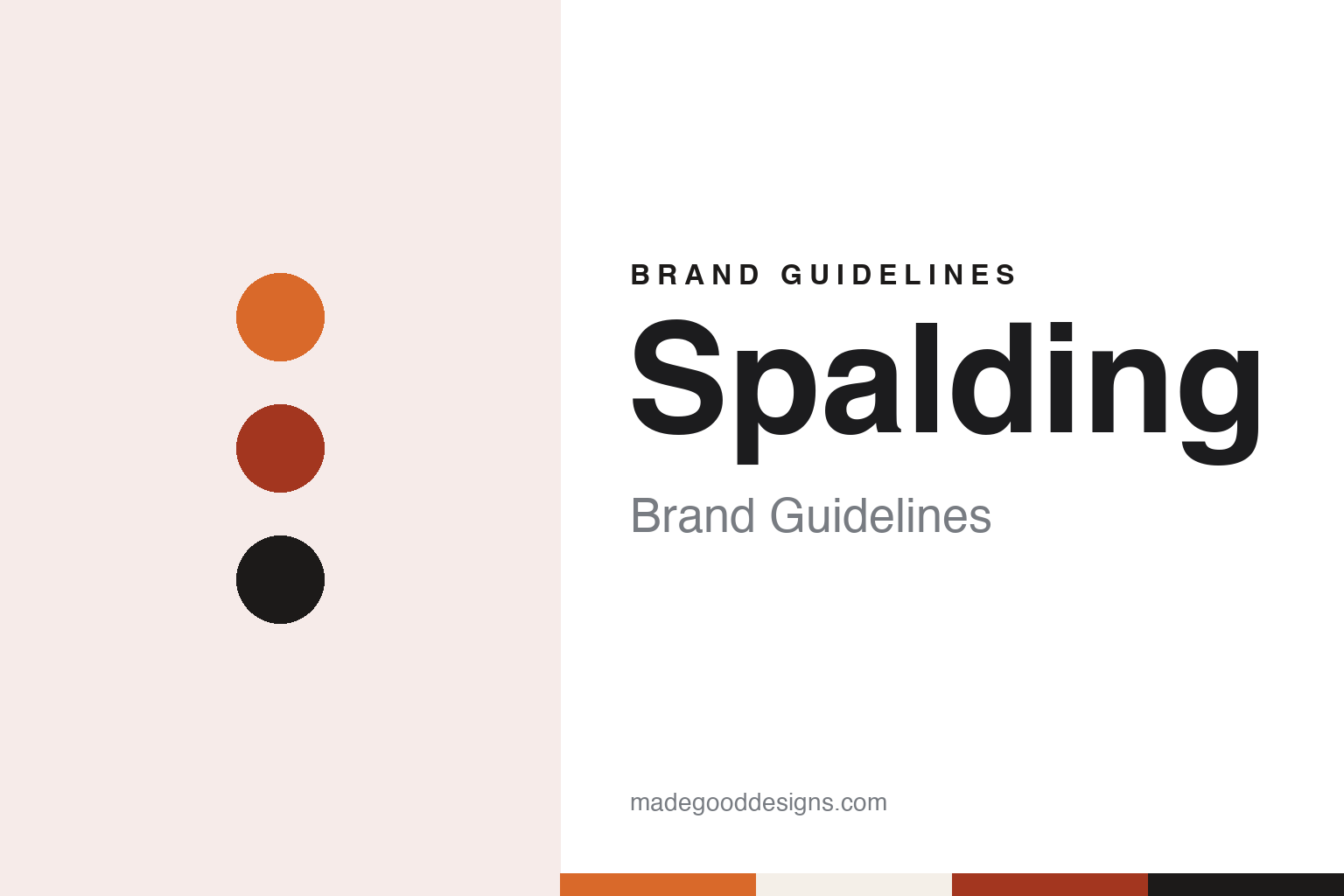
Spalding Brand Guidelines
The Chicago ball maker Albert Spalding founded in 1876.
Aa
Two constants: a court orange, seam red and channel black palette and a condensed athletic sans register. Abstract homage — not a Spalding product or mark; no ball, panel pattern or logo is reproduced.
A. G. Spalding & Bros.
A pitcher, a Chicago store and a league ball.
Spalding began in Chicago in 1876. English Wikipedia says Albert Spalding, a pitcher who played major league baseball from 1871 to 1878, opened a sporting-goods store in the city with his brother Walter that year, while he was playing for the Chicago White Stockings and helping William Hulbert organise the new National League. The company article describes the business as a baseball manufacturer from the start, and the firm traded as A. G. Spalding & Bros.; Wikipedia credits the league ball of 1896 to A. G. Spalding & Bros. of Chicago, New York and Philadelphia.
The link with the National League shaped the brand from its earliest years. Wikipedia, citing a Spalding advertisement published in December 1895, says the Spalding “League Ball” was adopted by the National League and used from 1880, and that the American Association of Professional Base Ball Clubs used it for the seasons of 1892 to 1896. The company kept the Major League ball for decades: Wikipedia says Spalding made the official Major League ball through the 1976 season, putting the Reach brand on American League balls and the Spalding trademark on National League balls, and that Rawlings has made the ball since 1977.
The 1890s brought a run of purchases. Wikipedia, citing Time magazine’s 1929 account of the company, says Spalding bought the rival sporting-goods firm Wright & Ditson in 1892 and also acquired the A. J. Reach company, founded by the professional ballplayer Al Reach. In 1893 A. G. Spalding & Brothers bought the Lamb Knitting Machine Company of Chicopee Falls, Massachusetts, renamed it the Lamb Manufacturing Company, and moved its ice-skate and gymnasium-goods production there. The Chicopee plant also made bicycles until 1899, when Spalding sold its bicycle division to the American Bicycle Company.
The catalogue widened with the plant. Wikipedia lists dumbbells, Indian clubs and punching bags on sale by 1900, and by 1916 a range that ran from athletic clothing, shoes and swimming suits to fencing foils, golf clubs, rowing machines and track equipment. By 1919, it says, the company had developed infantry and cavalry fencing masks for the United States government.
Colour
Books, pucks, footballs and an NBA ball.
Spalding also published. In 1892, Wikipedia says, the company created the Spalding Athletic Library, sold through its own American Sports Publishing Company, founded the same year. The series ran to handbooks on baseball, basketball, boxing, fencing, golf, jiu-jitsu, rowing, skating, tennis and many other pastimes, and its baseball guides carried writing by players including Ty Cobb. Wikipedia quotes the Brooklyn Daily Eagle describing the collection as “the recognized American cyclopedia of sport”, and says its last publication appeared in 1941. Mail-order catalogues set the books beside the equipment, each item pictured and described.
The ball range kept growing. Wikipedia dates Spalding’s basketball to 1894, modelled on the design of a baseball, and says the company made the National Hockey League’s game pucks from the early 1930s to the mid-1940s. From 1949 it sold the high-bounce rubber ball city children called the “Spaldeen”. In American football, Spalding made the J5-V ball used by the American Football League before the merger with the NFL, a ball the Canadian Football League used until 1995; the balls for the 2001 XFL, Wikipedia says, were black with a red “X” across the sides; and Spalding supplied the Arena Football League from 2004 until that league shut down in 2019.
Basketball brought a long league partnership. CNBC reported on 13 May 2020 that Spalding had made the NBA’s game balls exclusively since 1983, and that the league had chosen Wilson to make its ball from the 2021–22 season. The same report noted that Spalding had become the league’s official backboard supplier in 2009. Wikipedia records that in 2006 Spalding and the NBA introduced a synthetic game ball with interlocking panels, citing The New York Times, and that the league returned to the leather ball with the old eight-panel pattern on 1 January 2007.
Ownership changed several times in the late twentieth century. Wikipedia, citing the Tampa Bay Times and The Wall Street Journal, says Kohlberg Kravis Roberts acquired Spalding in August 1996. In 2003, citing The New York Times, it says Spalding became a division of the Russell Corporation, while the golf business, with the Top-Flite, Ben Hogan and Strata brands, went to Callaway Golf later that year. On 17 April 2006 CNNMoney reported that Berkshire Hathaway had agreed to buy Russell, which then made sportswear under the Jerzees, Spalding and Huffy names; Wikipedia, citing Berkshire Hathaway’s 2006 annual report, dates the completed purchase to August 2006. Wikipedia gives Spalding’s headquarters today as Bowling Green, Kentucky, and says it sells softballs through its subsidiary Dudley Sports.
Typography
Design and documentation.
A ball or a bat carries its maker’s identity in a way few other products do. The mark has to survive being struck, thrown, kicked, scuffed and photographed from a distance, so the design work happens on curved panels, turned wood and moulded rubber rather than on a flat label or a box.
On a ball, the logo usually sits between seams or on a single panel, printed or stamped so it can still be read as the ball spins, while the colours of the panels themselves often do as much work as the wordmark. On a bat, the name is burned, stamped or printed along the barrel, where a player and a camera can see it, and the same few letters may be repeated on the knob or grip. Balls supplied for a particular league or competition often carry that body’s marks beside the maker’s, so a single panel can hold two identities at once.
Each guide separates what independent sources record from what the company says about itself — its founding story, its owners over time, where its balls or bats are made and how its marks have changed — and marks plainly what rests only on the company’s own word.
Aa
A condensed athletic sans — the register of a ball panel, a scoreboard and a catalogue cover. (Specimen set in Oswald, a sans-serif STAND-IN; NOT the Spalding logo.)
Spalding
A surname printed on the ball.
The core of the Spalding identity is a surname. From the Chicago store of 1876 to the National League ball, the athletic library and the NBA game ball, the founder’s name has been the mark itself, printed directly on the product rather than replaced by a symbol.
The company also ran more than one name at once. On Major League balls, Wikipedia says, Spalding used the Reach brand for the American League and its own trademark for the National League until 1976, so two identities came out of one maker. Its publishing arm put the Spalding name on covers rather than balls, and the Spaldeen showed the name being reworked by the people who played with it, a nickname taken from the brand and attached to a high-bounce rubber ball sold from 1949.
The NBA years from 1983 to 2021, the J5-V of the American Football League and the black XFL ball with its red “X” each put Spalding’s mark on balls made for a particular league. When the NBA moved to Wilson for the 2021–22 season, as CNBC reported in 2020, that stage changed, while Spalding continued to sell basketballs, softballs and other equipment from its base in Bowling Green.
For a design guide, Spalding shows how a family name can do the work of a logo across a ball, a book and a backboard. Compare Wilson, which took over the NBA ball, and Rawlings, which took over the Major League baseball in 1977. For this guide we use court orange, seam red and channel black with a condensed sans, an unofficial interpretation; no product or logo is reproduced.
Explore & save
Keep Spalding’s identity on hand — save it to a board in the Made Good inspiration library.
Spalding identity set
Pin the Spalding court orange, seam red and channel black palette and the condensed athletic sans register to your own board.


