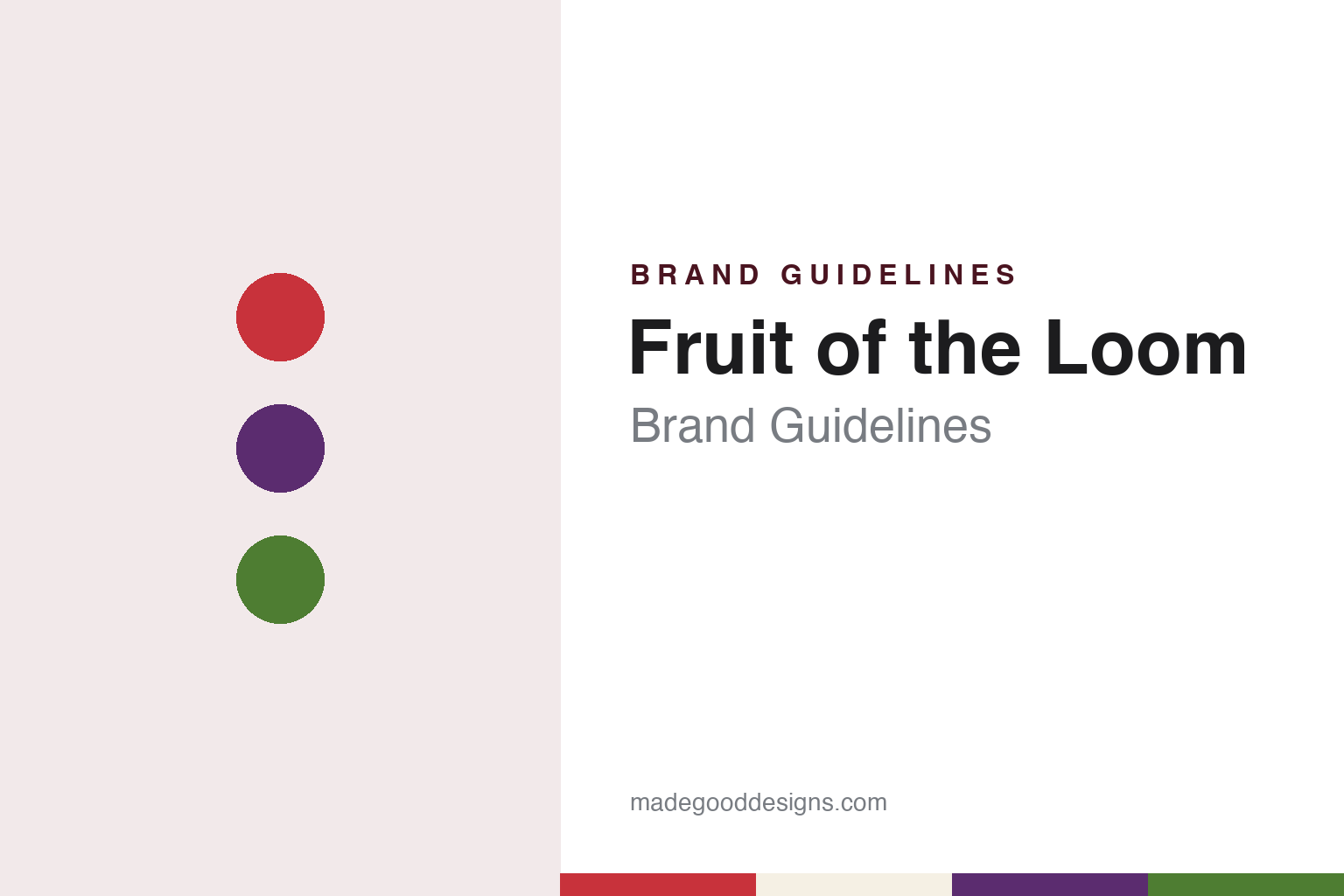
Fruit of the Loom Brand Guidelines
A painted fruit label from 1871 Rhode Island, still on the waistband.
Aa
Two constants: an apple red, grape purple and leaf green palette and a label serif register. Abstract homage — not a Fruit of the Loom product or mark; no fruit cluster, label or logo is reproduced.
The Knight mills
Two brothers, a Rhode Island mill and a painted apple.
Fruit of the Loom traces its origins to B.B. & R. Knight, a cotton business run by the brothers Benjamin and Robert Knight in Rhode Island. The company says the brothers took full ownership of the Pontiac Mill in Warwick in 1851, and that muslins from the mill were sold under the name Fruit of the Loom from 1856, the year it gives for the adoption of the name. English Wikipedia notes that the phrase echoes the biblical “fruit of the womb,” which appears in Genesis and in the Psalms.
The fruit itself came from a shop counter. In the company’s account, a merchant named Rufus Skeel sold Knight muslins at his store in Providence, and his daughter painted pictures of an apple her family favoured and pasted them onto the bolts of cloth she particularly admired. The company says the muslins carrying her paintings were the ones that sold, that more paintings were requested, and that she added other fruits, among them grapes, a pear and cherries. Robert Knight, it says, had the pictures copied as printed labels bearing the Fruit of the Loom name, used on cloth from the Knight mills in 1871, and registered the name with the U.S. Patent Office on 8 August 1871.
The company’s history also traces how the cluster changed over the following decades. It says a combination of three fruits — a peach, a pear and a bunch of grapes — was adopted for the label in 1875, and that in 1883 a new assortment was prepared of the apple, grapes and gooseberries, the fruits it says still appear today. It adds that it introduced an unconditional guarantee in 1891, and that in 1928 it began licensing the brand and the logo to manufacturers of finished clothing lines.
Colour
Kentucky, a reorganisation and Berkshire Hathaway.
In the twentieth century the business moved its manufacturing south. The company dates its manufacturing in Kentucky to 1932, when it says it opened a plant in Frankfort, and it says it supplied underwear and T-shirts to the armed forces during the Second World War. It also says it acquired the BVD trademark in 1976 and expanded into women’s intimates in 1983. Wikipedia says Fruit of the Loom was part of Northwest Industries when the financier William F. Farley bought that group in 1985, and that he went on to lead the company as its chief executive.
The Los Angeles Times reported that Fruit of the Loom, then based in Chicago, filed for Chapter 11 protection in Wilmington, Delaware, on 29 December 1999. In his letter to shareholders of February 2002, Warren Buffett wrote that Berkshire Hathaway had contracted to buy the business, and on 30 April 2002 Berkshire announced that it had completed the purchase of substantially all of Fruit of the Loom’s operations. The release said the company, headquartered in Bowling Green, Kentucky, would operate as an independent, wholly owned subsidiary, selling principally under the Fruit of the Loom and BVD brands.
Berkshire Hathaway has owned Fruit of the Loom since 2002, and its 2025 annual report still lists the company among its subsidiaries. Under Berkshire the group widened. In April 2006 Berkshire announced an agreement to acquire the Russell Corporation, which the release described as an apparel business founded in Alabama in 1902, and Fruit of the Loom’s timeline says that purchase brought in Russell and the Spalding brand. In January 2007 Women’s Wear Daily reported that VF Corporation would sell its global intimate-apparel business, including the Vanity Fair label, to Fruit of the Loom. Fruit of the Loom, Inc. now lists BVD, Jerzees, Russell Athletic and Spalding among its brands on its corporate website, alongside the label that gave the company its name.
Typography
Design and documentation.
Underwear and basics brands in general live on a small set of surfaces. Before a garment is worn, its brand is carried by a box, a sleeve, a multipack bag or a card header on a peg; once it is unwrapped, the name moves to a woven waistband, a printed neck label or a small sewn-in tag; and in a store, a hang-tag or a fixture sign does the work that a shop assistant once did behind the counter.
Each of those surfaces has its own constraints. A waistband has to read in a narrow horizontal band, often repeated around the body, so a name set there tends to be short, wide and simple. A pack has to hold a name, a size and a style at arm’s length on a crowded shelf. A hang-tag sits close to the eye and can carry more words, a fuller logo and a line of copy.
The guides in this group look at those surfaces brand by brand: who started each name, who owns it now, how its labels, packs and advertising have changed, and where independent records and the company’s own account each stand.
Aa
A label serif — the register of a printed cloth ticket and a trademark registration. (Specimen set in Libre Baskerville, a serif STAND-IN; NOT the Fruit of the Loom logo.)
Fruit of the Loom
A painted still life that became a trademark.
The Fruit of the Loom identity is a still life. The company dates the printed label carrying both the name and the fruit to 1871, and its own account of the mark is a story about pictures: a shopkeeper’s daughter painting fruit, a mill owner turning the paintings into printed labels, and a cluster revised in 1875 and again in 1883. In the company’s version, apples, grapes and gooseberries make up the cluster; Snopes, describing the logo in 2024, named an apple, green grapes, purple grapes and leaves. In March 2024 Snopes, citing the company and archived newspaper advertisements from the 1910s to the 2020s, rated as false the widely repeated belief that the logo once included a cornucopia.
Advertising gave the fruit a public life beyond the label. The company dates its television advertising to 1959, when it says a commercial aired on NBC’s Today show. It says it signed the sportscaster Howard Cosell for television commercials from 1968, and that the Fruit Guys became its mascot spokespeople in 1975. In 1978, it says, it launched Underoos, decorated underwear for boys and girls, and in 1988 it ran a television campaign under the line “We Fit America.”
The label has a home town as well as a history. Berkshire Hathaway’s 2002 release placed the company’s headquarters in Bowling Green, Kentucky, and the company’s website describes a Fruit of the Loom brand shop in the city that sells its own products together with Jerzees print wear, Russell Athletic apparel and Spalding sporting goods.
For a design guide, Fruit of the Loom shows how a hand-painted shop display, turned into a printed cloth label in 1871, can outlast the mill that commissioned it, a reorganisation and a change of owner while keeping the same subject matter. Compare it with BVD, the underwear trademark the company says it acquired in 1976, and Vanity Fair Lingerie, the intimates label it bought from VF Corporation in 2007. For this guide we use apple red, grape purple and leaf green with a serif, an unofficial interpretation; no product or logo is reproduced.
Explore & save
Keep Fruit of the Loom’s identity on hand — save it to a board in the Made Good inspiration library.
Fruit of the Loom identity set
Pin the Fruit of the Loom apple red, grape purple and leaf green palette and the label serif register to your own board.