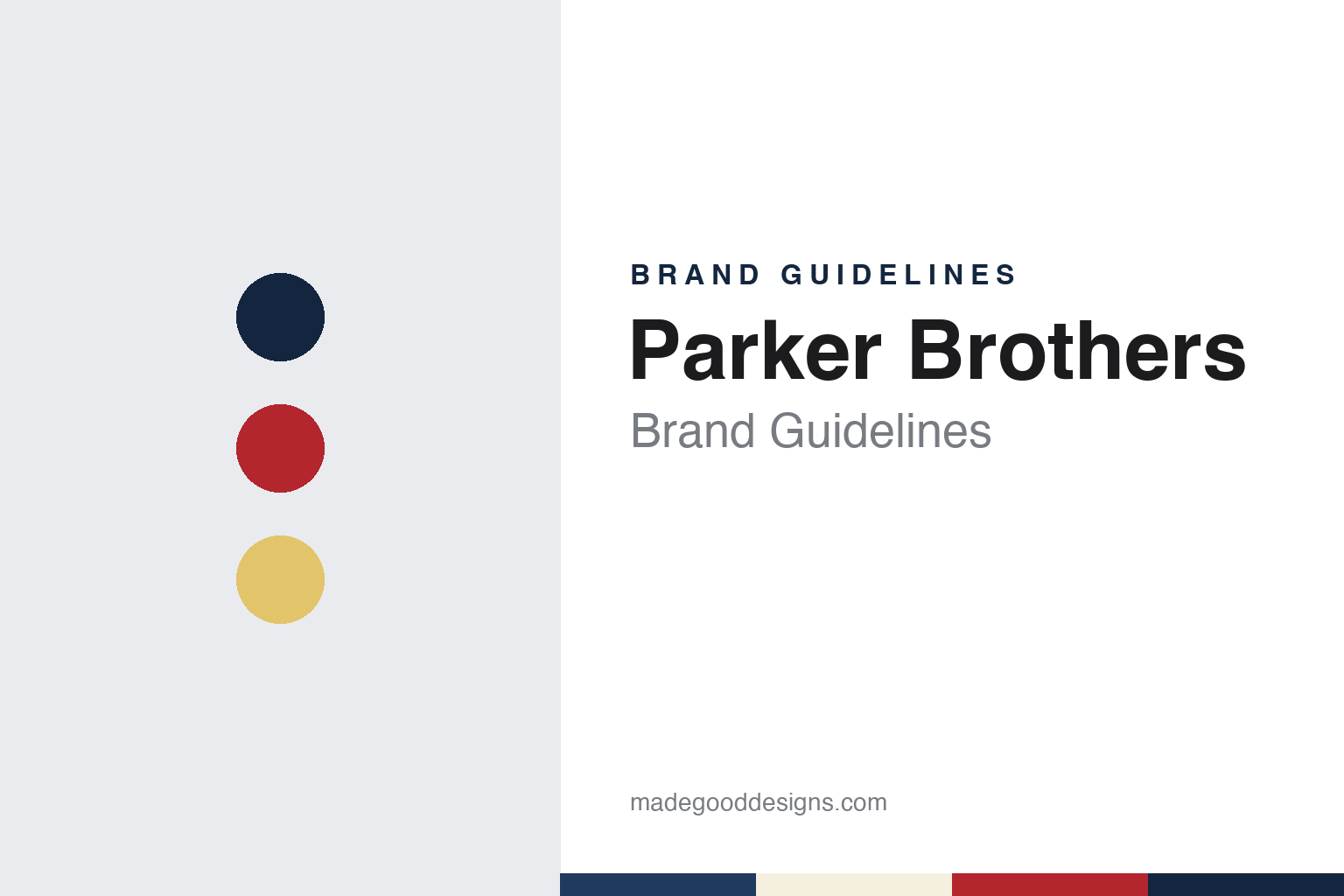
Parker Brothers Brand Guidelines
The Salem game publisher that became a Hasbro name.
Aa
Two constants: a Salem navy, game-box red and token gold palette and a lid-top display serif register. Abstract homage — not a Parker Brothers product or mark; no box, board or logo is reproduced.
Salem
A game publisher named for a family of brothers.
Parker Brothers began in Salem, Massachusetts, in 1883, when George S. Parker published a card game of his own called Banking. English Wikipedia says the business was originally called the George S. Parker Company, and that it took the name Parker Brothers when his brother Charles joined in 1888; a third brother, Edward H. Parker, followed in 1898. The Boston Globe, reporting in December 2003 on the company history written by the former Parker Brothers vice president Philip Orbanes, described the founder as a ship captain’s son who was later joined by two older brothers, and said Orbanes drew on Parker’s own diaries, invoices, photographs and letters, kept in a steamer trunk by the family.
The founding idea was about tone as much as product. Orbanes told the Globe that George Parker felt games should be played for fun, at a time when many games on sale were built to teach moral lessons. Wikipedia says that for many years Parker designed many of the company’s games himself and wrote all of the rules, and that many of them were drawn from the news of the day: Klondike took its subject from the Klondike Gold Rush, and War in Cuba from the run-up to the Spanish–American War. The card game Rook followed in 1906.
Puzzles were part of the catalogue from early on. Wikipedia, citing the puzzle historian Anne D. Williams, dates the company’s jigsaw puzzles to 1887 and its hand-cut wooden Pastime puzzles to 1908–1958, alongside lines sold as Climax, Jig-A-Jig and Paramount; die-cut puzzles were phased out in the late 1970s. The New-York Historical Society holds Parker games from the Salem years, among them The Good Old Game of Corner Grocery of 1887.
The decision that shaped the name for the rest of the century came in the Depression. Wikipedia says Parker Brothers turned down Monopoly in 1934 and agreed to publish it the following year; the Globe called the 1935 purchase momentous. In the decades that followed the company added Clue, licensed from a British publisher and sold as Cluedo outside North America, together with Risk and Sorry!. Outside North America the brand has long appeared simply as Parker, Wikipedia notes, so the family name worked as a short mark on a box lid in several markets.
Colour
General Mills, Kenner, Tonka and Hasbro.
The Globe says Parker Brothers was a family-run business until 1968, when General Mills bought it, and that the cereal company left day-to-day control with the Parker and Barton families. The company built a corporate headquarters in Beverly, Massachusetts — Wikipedia dates it to 1977 — and the Globe credits its Salem factory with the foam Nerf line and with the Ouija board among its products of that era. In the United Kingdom during the 1970s, Wikipedia says, some Parker game rights passed to the games division of Palitoy, another General Mills company.
The late 1970s and early 1980s took the name into electronics. Wikipedia records the handheld Merlin in 1978, the electronic action figure Rom in 1979 — whose Marvel comic outlasted the toy — and a run of cartridges for the Atari 2600 that included a licensed Star Wars game and home versions of Frogger, Popeye and Q*bert. In 1983 the company added a children’s book line built on the Care Bears and Strawberry Shortcake characters, which the Globe reported in February 1984 alongside a move into children’s records.
Corporate change followed quickly. The Globe says General Mills spun off its toy division in 1983 and that Randolph P. Barton, the founder’s grandson, retired as president in 1984, ending family control. The New York Times reported in September 1987 that Kenner Parker Toys of Beverly, spun off by General Mills in 1985 and combining Parker Brothers with Kenner Products, had agreed to be acquired by the Tonka Corporation of Minneapolis after fending off a hostile bid. The Times later recorded that Tonka acquired Kenner Parker Toys in 1987, gaining Monopoly through the Parker Brothers side of the business.
On 1 February 1991 the Times reported that Tonka had agreed to be acquired by Hasbro of Pawtucket, Rhode Island, bringing Play-Doh, Nerf and Trivial Pursuit and giving Hasbro a board-game business to combine with its Milton Bradley games. Hasbro has owned Parker Brothers since 1991. The Globe says Hasbro shut game manufacturing in Salem, and Wikipedia says production moved to Milton Bradley’s plant in East Longmeadow, Massachusetts, while Parker Brothers kept offices in Beverly. In 1998 the two game companies were consolidated as Hasbro Games; CNN reported in December 1998 that Hasbro made games under its Milton Bradley and Parker Brothers brands. English Wikipedia says the Parker Brothers trade name stopped being used in 2009, with its former games sold under the Hasbro Gaming label instead.
Typography
Design and documentation.
A toy company’s name usually reaches people indirectly. Children meet the characters, the dolls and the games first, and the maker’s mark sits in a corner of the box, on the base of a figure or on the back of the instructions. For many toy makers the corporate logo works more like a signature than a headline, a small, repeatable sign that has to sit beside a crowd of louder product names without competing with them.
The places where that mark does its main work are mostly trade settings: the cover of a dealer catalogue, the spine of a retail display, the stand or showroom at a toy fair where buyers see a season’s range before it reaches shops. A company that changes owners, merges with a rival or licenses its name may carry several versions of its mark across those settings at once, and older boxes keep earlier versions in circulation long after a redesign.
Each guide follows the company rather than any single toy: who founded it and where, who has owned it since, how its name and mark have changed, and which lines it is remembered for, with the company’s own account marked as its own.
Aa
A lid-top display serif — the register of a game box and a printed rule sheet. (Specimen set in Playfair Display, a serif STAND-IN; NOT the Parker Brothers logo.)
Parker Brothers
A family name that became a label on someone else’s box.
The Parker Brothers identity was a name before it was a mark. For more than a century the words on the lid told a buyer who had published the game, and the company’s catalogue — card games, puzzles, board games and later electronic games — was held together by that line of type rather than by any single product. The shift from George S. Parker Company to Parker Brothers in 1888 turned a founder’s name into a family one, and the shortened Parker used outside North America shows how compact the mark could become.
The Globe also recorded what happened to the places behind the name. By 2003 the original Salem factory had been replaced by condominiums and the Beverly headquarters had been sold to a French video-game company. Philip Orbanes, the former vice president whose history The Game Makers was published by Harvard Business School Press in 2003, ran a games company in Danvers that the Globe said was licensed by Hasbro to sell Parker Brothers titles to specialty retailers. Orbanes told the paper that George Parker ran the business on a short set of rules of his own, among them learning from failure and sharing what you learn.
Since the name was retired, the games it carried have continued under Hasbro’s own branding. Wikipedia says its former products are marketed under the Hasbro Gaming label, with that logo shown on Monopoly games. That makes Parker Brothers a heritage name rather than a trading one: it survives on vintage boxes, in collections such as the New-York Historical Society’s, and in the histories of the games themselves.
For a design guide, Parker Brothers shows how a publisher’s name on a box lid can carry a reputation across owners — General Mills, Kenner Parker, Tonka and Hasbro — until the games outgrow the label that introduced them. Compare it with Monopoly, the game it agreed to publish in 1935, and Nerf, the foam line that began at its Salem factory. For this guide we use Salem navy, game-box red and token gold with a serif, an unofficial interpretation; no product or logo is reproduced.
Explore & save
Keep Parker Brothers’s identity on hand — save it to a board in the Made Good inspiration library.
Parker Brothers identity set
Pin the Parker Brothers Salem navy, game-box red and token gold palette and the lid-top display serif register to your own board.